
Specifications
- Fuel types
- Petrol (mild-hybrid)
- No of seats
- 5
- Boot space
- 583 litres
- Dimensions
- 4,690 mm x 1,860 mm x 1,690 mm
- Fuel economy
- 40.4 mpg
- Acceleration (0-62mph)
- 10.5 seconds
- Insurance group
- 15-23
- Body style
- SUV
- CO2 emissions
- 157 g/km


Despite competition from established rivals such as the Kia Sportage, Nissan Qashqai and Hyundai Tucson, the Mazda CX-5 has traditionally stood out for its cabin quality, handling balance and competitive pricing. For 2026, Mazda has introduced an all-new CX-5 to sway more buyers away from the popular players. So, the obvious question is, should you buy it, and is the new CX-5 a better car than its predecessor?
AA Cars Rating: 4.2/5
How we test carsWhen buying a used Mazda CX-5, check that the service schedule has been followed, especially oil changes, as Mazda’s Skyactiv engines rely on clean oil. On a test drive, listen for suspension knocks, check the rear brakes, and make sure the electronic parking brake works smoothly. It’s also worth testing the infotainment, parking sensors, reversing camera and driver assistance systems before buying.

Michael Green is an RSS Patrol at The AA, with extensive experience in roadside support, diagnostics, mentoring, and electric and hybrid vehicle repair.
Read bioThe Mazda CX-5 has a strong reliability record, with most issues linked to age, mileage or missed maintenance rather than major mechanical faults.
Common issues include:
Skyactiv petrol and diesel engines are generally robust when serviced on time. Diesel models need extra care if they’re mostly used for short trips, as this can increase the risk of DPF build-up.
Most Mazda CX-5 models need servicing every 12 months or around 12,500 miles, depending on the engine and service schedule.
Key maintenance to keep on top of includes:
Most Skyactiv engines use timing chains, so there’s usually no scheduled timing belt replacement.
The Mazda CX-5 is a well-built family; after many years, most issues are usually routine wear, such as brakes, tyres, suspension parts or software updates. A well-maintained CX-5 with correct service history, smooth gearbox and no warning lights is good used buy.
The Mazda CX-5 retains important strengths, including a spacious, well-finished cabin, a comfortable ride and competitive pricing. But it does feel like a step down in key areas, especially the driving experience, compared to rivals that offer modern engine options.

Adithya is the Content Editor at AA Cars and a Motoring Journalist, with over 1,000 published articles across numerous publications.
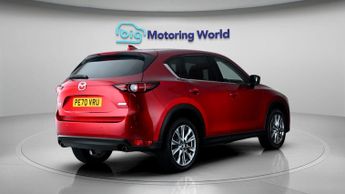
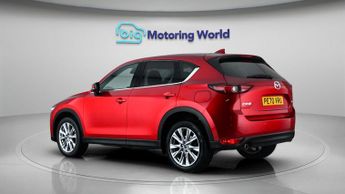
Read bioBrand new, the Mazda CX-5 is competitively priced. At the time of writing, the range starts from £31,050 for the base Prime-Line trim. The more equipped Centre-Line is priced at £34,050 while the Exclusive will set you back by £36,550. Meanwhile, the range-topping variant is the Homura, priced at £38,950 (all prices on road).
Since the new Mazda CX-5 is a brand-new model, we are yet to see any used examples come up for sale. But, previous-generation models dating from 2013 are available from around £2,000 to £25,000, depending on age, mileage, condition and service history.
Mazda does things differently. While rivals offer multiple hybrid and turbocharged engines, the Japanese brand has decided to keep things simple with one engine (for now).
The engine is the e-SKYACTIV G, a 2.5-litre four-cylinder naturally aspirated petrol unit that develops 139hp and 238Nm. Drive is sent to either the front wheels or all four wheels through a six-speed automatic transmission.
The new Mazda CX-5 is best when driven sedately, making use of the engine’s low-end torque and sharp throttle response. It feels relaxed at low speeds, and a light throttle input is enough to make gradual progress. However, ask a bit more, and the CX-5’s biggest weakness becomes evident. With 139hp, the engine lacks the outright grunt to make quick progress. Even though it revs cleanly, the engine sounds loud and harsh once it crosses 3000rpm.
The six-speed automatic shifts smoothly, but it is slow to change up and too eager to change down. We found ourselves using the paddles more often to upshift and keep the engine in its comfortable zone. The whole driving experience comes across as dated, while it is just about adequate if you prefer a simple powertrain with sufficient performance for everyday driving.
The CX-5 is easy to drive around town. The controls are light, and the elevated seating position gives you a clear view. The ride quality is noticeably supple with the CX-5 isolating its passengers from the road. This is down to how the CX-5 deals with road imperfections and bumps, combined with the remarkable cabin insulation. Road noise and ride refinement are class-leading and even comparable to more expensive cars. This, unfortunately, also makes the engine noise more pronounced.
The ride and handling setup is overtly more comfort focused. So, around bends, there’s a noticeable amount of body roll when you initially steer, but it soon settles and remains composed through a corner. There is also no vertical motion or bounciness at any speed typical of some SUVs. Grip levels are average and at motorway speeds, the CX-5’s ride smoothens out and feels stable. Similarly, on a B road, the CX-5 remains composed and even over large bumps, the body control is better than you might expect from a tall SUV. Meanwhile, the brake pedal feels reassuringly weighted, with good initial bite and progressive stopping power.
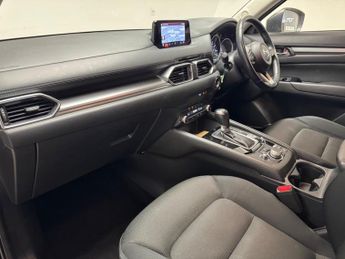
At first glance, Mazda pulls off a good impression of being a premium brand judging by the interior of the new CX-5. All the immediate touchpoints are well finished with the massive 15.6-inch touchscreen being the biggest highlight. The interiors feel airy, especially in brighter colours like our test car. Spend a couple of days in the new CX-5, and you will start to notice the odd bits like minor fit and finish issues and hard plastics in the lower dashboard.
Overall, this is still a cabin with some upmarket feel, with enough soft-touch and materials to create a strong first impression. However, the new CX-5 no longer has the definite advantage over its rivals when it comes to cabin quality. From an ease-of-use perspective, it is less intuitive than before because almost all key functions are controlled through the touchscreen.
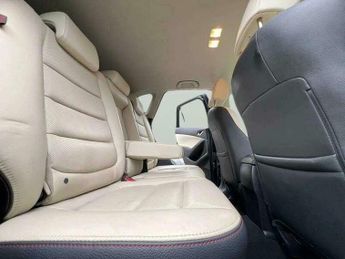
With 583 litres of boot capacity, the new CX-5 offers around 60 litres more than the outgoing version. Similarly, the cabin space has also substantially opened up. The new CX-5 feels notably spacious for a family SUV.
Up front, the seats are supportive, although it could do with a bit more under-thigh support. At the rear, even taller occupants will feel spacious. Compared to the Nissan Qashqai, the CX-5 can easily accommodate three adults while the seats offer more support and acres of legroom. The doors also open wide and to 90 degrees so it’s easy getting in and out.
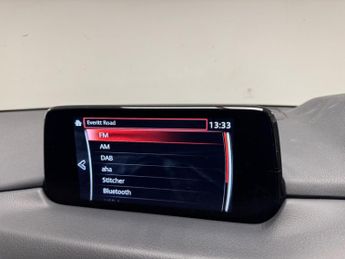
The 15.6-inch touchscreen is sharp with good contrast and brightness. The unit is also snappy with a clean user interface There is little to fault apart from the omission of physical controls. Similarly, the digital driver’s display uses vivid graphics for the driver assist functions and is easy to read on the move. Higher trim levels add the 12-speaker Bose sound system which we highly rate, as the sound quality is deep enough with a convincing soundstage.
Other highlights include 19-inch wheels, a powered tailgate, heated and cooled seats, adaptive LED headlights, ambient lighting, wireless charging, wireless Apple CarPlay and Android Auto, a heated steering wheel, an electrically adjustable driver’s seat, a head-up display and an optional panoramic sunroof.
For the 2026 Mazda CX-5, there are four trim options: Prime-Line, Centre-Line, Exclusive-Line and Homura (our test car).
Arctic White is the no-cost colour. Aero Grey, Polymetal Grey, Navy Blue and Jet Black cost £700; Machine Grey and Rhodium White cost £800; and Soul Red Crystal costs £1,000.
Euro NCAP awarded the new CX-5 five stars in 2025. It performed well in child-occupant testing and in assessments of its autonomous emergency braking systems. Notable safety features include a 360-degree camera, Smart Brake Support, blind-spot monitoring, adaptive cruise control and other driver-assistance systems.
The driver-assistance systems worked consistently during our test. The all-digital instrument cluster uses clear graphics to show which safety systems are active. We particularly liked the adaptive cruise control system, which identified motorcycles and scooters reliably during our test.
The new CX-5’s fuel economy is reasonable rather than exceptional. The 2.5-litre engine is rated at 40.4 mpg combined, and we often saw figures close to that during our testing. If fuel efficiency is important to you, a rival with a full-hybrid powertrain may be more suitable.
The CX-5's CO₂ emissions are rated at 157g/km, which is high for a company car. Most front-wheel-drive versions sit below the £40,000 threshold before options, but some higher-spec or AWD models may attract the Expensive Car Supplement.

 London
AA finance available

London


London
Connect with us


