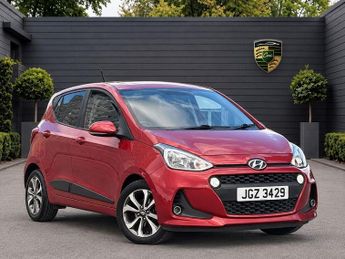
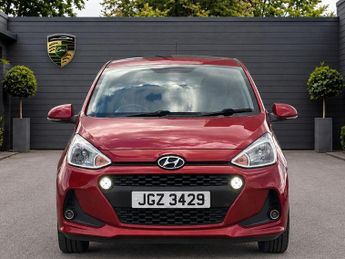
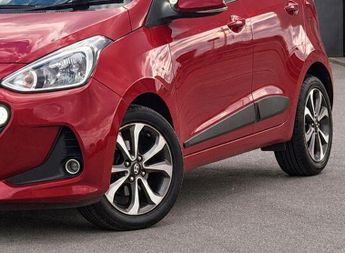
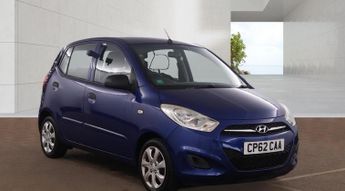
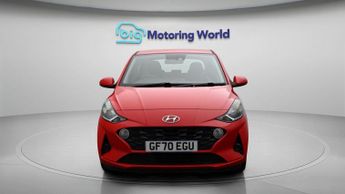
Specifications

Fuel types
Petrol
No of seats
5
Boot space
252 litres
Dimensions
3,670 mm x 1,680 mm x 1,480 mm
Fuel economy
50 – 56 mpg
Acceleration (0-62mph)
10.5 – 14.7 seconds
Insurance group
1 – 7
Body style
City hatchback
CO2 emissions
103 – 117 g/km
Browse 806 in stock

AA Mechanic review

When checking a used Hyundai i10, look for regular servicing and evidence of frequent oil changes. These small petrol engines usually last well, but they respond best to clean oil and timely maintenance. Because many i10s are used for town driving, check the clutch engages smoothly, listen for suspension knocks over bumps, and look for wear around the switches, door handles and driver’s seat.
Michael Green
Michael Green

Michael Green is an RSS Patrol at The AA, with extensive experience in roadside support, diagnostics, mentoring, and electric and hybrid vehicle repair.

Read bio

4.2/5

Repairs

The Hyundai i10 has a strong reliability record. Most faults are minor and usually come from age, mileage or regular stop-start driving rather than serious mechanical problems.

Common issues include:

Front suspension wear, especially drop links and bushes on higher mileage cars

Clutch wear on manual cars used mainly in traffic

Misfires, often caused by overdue spark plug replacement

Engine mount vibration, which can be more noticeable at idle

Rear brake shoes or drums wearing more quickly on town-driven cars

Basic or slow infotainment units on earlier models

Occasional parking sensor faults on cars fitted with them

Maintenance

Most Hyundai i10 models should be serviced every 12 months or around 10,000 to 12,000 miles, depending on the model year, engine and service schedule. Cars used mainly for short trips may benefit from more frequent oil changes.

Key maintenance to keep on top of includes:

Annual oil and filter changes to protect the engine

Brake fluid replacement every 2 years

Cabin filter replacement every 2 years

Coolant replacement around year 4 or 5

Gearbox oil refresh around 60,000 miles to help maintain shift quality

Most i10 petrol engines use a timing chain rather than a timing belt, so there’s usually no scheduled belt replacement. Timing chains are designed to last longer, but clean oil and regular servicing are important to reduce wear.

Is the Hyundai I10 a reliable car?

The Hyundai i10 is a dependable city car that’s cheap to run and simple to maintain. It’s comfortable for its size, easy to drive, and has straightforward mechanical parts that most garages can work on without difficulty. After several years, most problems are usually normal wear items such as brakes, suspension parts, tyres and clutches. A well-serviced i10 should remain quiet, smooth and inexpensive to own, even at higher mileage.

Browse 806 in stock

AA Cars review

The Hyundai i10 is a really good option for anyone who wants cheap and cheerful motoring, while not sacrificing when it comes to the mod cons that so many car buyers have now come to expect. It has been designed with everyday driving in mind and feels incredibly roomy for a car of its size. For drivers who want a dependable and affordable runaround that still feels grown-up, the i10 is certainly worth considering.
Jack Evans
Jack Evans

Jack is an experienced motoring journalist who has been covering the latest new-car releases for the last 10 years.

Read bio

3.7/5

How much does it cost?

The i10 offers excellent value with prices for the entry-level ‘Advance’ trim kicking off at just £17,100. Moving up the range, the mid-level ‘Premium’ car starts at £18,400, with the sportier ‘N Line getting underway at £19,700. With even the most expensive cars in the range beginning at under £20,000, the Hyundai is an excellent low-cost proposition.

There is even better value to be found in the used market, with hundreds of second-hand i10s available via AA Cars. The current generation was launched back in 2020 and cars from that period are currently available for as little as £5,500. If you are looking for a slightly younger vehicle, three-year-old, low-mileage i10s can be picked up for less than £10,000.

Engine and performance

Overview

The i10’s range of engines is small and simple, with Hyundai offering the car with a trio of efficient petrol engines. Unlike some of its rivals, there are no hybrid or electric choices, which is perhaps surprising given Hyundai’s EV success elsewhere. All engines prioritise low running-costs and are well suited to inner-city driving. The most basic unit is a 1.0-litre MPi, which produces just 67 bhp. The three-cylinder engine is smooth at low speeds but does feel underpowered when you leave built-up areas and head to the motorway. Noticeably more comfortable at higher speeds is the 1.2-litre MPi unit which produces 84 bhp. While still not the most refined engine in the world, this choice is certainly the better of the two naturally-aspirated options.

The final choice is a sportier 1.0-litre T-GDi engine, which is available exclusively on the N Line trim. Teamed with a turbocharger, this is the unit which turns the i10’s performance from being practical to the point of being slightly drab into a much more exciting proposition. It offers livelier acceleration and a much more engaging feel so if it’s driving pleasure you’re after, then this is the engine to choose.When it comes to gearboxes, all engines can be teamed with either a five-speed manual or automated manual transmission (AMT). While the AMT does add convenience, it also feels pretty hesitant. The manual is much smoother and is definitely the one we’d recommend.

Hyundai I10 performance

Out on the road

The i10 has been designed with modern cities in mind and it is in that environment where it performs best. In built-up areas, the Hyundai’s compact size, strong visibility, and nimble handling make it the perfect car for your everyday runaround. It has light steering, which is perfect for darting in-and-out of traffic, and the car’s short overhangs make it far easier to judge gaps than most other cars in this sector. Whether it is tight spaces, narrow lanes or busy roundabouts, the little i10 is comfortable tackling whatever the city has to throw at it.

However, where things do start to go slightly wrong is when you leave the city and head out onto the motorway. The basic 1.0-litre engine in particular can feel painfully slow when getting up to high speeds and the car does feel woefully underpowered at times. The same problem is found on steep gradients, where the i10 simply feels underpowered. Once up to speed, the i10 is able to cruise comfortably enough, albeit the experience is fairly loud and unrefined as a result of wind and engine noise. The 1.2-litre version largely corrects these issues and offers a far smoother ride.

If you are after a bit of driving pleasure, then the N Line is the model which really stands out. Its turbocharged engine provides more grunt, and while it’s still by no means the most exciting small car out there, it does add some energy and character.

Hyundai I10 on the road

Ride and handling

For a small car, the i10 offers a seriously impressive and smooth ride. A lot of cars of this size start to let themselves down when the surface gets bumpy, but Hyundai has put significant time and effort into making sure this is not an issue in the i10. The car’s suspension blends comfort with control, meaning that driving over potholes, speed humps or other bumps is surprisingly soft and comfortable. Around town, the Hyundai offers stable handling which is functional, without being particularly sharp or sporty. The driving experience aims to be practical rather than exciting and the i10 certainly delivers on that front.

On country roads, the Hyundai is largely secure and grippy for a car of this size but its short wheelbase does mean that you can get the odd unsettled moment when body roll feels like it could set in at any moment. Overall, the i10 delivers a generally very mature and impressive driving experience around town, despite its obvious shortcomings once you get it out of its comfort zone.

Hyundai I10 ride and handling

Interior and features

Interiors

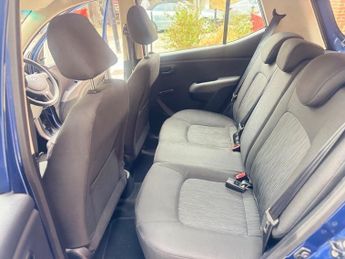
The cabin of the i10 has been very carefully and cleverly designed to make the very most of the limited space on offer. Despite its pocket-sized appearance, there is ample room for five adults to sit in relative comfort, with acceptable leg and headroom. The dashboard is uncluttered, with a responsive 8-inch touchscreen, and all of the buttons and controls are simple and easy to use. Unsurprisingly, given the i10’s price point, the cabin does include its fair share of cheap, scratchy plastics but the components you use most regularly – namely the buttons, steering wheel, gear stick and handbrake – are more pleasant and soft to the touch. Even where the quality of materials perhaps isn’t the best, everything does feel well put together and neatly finished.

Hyundai I10 interior

Boot space and practicality

The i10 offers an impressive 252 litres of boot space, rising to 1,050 litres, with the back seats folded down. This represents one of the largest luggage areas of any car in this segment and is easily big enough for the weekly shop or even a couple of suitcases. Inside the cabin, Hyundai has fully utilised its limited space by including a number of smart storage solutions. There are generous door bins, a large glovebox and several clever cubbies, all of which contribute to an incredibly practical little car.

Hyundai I10 boot space and practicality

Features

Despite keeping costs low, Hyundai has certainly not skimped when it comes to the technology available in even the most basic i10. All models enjoy an intuitive touchscreen infotainment system, including Apple CarPlay and Android Auto as standard. Other features include cruise control, a reversing camera and automatic headlights.

Premium and N Line trims add a host of extra features, including satellite navigation, upgraded speakers and heated front seats.

Hyundai I10 feature

Trim and colour options

The i10 is available in Advance, Premium and N Line trim levels, all of which offer a good level of tech. For everyday use, we’d recommend the Premium line, which offers a good blend of practicality and drivability.

Colours include Mangrove green, Atlas white, Lucid lime Aurora grey, Dragon red, Lumen grey, Meta blue, Phantom black and vibrant blue.

Hyundai I10 trim and colour

Safety and reliability

The i10 comes with a good range of safety equipment available including autonomous emergency braking, lane keeping assist, driver attention warnings, speed limit recognition and high beam assist. The car was tested by Euro NCAP shortly after it was first launched in 2020, when it achieved a three-star score out of five.

When it comes to reliability, Hyundai now enjoys a reputation as one of the very best carmakers in the business, and the i10 is no different. Buyers have praised the car’s durability and the brand’s five-year, unlimited mileage warranty only serves to add extra peace of mind.

Hyundai I10 safety and reliability

MPG, emissions and tax

Thanks to its choice of small petrol engines, the i10 offers impressive fuel economy with official figures suggesting up to 56 mpg in mixed driving. Having lived with an i10 for a significant period of time, this is more likely to average out at between 45 and 50 mpg, but this is still not to be sniffed at.

CO₂ emissions are also relatively low, ranging from 103 to 117 g/km, contributing to smaller road tax and company car costs.

Hyundai I10 MPG, emissions and tax
Browse 806 in stock