
Specifications
- Fuel types
- Petrol, diesel
- No of seats
- 5
- Boot space
- 400 litres
- Dimensions
- 4,154 mm x 1,780 mm x 1,552 mm
- Fuel economy
- 47.9–59 mpg
- Acceleration (0-62mph)
- 8.2–11.3 seconds
- Insurance group
- 8–19
- Body style
- SUV
- CO2 emissions
- 124–135 g/km


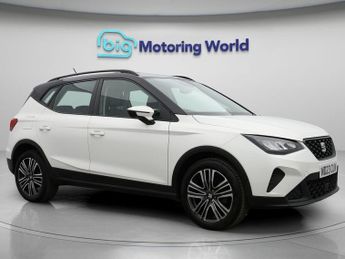
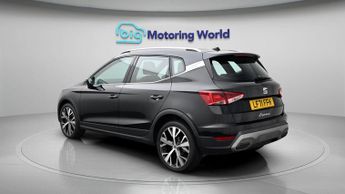
Seat sought to capitalise on the Ateca’s success with the smaller Arona in 2017, and hoped to take sales away from the likes of Nissan Juke, Renault Captur, Citroen C3 Aircross and Kia Stonic. The Arona has proved to be popular in the UK. A comprehensive facelift arrived in 2021, bringing refreshed looks and new technology. The Spanish car maker has even revealed an updated version for 2025 to keep the Arona feeling fresh against much newer competition.
AA Cars Rating: 4/5
How we test carsWhen viewing a used SEAT Arona, check the service history and make sure the 1.0 TSI or 1.5 TSI petrol engine runs smoothly. Diesel models need regular longer journeys to help prevent diesel particulate filter issues. On a test drive, DSG automatic versions should shift cleanly without hesitation or jerking. Also check the touchscreen, rear light clusters for condensation, and any panoramic roof drains if fitted.

Michael Green is an RSS Patrol at The AA, with extensive experience in roadside support, diagnostics, mentoring, and electric and hybrid vehicle repair.
Read bioThe SEAT Arona is generally reliable and uses proven Volkswagen Group parts, but there are a few issues to check on used examples.
Common issues include:
Most faults are manageable if caught early. DSG issues and diesel emissions faults can become more expensive, so check the service history carefully.
Most Arona models should be serviced every 12 months or around 10,000 miles, depending on age, engine and usage.
Key maintenance to keep on top of includes:
Running costs are usually reasonable. Petrol models are the most common and tend to be cheaper to own than older diesel versions, especially for drivers who mainly do short trips.
The SEAT Arona is a practical small SUV with good equipment levels, low running costs and a comfortable drive. It’s a sensible used choice when it has been serviced properly. After 5 to 7 years, most issues are likely to be linked to software, brakes, DSG servicing or diesel emissions systems rather than serious mechanical failure.
The Seat Arona has a stylish design, is easy to drive, and is efficient. Plus it’s a well proven product as it shares much of its componentry with other Volkswagens. It isn’t the most exciting choice in the small SUV class, but it’s appealing enough and makes for a great used buy.

Jack is an experienced motoring journalist who has been covering the latest new-car releases for the last 10 years.
Read bioPrices start from just over £23,000 for an entry-level Arona SE, rising to £30,540 for the top-spec FR Sport with a 1.5-litre petrol engine and an automatic gearbox. These are for the new-for-2025 facelifted car.
As the Arona has been around since 2017, there's plenty of choice on the used market at far more affordable prices. On platforms such as AA Cars, used prices start at £6,000 for cars with around 100,000 miles on the clock. You should budget around £9,000 for Aronas with around 60,000 miles, and at least £10,000 for refreshed-2021 cars.
The Arona dates back to the late-2010s when hybrids were less common than they are now, so it has only ever come with pure-petrol and diesel engines – even brand new Aronas don't have any form of electrified powertrain on offer. This doesn't mean the Arona should be struck off your shortlist though, as these simpler engines mean relatively low purchase prices.
There's only the choice of petrol power if you go for a brand new Arona, while petrol was the more popular choice traditionally among Arona customers, too. Most Aronas on the used market are of the 1.0-litre TSI type. This engine comes in 94bhp and 108bhp flavours, and offers an excellent balance of performance and efficiency. A 1.5 TSI with 148bhp is also available, and offers more refinement and better cruising ability.
The Arona was also originally offered with diesel power, but in more recent years Seat has ditched these engines. The 1.6 TDI, available in 94bhp and 113bhp forms, are better suited to high-mileage drivers, offering excellent fuel economy. Manual gearboxes are most popular, with a seven-speed automatic available on some versions.
Unsurprisingly, if you've driven a Seat Ibiza, the Arona will instantly feel familiar. The steering and pedals all have a well-engineered feel, but are also pleasantly light, plus, because it's an SUV, there's a nice raised driving position giving good visibility.
The 1.0-litre turbocharged three-cylinder TSI petrol engines are the pick as they are torquey around town, and can easily hold their own on faster roads. The gutsier 1.5-litre four-cylinder turbo petrol is a smoother all-rounder, while the diesels deliver the best fuel consumption for long-distance drivers.
The five- and six-speed manuals are very slick to use, and tend to be the most popular on used car listings platforms like AA Cars. The DSG automatic gearbox is, for the most part, very smooth thanks to being of the dual-clutch type. But around town it can occasionally hesitate, especially at junctions when quick responses are desired.
Seat has traditionally been positioned as one of Volkswagen Group's sportier brands, and while that placing is going to change from 2025 onwards, the Arona dates back to a time when that was still the case. That's why it has a slightly sportier feel than a Citroen C3 Aircross or a Renault Captur, for example.
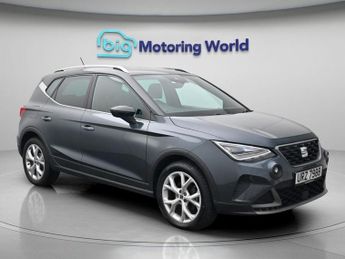
While the steering is light, it's accurate and there's plenty of feedback through it. All Aronas have a slightly firmer suspension set-up than rivals, and that's especially true in the FR models with their larger wheels. Stiff suspension means the body doesn't roll around much in corners, but the downside is a firmer ride around town over potholes and speed humps. It's not a deal-breaker, but if a supple ride is high on your wish list then rivals are more suitable.
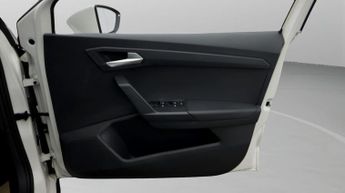
Being the Ibiza's sister, the Arona pinched a lot of that car's dashboard look and feel. Sadly, that also meant the same hard plastics and dull design. That said, the driving position is comfortable, and equipment levels are good.
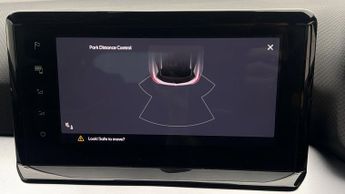
Facelifted models introduced in 2021 boosted the interior's appeal. There are softer materials, a more modern touchscreen system, and even ambient lighting for a premium touch.
Being based on the Ibiza means there's only so much Seat could do to make the Arona more spacious. While legroom is a little on the tight side compared to rivals, and fitting three in the back seats will be a tight squeeze, the Arona's taller shape means headroom is excellent. Bigger windows also make the rear space brighter and more airy than you might expect, too.
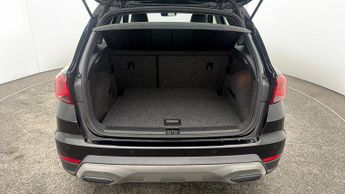
The Arona's real trump card over cars like the Nissan Juke and Ford Puma is the boot space. At 400 litres it comfortably beats many other small SUVs, and it's a good, practical shape. While the back seats don't slide backwards and forwards like they do in a Citroen C3 Aircross, they do fold in a 60:40 split and lie down pretty flat. With the back seats folded, space is a very impressive 1,280 litres.
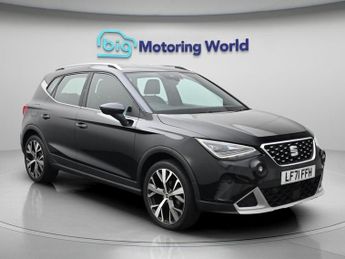
Over its lifetime the Arona has come in SE, SE Technology, Xcellence, FR, FR Sport and Xperience Lux trims, along with special Black Edition lines.
Even base-spec SE cars are well equipped, with air conditioning, a touchscreen infotainment system, smartphone connectivity and cruise control coming as standard. SE Technology and FR are by far the most numerous, thanks to their upgraded tech and, in the case of the FRs, sportier styling.
Post-2021 facelift Aronas get a larger touchscreen, digital driver displays on higher trims, and improved driver assistance systems.
SE Tech and FR cars are most popular in used car listings and it's easy to see why. These cars gained a raft of tech upgrades over the standard SE cars, and extra body styling and design touches for the FR models. Don't dismiss those entry-level SE cars, though, as they are a little cheaper on the used market but still have good kit levels.
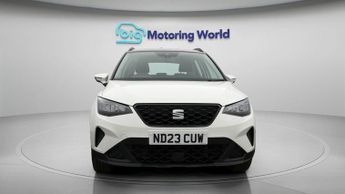
The Arona comes in a range of bright colours such as red, blue and orange plus more muted shades like white and black.
Independent crash safety testers Euro NCAP gave the Arona a full five-star safety rating in 2017. It received strong scores for adult and child occupant protection, and rather impressively, it held onto this five-star rating when the car was re-tested in 2022. That's not always the case, so it shows how safe the Arona really is.
Every Arona gets autonomous emergency braking (AEB), six airbags, tiredness recognition, tyre pressure monitoring sensors, and front and rear seat belt reminders. Thanks to sharing so many of its components with cars from Volkswagen, Skoda, and of course, Seat, the Arona has a similarly high reliability record as those cars. That said, industry reliability surveys rank the Seat brand as a whole not particularly highly.
Being a small SUV, it won't be a surprise to learn that running costs won't break the bank. In fact, the Arona is one of the more cost-efficient cars in its class.
The 1.0 TSI engines are very frugal despite their tiny size. The 115PS (108bhp) variant is the most efficient of the lot with claimed figures of over 53mpg, while the less powerful 95PS (94bhp) version is slightly less at 51mpg. Even the gutsier and more powerful 148bhp 1.5 TSI still delivers combined fuel consumption in the high-40s thanks to clever cylinder-deactivation tech – when cruising or under light loads, two of the four cylinders shut down to save fuel.
The diesels were deleted from the range with the arrival of the facelifted Arona in 2021. If you regularly drive long distances, particularly on motorways, the diesel-powered Aronas are the ones to hunt out as they are the most efficient of the lot. Seat claimed up to nearly 60mpg on the combined cycle. It's worth noting, however, that all of these figures are for cars fitted with manual gearboxes. The DSG automatics knock around five MPG off the petrols' claimed figures. Emissions range from 121g/km to 137g/m, and the Arona attracts a flat-rate of £195 in VED (road tax).
 London
London
London
Connect with us


