Specifications

Fuel types
Electric
No of seats
5
Boot space
435 litres, expanding to 1,161 litres with the seats folded
Dimensions
4,490mm length, 1,788mm width, 1,540mm height
Fuel economy
Up to 239 miles (WLTP, Leaf e+)
Acceleration (0-62mph)
7.9 or 6.9 seconds depending on model
Insurance group
21 - 25
Body style
5-door hatchback
CO2 emissions
0 g/km (all-electric)
Browse 211 in stock

AA Cars review

The Nissan Leaf remains a sensible, reliable, and affordable choice for those entering the world of electric cars. It’s easy to drive, well equipped, and backed by Nissan’s impressive EV expertise, but it’s not massively exciting and feels dated compared with some of the latest pure electric contenders.
Jack Evans
Jack Evans

Jack is an experienced motoring journalist who has been covering the latest new-car releases for the last 10 years.

Read bio

3.6/5

How much does it cost?

Brand new, the last of the second-generation Nissan Leafs started officially from around £28,995 for the entry-level Acenta, rising to over £36,000 for the range-topping Tekna e+. But with a new model in the offing, there are some excellent deals on pre-registered and nearly new examples. All models are well equipped, with a focus on value and user-friendly technology. On the used market, early second-generation Leafs can be found from as little as £11,000 on AA Cars, making them one of the most accessible used EVs and a safe choice, thanks to their proven technology and widespread popularity. Newer, longer-range Leaf e+ models typically command a premium, but still offer strong value compared to other electric hatchbacks.

Engine and performance

Overview

The 2018-on Nissan Leaf is available with two battery options: a 40 kWh pack (150bhp) and the more powerful 62 kWh Leaf e+ (217bhp). The standard model provides a range of up to 168 miles (WLTP), while the e+ variant can cover up to 239 miles on a single charge. Performance is brisk in everyday driving. The entry-level model accelerates from 0-62 mph in 7.9 seconds, while the e+ manages it in 6.9 seconds. Instant torque from the electric motor makes city driving nippy and responsive.

All Leafs feature regenerative braking and Nissan’s e-Pedal system, allowing for one-pedal driving in most situations – once you get used to it, it’s an absolute breeze and can usefully improve the car’s range. While the Leaf’s charging speed (up to 50 kW DC) isn’t class-leading, it’s sufficient for most users, with a typical 20–80% charge taking around 60 minutes at a rapid charger. This may well be a deal-breaker, though, if you regularly drive long distances and rely on the public charging network for top-up charges.

Nissan Leaf performance

Out on the road

The Leaf is in its element when driving in urban environments, thanks to its compact size, light steering, and excellent visibility. Manoeuvring is stress-free, aided by standard rear parking sensors and a reversing camera, or on most models Nissan 360º Around View camera monitoring. On the motorway, the Leaf is quiet and comfortable, though wind and road noise are more noticeable at higher speeds compared with some newer rivals. Suspension is supple, soaking up most bumps and potholes with ease.

Nissan Leaf on the road

Ride and handling

Comfort is the Nissan Leaf’s forte, and that means it’s not especially engaging when driven hard – but this is unlikely to be an issue for most buyers. The ride is supple and well-damped over most surfaces, making it a pleasant daily driver. The steering is light and accurate, ideal for city use, though keen drivers will certainly find the lack of feedback and rather numb steering less appealing than in some rivals. Body control is decent, though, and the car feels stable, although there is some lean in corners if pushed hard. The e+ variant’s extra power offers stronger acceleration, but doesn’t significantly alter the car’s character despite an abundance of power.

Nissan Leaf ride and handling

Interior and features

Interiors

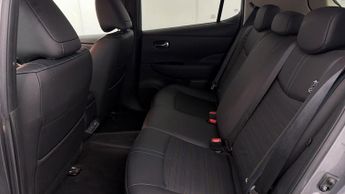
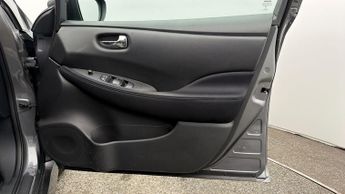
The Leaf’s interior is spacious and practical, if a little conservative in design. There’s ample room for five passengers, with generous head and legroom both front and rear. The dashboard features an 8-inch touchscreen infotainment system with navigation, Apple CarPlay, and Android Auto as standard. Materials are robust, with soft-touch elements in higher trims, but the overall finish is more functional and hard-wearing than it is luxurious.

Nissan Leaf interior

Boot space and practicality

Boot space is competitive for the class, with 435 litres available, expanding to 1,161 litres with the rear seats folded. The floor isn’t entirely flat, but the wide opening and low lip make loading relatively easy. Cabin storage is generous, with large door bins, a spacious glovebox, and several cubbies for small items. The centre console

Nissan Leaf boot space and practicality

Features

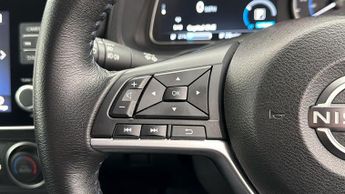
All models are well equipped, with climate control, keyless entry, automatic headlights and wipers, and a comprehensive suite of safety systems as standard. Higher trims add features such as ProPILOT semi-autonomous driving, heated seats and steering wheel, upgraded audio, and 360º cameras.

Nissan Leaf feature

Trim and colour options

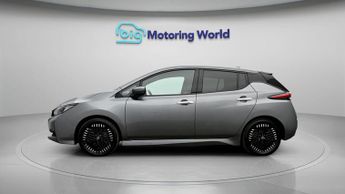
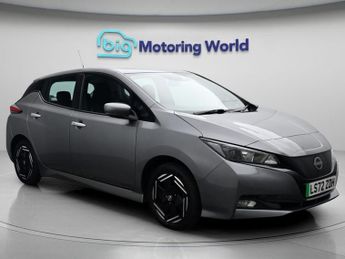
The Nissan Leaf is available in several trims: Acenta, N-Connecta, Tekna, and e+ models with enhanced performance and range. The Acenta serves as the entry point to the Nissan Leaf range, featuring 16-inch alloy wheels and LED front fog lights for a smart exterior look. Inside, it comes fully equipped with Nissan’s suite of infotainment and safety technologies, including autonomous emergency braking, lane departure warning, blind spot monitoring, and traffic sign recognition.

This trim offers excellent value for those seeking essential features and robust safety in a zero-emission package. Moving up, the N-Connecta trim builds on this by adding extra comfort and convenience. It introduces part-leather upholstery for a more premium cabin feel and includes upgraded connectivity. The Tekna trim is the flagship of the standard Leaf line-up, delivering further luxury and cutting-edge features. It has a Bose premium audio system, advanced driver assistance systems, and high-quality interior materials. Tekna models also benefit from a host of exterior enhancements, including smart black accents and a bolder wheel design.

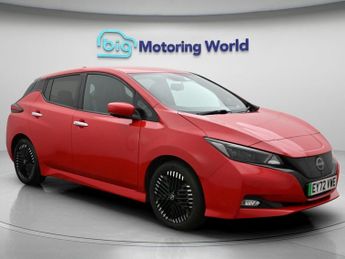
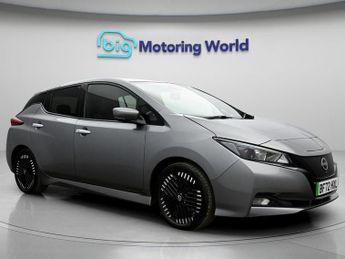
Completing the range, the e+ models offer enhanced performance and extended driving range, thanks to a larger battery and more powerful motor. Alongside the equipment found in Tekna, e+ models deliver improved acceleration and a real-world range that can stretch to 200 miles, making them suitable for longer journeys. The Leaf is offered in a range of colours including Flame Red, Pearl Black, and Pure White. Nissan also offers signature colours like Magnetic Red and Arctic White for a modern, distinctive look.

Nissan Leaf trim and colour

Safety and reliability

The Nissan Leaf holds a five-star Euro NCAP safety rating, recognised for its strong occupant protection and advanced safety features. In its 2019 Euro NCAP testing, the Leaf achieved impressive percentage scores across key categories. Adult occupant protection was rated at 93%, while child occupant protection received a score of 86%. The car also performed well in pedestrian safety, scoring 71%, and its safety assist features were awarded 71%. Standard kit includes autonomous emergency braking, lane departure warning, blind spot monitoring and traffic sign recognition. Nissan’s long-standing EV expertise means the Leaf is proven and reliable, with the battery covered by an eight-year/100,000-mile warranty and the rest of the car by Nissan’s three-year/60,000-mile warranty.

Nissan Leaf safety and reliability

MPG, emissions and tax

The Leaf is a zero-emission vehicle, with running costs among the lowest in its class. Efficiency is typically between 3.5 and 4.2 miles per kWh, giving a real-world range of 130–200 miles depending on the model and driving style. Charging at home via a 7kW wall-box takes around 7.5 hours for a full charge (40 kWh model), while the e+ takes roughly 11.5 hours. Rapid charging to 80% takes about 40–60 minutes, though the maximum DC charging speed (50 kW) is outpaced by some newer EVs. VED (road tax) is currently £10 in year one, and £195 a year thereafter. Insurance groups are lower than many rivals, typically falling between 21 and 25.

Nissan Leaf MPG, emissions and tax
Browse 211 in stock