Specifications

Fuel types
Mild-hybrid petrol, mild-hybrid diesel, petrol plug-in hybrid, diesel plug-in hybrid
No of seats
5
Boot space
Saloon: 370-540 / Estate: 460-615 (seats up) - 1,680 - 1,835 (seats down)
Dimensions
4,226 mm x 1,754 mm x 1,451 mm
Fuel economy
40.4 mpg - 176.6 mpg
Acceleration (0-62mph)
3.8 - 7.8 seconds
Insurance group
41E - 50E
Body style
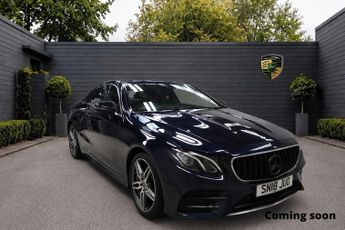
Saloon, estate
CO2 emissions
15 - 153 g/km
Browse 975 in stock

AA Mechanic review

When buying a used Mercedes-Benz E-Class, check for a full-service history, smooth automatic gearbox changes and no warning lights. Pay close attention to the electronics, suspension and brakes, as these can become expensive on a heavier premium car. It’s also worth using an online vehicle check to look for outstanding finance, insurance write-offs or mileage discrepancies.
Allen Childs
Allen Childs

Allen Childs is a Regional Manager at The AA, with extensive experience in roadside assistance, vehicle repair, recovery operations, team development and operational leadership.

Read bio

4.2/5

Repairs

The Mercedes-Benz E-Class is a refined and well-built executive car, but repairs can be costly if maintenance has been missed. Common issues include:

• Suspension wear, including bushes and joints

• Air suspension faults on some models with age

• Automatic gearbox hesitation if servicing has been missed

• Brake wears due to the car’s weight and high miles

• Timing chain or oil cooler leaks on old diesel engines

Most issues are manageable if caught early, but repair costs can range from a few hundred pounds to more than £1,000 depending on the fault.

Maintenance

The E-Class usually follows Mercedes-Benz Service A and Service B schedules, with servicing needed every 12 months or around 10,000 to 15,000 miles, depending on the model and how it’s used. Key maintenance to keep on top of includes:

• Regular oil and filter changes

• Brake fluid replacement every 2 years Suspension inspections, especially on cars with air suspension

• Brake and tyre checks, as wear can increase from year 3 onwards.

Is the Mercedes E Class a reliable car?

The Mercedes-Benz E-Class is a comfortable, high-quality executive car with strong refinement and useful technology. It holds up well when serviced properly, but it needs consistent maintenance to stay reliable. After many years, neglected examples are more likely to show several issues at once, especially with suspension, electronics, brakes and gearbox behaviour.

Browse 975 in stock

AA Cars review

If you’re looking for a super-comfortable, refined and luxurious saloon or estate car, the E-Class is a fine choice – in many ways it is the perfect executive express for those who place comfort and style at the top of their wish list. It’s a bit of a technological marvel, too, offering the type of high-end on-board gadgets that other cars can only dream of. The estate version, meanwhile, is a proper load-lugger, and is one of the largest wagons available on the market.
Jack Evans
Jack Evans

Jack is an experienced motoring journalist who has been covering the latest new-car releases for the last 10 years.

Read bio

4.1/5

How much does it cost?

The Mercedes-Benz E-Class sits in the executive class, and as such it doesn’t come cheap. New models start from £56,650 and rise to £98,000 for the most powerful versions, while the commodious estate models command between a £2,250 and £5,895 premium. It may be a relatively new model but there are plenty of used examples on the market, with prices starting from £37,980 on AA Cars, representing a significant saving over new. Despite the E-Class being a well-specified car, many original buyers ticked items off the options list, so look out for some desirable extra equipment on listings when searching for your used car.

Engine and performance

Overview

The latest E-Class has a diverse range of engines, from mild-hybrid petrols to diesel plug-in hybrids – there's even a high performance petrol plug-in hybrid available. The entry-level engines are mild-hybrids – there's a 201bhp 2.0-litre petrol badged E200, and a 195bhp 2.0-litre E220'. Both units are fine, but for outright refinement the E450d six-cylinder diesel is perfect.

The E300e and E300de plug-in hybrids are based on the 2.0-litre petrol and diesel units, but add a larger electric motor and battery pack to give up to 71 miles of pure-electric running. Sitting at the top of the range is the potent Mercedes-AMG E53 Hybrid 4Matic+, which uses a 577bhp 3.0-litre straight-six petrol engine and hybrid system for maximum power. Plus, as it's a plug-in hybrid, it can be pretty efficient to run, although that’s not really its purpose.

Mercedes E Class performance

Out on the road

The 2.0-litre mild-hybrids are perfectly decent engines and you won't feel shortchanged going for one of these if that's all that your budget allows. The E450d and the E300e and E300de are the real stars, though, but for different reasons. The E450d has creamy power delivery from its 3.0-litre straight-six diesel engine, with super smooth acceleration and tremendous punch, and it's the perfect choice if you need to do regular long-distance driving.

The E300e, meanwhile, is impressive as it can do motorway cruising just as well. But, thanks to its electric motor and large electric battery, it offers eerily quiet driving when around town. It has an electric range of 70 miles, meaning the 2.0-litre petrol engine only really kicks in for extra power or when the battery is depleted. Accelerating up to motorway speeds on electric power is no problem, either. The same is true for the E300de. The E53, meanwhile, offers incredible performance thanks to its 577bhp power reserve, but can also deliver up to 59 miles of electric-only motoring.

Mercedes E Class on the road

Ride and handling

The battle between the E-Class and its arch rival, the BMW 5 Series, has usually come down to whether drivers prefer a comfortable driving experience or a sportier one. The E-Class has traditionally offered the former, and that's the case with this generation. The E-Class might have a wide range of powerful engines, but tackle a country road and you'll quickly realise that this isn't the car's stamping ground. It's more focussed on delivering a pampering experience for the driver and passengers, with a comfortable ride, light steering, and high levels of sound insulation. In this regard, the E-Class is outstanding – no wonder why so many are chosen as limousines.

Mercedes E Class ride and handling

Interior and features

Interiors

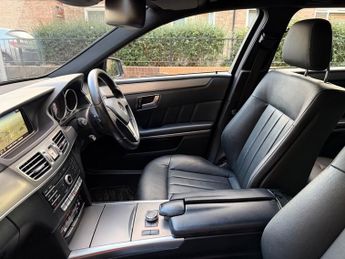
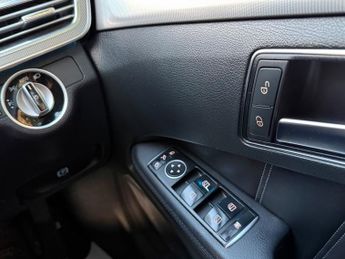
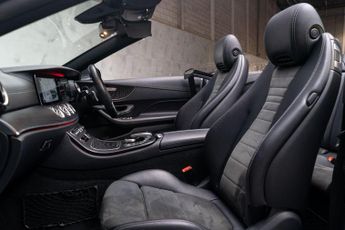
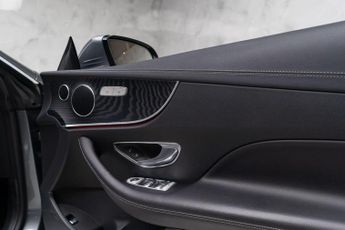
Being one of Mercedes's latest models, it won't be a surprise to hear that the E-Class's interior has all of the firm's latest tech and glitziest design. All cars get a pair of screens, but mid-range AMG Line Premium Plus adds a third screen for the passenger – Mercedes calls the collection of displays the 'Superscreen' package, and it creates one large screen across the dashboard fascia and comprises the central touchscreen and the passenger’s display. On top of this, the E-Class has one of the most comprehensive ambient lighting systems available anywhere, with near infinite ways to bathe the interior in colour. The interior certainly has a modern feel, but the quality isn't quite as good as it should be – an Audi A6 or BMW 5 Series feel just slightly better in this department.

Mercedes E Class interior

Boot space and practicality

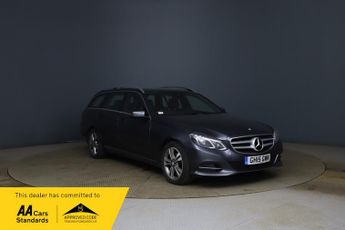
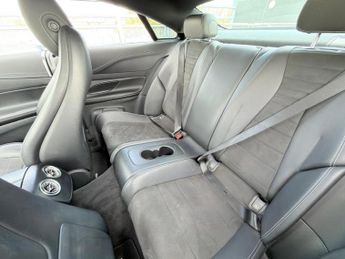
On first impressions, the interior up front feels a bit claustrophobic thanks to the high centre console that runs between the front seats. But this is a little deceiving as there's plenty of space for both driver and passenger to get a comfortable seating position. There's plenty of space in the back, too, and offers the kind of room that's expected for an executive car such as this. You can fit three across the back, at a push, while easily-accessible Isofix points make loading child seats a breeze. Most families with children will be tempted by the estate, though. Its higher roofline gives more headroom for backseat passengers, and its boot is huge.

At 615 litres, it trumps the Audi A6 and BMW 5 Series, while handy 40/20/40 split folding seats make the loading area even more flexible. Just be aware, though, plug-in hybrids have a shallower boot, and therefore less space, due to their batteries. The saloon, meanwhile, has an impressive 540 litres of room, and the back seats also split in the same 40/20/40 configuration. Again, hybrid models have less space at 370 litres.

Mercedes E Class boot space and practicality

Features

Aside from the performance Mercedes-AMG E53, the E-Class comes in five trim levels, with even the basic Urban Edition being well-equipped – it gets 20-inch AMG alloys, the twin screens, heated seats, privacy glass, and an electric tailgate for the estate version. The most popular versions, however, are the AMG Line models as they have a sportier look and get extra equipment such as electric memory seats, heated steering wheel, heated armrests, Burmester 4D stereo system, and the ‘Superscreen’. Exclusive models ditch the sporty styling for a more refined appearance, and even get the classic three-pointed star bolted to the bonnet.

Mercedes E Class feature

Trim and colour options

As already mentioned, the E-Class has a wide range of trim levels, with each one adding extra luxuries. The AMG Line models are the most popular and remain the sweet spots when buying used as they look and feel distinctly premium. Standard equipment on the AMG Line Premium includes digital LED headlights, a panoramic sliding roof, a high-end Burmester 4D sound, while AMG Line Premium Plus adds luxuries such as heated armrests and a head-up display. Exclusive Premium and Exclusive Premium Plus adopt a more refined look with more chrome, the traditional slatted Mercedes grille and three-pointed star on the bonnet.

Mercedes E Class trim and colour

Safety and reliability

Perhaps unsurprisingly given Mercedes's history of building very safe cars, the E-Class was awarded a full five-star safety rating when it was tested by Euro NCAP in 2024. It received excellent scores of 92 per cent and 90 per cent respectively for adult and child occupant protection, while protection for vulnerable road users was rated at 84 per cent, and the E-Class's safety assist systems at 87 per cent.

Mercedes E Class safety and reliability

MPG, emissions and tax

For such a big car, the E-Class offers some very impressive efficiency figures. All of the mild-hybrid engines emit low CO2 figures, with the E200 petrol emitting 146g/km and the diesel 126g/km. The six-cylinder E450d diesel, meanwhile, only develops 165g/km, which is amazing for such a large engine. The plug-in hybrids are the greenest, though, as they emit around 15g/km. Even the thirstiest E-Class will return a claimed 40.4mpg on the combined cycle, which is impressive, while the plug-in hybrids can return fuel economy in excess of 170mpg. You'll only get economy like that if you regularly charge the car, though.

As all versions of the E-Class cost more than £40,000 when new, they attract the Luxury Car Tax. That means for the first five years of the car's life, you have to pay an additional £425 a year in VED, taking the total yearly cost to £620.

Mercedes E Class MPG, emissions and tax
Browse 975 in stock