Specifications

Fuel types
Petrol, plug-in hybrid, diesel
No of seats
5-8
Boot space
297-1,329
Dimensions
4,323 mm x 1,974 mm x 2,008 mm (90), 4,758 x 1,967 x 2,008 (110), 5,099 x 1,970 x 2,008 (130)
Fuel economy
20-109.4 mpg
Acceleration (0-62mph)
3.5-10.0 seconds
Insurance group
32-50
Body style
SUV
CO2 emissions
59-325 g/km
Browse 422 in stock

AA Mechanic review

When buying a used Land Rover Defender, start by checking which generation you’re looking at. Older Defenders are simple, tough and characterful, but rust, leaks and drivetrain wear are major concerns. Newer 2020 onwards Defenders are much more refined, but they’re also more complex, so check the electronics, software history, warning lights and air suspension if fitted. Always check service history, VIN details, insurance history and signs of theft-related damage.
Allen Childs
Allen Childs

Allen Childs is a Regional Manager at The AA, with extensive experience in roadside assistance, vehicle repair, recovery operations, team development and operational leadership.

Read bio

4.0/5

Repairs

The Defender’s common issues depend heavily on age. Older models are usually mechanical and structural. Newer models are more likely to suffer from electrical or software-related faults.

Common issues include:

• Chassis, bulkhead and door frame corrosion on older Defenders

• Oil leaks, turbo wear and timing belt neglect on older diesel models

• TD5 injector wiring and cooling system faults

• Gearbox, transfer box and differential wear

• Suspension bushes, shocks and steering wobble on older cars

• Water ingress around doors, footwells, windscreens and load areas

• Coolant leaks, sensor faults and emissions warning lights on newer models

• Air suspension faults on newer cars, if fitted

• Infotainment, camera, parking sensor and connectivity glitches

• 12-volt battery issues causing system warnings

• DC-to-DC converter issues on some plug-in hybrid models

Rust is the biggest concern on classic Defenders. Engine and drivetrain faults can often be fixed, but structural corrosion can become expensive very quickly.

Maintenance

Defender servicing depends on the model and engine, but regular maintenance is essential. Newer models usually follow dashboard-based service prompts, with servicing around every 12 months or 16,000 miles, depending on use.

Key maintenance to keep on top of includes:

• Regular oil and filter changes

• Timing belt replacement on older diesel models when due

• Gearbox, transfer box and differential oil servicing

• Coolant checks and early repair of leaks

• Brake, tyre and suspension inspections

• Chassis and underbody rust checks on older cars

• Software updates on newer models

• 12-volt battery checks, especially if electrical warnings appear

• Air suspension checks on models fitted with it

Running costs can be high, especially on newer Defenders. Tyres, brakes, insurance, servicing, security upgrades and extended warranty cover are all worth budgeting for. Defenders are also a known theft target, so check insurance quotes and consider security upgrades before buying.

Is the Land Rover Defender a reliable car?

The Land Rover Defender is a British motoring icon, but reliability depends on age, condition and maintenance. Older Defenders are tough and simple, but they need regular care and careful rust prevention. Newer Defenders are more comfortable and capable, but their extra technology can mean more faults and higher repair costs.

A well-maintained Defender can last for years and hold its value well. A neglected one, especially with corrosion, electrical faults or poor service history, can quickly become expensive.

Browse 422 in stock

AA Cars review

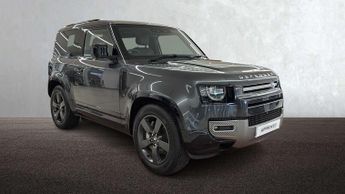
There were a lot of concerns when Land Rover decided to revive the Defender, but that needn’t have been the case - the modern-day car is a triumph and comes packed with technology as well as excellent off-road ability.
Jack Evans
Jack Evans

Jack is an experienced motoring journalist who has been covering the latest new-car releases for the last 10 years.

Read bio

4.0/5

How much does it cost?

The Land Rover Defender commands quite a hefty price tag, regardless of which model you’re looking at. Prices start at £57,135 for a standard 90 model, rising to £62,795 for the more practical 110 and £84,070 for the largest 130 model, which can seat up to eight people. The range-topping performance Octa version, with its 4.4-litre V8, comes in at £148,045, too.

Switch to the used car market and there are some savings to be had, mind you. On AA Cars currently, you can get a V8-powered 110 model - which would usually cost £101,125 - for £82,450, while for the same price as a regular 90 model you could get a larger 110 with an efficient plug-in hybrid engine and just 44,900 miles on the clock. Due to high demand and impacted production, prices of used Defenders continue to remain strong.

Engine and performance

Overview

The Land Rover Defender can be equipped with one of a broad number of engines. For many drivers, the mild-hybrid diesel will make the most sense; 3.0-litre-powered D250 and D300 models bring a good blend of performance and efficiency. On 110 models, you can also get an efficient plug-in hybrid setup, which uses a 2.0-litre turbocharged petrol engine and combines it with an electric motor and battery for a range of up to 31 miles on electric-only power.

Then, you’ve got the V8-powered models. On 110 and 130 cars, this brings a 5.0-litre supercharged petrol which can get these models from 0-60mph in as little as 5.0 seconds. At the top of the range sits the Octa, which uses a 4.4-litre twin-turbocharged V8 engine for heightened performance, while a range of performance upgrades to the suspension and brakes help to make this the sharpest Defender model overall.

Land Rover Defender performance

Out on the road

Tall and with a commanding view of the road ahead, the Defender remains an out-and-out off-roader. However, whereas its predecessor was quite uncompromising in terms of refinement, the new car is far quieter and easier to drive on a daily basis. The Defender’s steering isn’t too heavy, so it’s not so tricky to park - though 110 and 130 models do feel incredibly long and will fill - or often overhang - a regular parking space.

Diesel-powered models bring decent enough performance, while the plug-in hybrid model adds in some of the zip that you’d usually get from an electric car. Of course, for enthusiasts, the V8-powered models will no doubt prove appealing. The 5.0-litre models have some old-school character to them, while Octa cars really do feel more like a hot hatch on stilts.

Land Rover Defender on the road

Ride and handling

Despite being a large car, the Defender isn’t a tricky car to drive. You’ve got the option of either standard springs or air suspension, with the latter giving this car a glossier, more upmarket ride. It gives you the option to raise or lower the Defender, too, bringing extra ground clearance to get over obstacles or poor surfaces.

There’s a certain level of shimmy when the Defender hits a pothole or road imperfection, but it’s not too bad overall. When cornering, things remain relatively level, though push harder and the car will start to lean.

Land Rover Defender ride and handling

Interior and features

Interiors

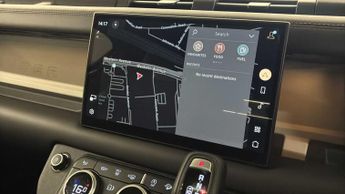
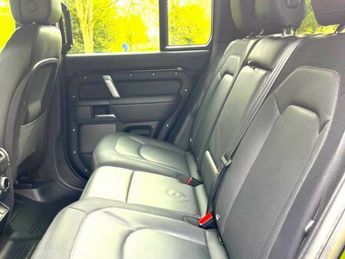
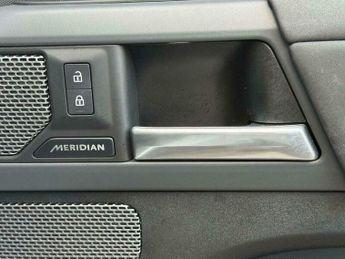
The Defender comes with a lot of equipment as standard, all wrapped in a solid, rugged-feeling finish. Even standard ‘S’ models get a Meridian sound system and 12-way heated and semi-powered front seats, as well as a sharp 13.1-inch touchscreen. The Defender’s infotainment is one of the easiest to use on the market today, with clear graphics and easy-to-navigate menus, while both Apple CarPlay and Android Auto come equipped as standard.

There are plenty of charge ports located throughout the Defender, too, with the 12-volt socket located in the boot being a particularly handy spot. Wireless smartphone charging comes as standard on the Defender, too, so you should always have a way to keep your device topped up.

Land Rover Defender interior

Boot space and practicality

How practical your Defender model is depends on the model you’ve selected. The smallest 90 models, for instance, have space for up to five people, or six if you’ve gone for the optional ‘jump’ seat in the middle of the front two chairs. At 397 litres, the 90’s seats-up boot space isn’t bad, given that this is the smallest of all the Defender models.

Switch to the longer 110 and you’ll unlock 646 litres of space with the rear seats in place, or 231 litres in seven-seater models with all rows raised. The largest Defender - the 130 - has seating for up to eight people, but can bring up to 389 litres with all three rows in place, or 1,232 with the rearmost seats laid flat. You can get up to 2,516 litres when all seats are folded flat, which is nearly van-like in size.

Land Rover Defender boot space and practicality

Features

The Land Rover Defender serves a good number of features, both mechanical and more comfort-led. For instance, it gets Land Rover’s latest Terrain Response system, which allows you to toggle through a variety of settings designed for different surfaces and conditions, and the car will automatically change to offer the best possible traction. You also get helpful features like hill descent control, which is almost like cruise control for going down steep inclines.

Inside, you’ve got Land Rover’s latest Pivi Pro infotainment system which is packed with features and accessed via a 13.1-inch touchscreen which is intuitively located within the cabin. There’s a clear driver’s display which can be configured to show different readouts, too.

Land Rover Defender feature

Trim and colour options

There is a huge number of trim levels available with each type of Defender. If you take the standard 90 as an example, then you’ve got S, X-Dynamic SE, X-Dynamic HSE and X trim levels, ensuring that there’s something for everyone. Entry-level cars get a huge amount of standard equipment, mind you, including 19-inch alloy wheels and LED headlights with prominent daytime running lights.

At the other end of the scale, ‘X’ cars add 22-inch diamond-turned alloy wheels, a sliding panoramic roof and Matrix LED headlights. Inside, Windsor leather adds a touch of class, while the front seats gain a cooling function to go with the heated ones. Paint-wise, there’s a good degree of choice, though nearly all are quite subdued and understated - there are very few bright reds and blues, for instance.

Land Rover Defender trim and colour

Safety and reliability

The Defender is a large, commanding SUV, so it’s likely that a lot of drivers will get a lot of confidence from its sheer size. However, it’s also equipped with a range of safety features to help things further, with features such as adaptive cruise control, lane keep assist and blind spot assist coming on all cars as standard. Many Defender models have a front ISOFIX child seat mounting point, too, which could be handy for larger families.

Reliability-wise, the Defender has a mixed reputation. Some owners have reported a variety of issues spanning engine and powertrains to in-car electronics. However, a good warranty and up-to-date servicing can help prevent this.

Land Rover Defender safety and reliability

MPG, emissions and tax

The engines available with the Defender all focus on bringing a good amount of performance. Diesel models will bring the best all-round efficiency, with Land Rover claiming around 33mpg from the D250 mild-hybrid cars. The plug-in hybrid might only be available on 110 cars and up, but it’s great for those who might be using their Defender cars around town most of all as with its good electric range it’s well suited to more urban environments. A claimed 109.4mpg will be tricky to achieve unless you’re driving on electric-only power for nearly all of the time, mind you. However, the plug-in hybrid fares the best in terms of emissions, with 59g/km CO2 being the best of all the Defender models. As a result, it’ll be the cheapest to tax.

The V8 cars will be the least efficient to run, with standard P425 models only able to return around 19mpg - though this will quickly fall if you’re driving around town or off-road. Since all Defender models cost over £40,000, they’ll all incur the Expensive Car Supplement for the first five years after registration.

Land Rover Defender MPG, emissions and tax
Browse 422 in stock