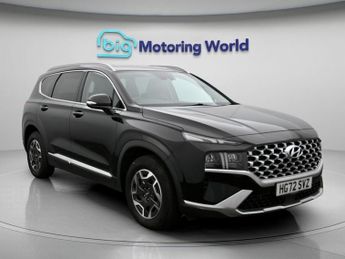
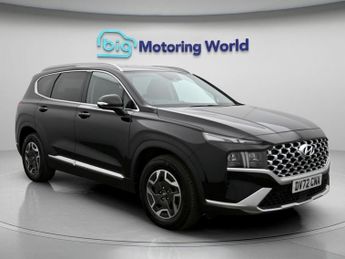
Specifications

Fuel types
Self charging hybrid, plug-in hybrid
No of seats
6 or 7
Boot space
628/621 litres (hybrid/plug-in hybrid)
Dimensions
4,830mm x 2,206mm x 1,780mm
Fuel economy
39.2 – 74.3 mpg
Acceleration (0-62mph)
8.0 - 9.2 seconds
Insurance group
38 - 44
Body style
SUV
CO2 emissions
36 – 164g/km
Browse 225 in stock

What does our motoring journalist think of the Hyundai Santa Fe?

The Hyundai Santa Fe will win you over if you’re looking for the most spacious, practical and comfortable SUV. It’s one of the best 7-seater SUVs money can buy today, but it misses out on top scores for its intrusive driver aids and the powertrains that feel a bit ordinary.
Adithya Gopal
Adithya Gopal

Adithya is the Content Editor at AA Cars and a Motoring Journalist, with over 1,000 published articles across numerous publications.

Read bio

4.3/5

How much does a Hyundai Santa Fe cost?

The Santa Fe starts at £49,090 for the entry-level Premium hybrid, rising to £52,590 for Ultimate and £55,090 for the top-spec Calligraphy. The plug-in hybrid starts at £53,245 for Premium, £56,745 for Ultimate and £59,335 for Calligraphy. The Santa Fe is a seven-seater as standard, while a six-seat layout is available at extra cost with Calligraphy.

Buying a nearly new or used Santa Fe can bring significant savings. At the time of writing, AA Cars had many 2026-model Santa Fe examples listed below £50,000. Older, high-mileage Santa Fe models started from £2,500.

Engine and performance

Overview

Hyundai offers the Santa Fe with a self-charging hybrid and a plug-in hybrid option:

  • Santa Fe Hybrid: 1.6-litre petrol engine with a six-speed automatic and front- or four-wheel drive – 236hp/265Nm, 0–62mph in 9.0–9.2 seconds
  • Santa Fe Plug-in Hybrid: 1.6-litre petrol engine, six-speed automatic and electric motor, with four-wheel drive – 284hp/380Nm, 0–62mph in 8.0 seconds, electric range of 33 miles
Hyundai Santa Fe performance

Out on the road

We lived with the Santa Fe hybrid in Calligraphy trim that features a 1.6-litre engine (235hp), coupled with a 6-speed automatic and a small 1.49kWh battery that self-charges. At low speeds, the Santa Fe tries its best to drive around on electric power. However, since it’s huge, and the battery is small, the engine often steps in after you get moving.

This is not necessarily a problem as the 1.6-litre T-GDI unit is adequately refined for everyday use. You can feel the engine starting up as there’s a slight cranking like vibration, but it mostly remains in the background, unless you ask for more acceleration. At this point, the engine is clearly audible, and the Santa Fe drives more like a normal car.

In terms of power delivery from, there’s just enough response to get the Santa Fe going and not make it feel sluggish. But performance can be termed adequate than quick, and you need to spin the engine much higher as there’s not much of a step up in power at mid or lower rpms.

The 6-speed automatic is also not the sharpest tool as it often hunts for gears and holds on to them, especially when you want to up shift and get going.

Overall, the engine and gearbox feel ordinary and there are rivals that offer more real-world performance. The Santa Fe plug-in hybrid with 285hp and a larger electric motor should more convincing in this respect. But then again, it’s below average all-electric range of 33 miles is not that promising.

Hyundai Santa Fe on the road

What is the ride quality like?

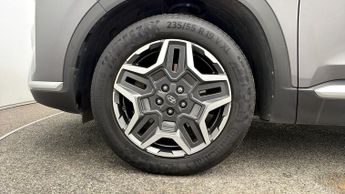
Considering the Santa Fe is a heavy 6/7-seater SUV, the ride and handling seems to be resolved. The ride has a soft edge to it (despite on 20-inch wheels), but at the same time it does not feel bouncy or floaty. The suspension deals with broken roads easily, and there’s an acceptable level of body rock that is well judged to not make any occupants uncomfortable.

And around corners, the Santa Fe somehow manages to shrink around you, and feels like a smaller SUV. The quick, direct steering and controlled body lean definitely helps. Grip levels are also notable, and the Santa Fe, despite its proportions, can actually be hustled without feeling nervous. It manages to find a good balance. Yes, it is not as engaging to drive as the Kodiaq, but apart from that, there’s not much to report here.

In terms of stopping power, the brakes are strong with decent pedal feel and bite. There’s some amount of road noise at speeds, nothing too concerning and in line with other 6/7-seaters.

The Santa Fe is also easy to pilot around tight streets, thanks to its boxy proportions and great visibility out all four corners. Its high seating position also makes the car feel less intimidating to place.

Hyundai Santa Fe ride and handling

What are the features of a Hyundai Santa Fe?

Interiors

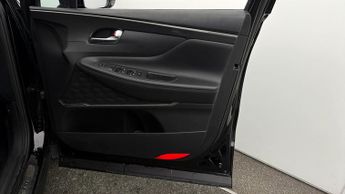
The Santa Fe’s cabin feels modern, using two 12.3-inch displays rather than one oversized screen. The design is functional and purposeful. Well-thought-out storage recesses, large door handles and other practical details give the cabin a function-over-form character, supported by strong overall build quality.

Everything you touch feels solid and well made, giving the cabin a durable quality that large families are sure to appreciate. Like the exterior, the interior has a retro-modern appearance. It is not perfect, though. The physical climate controls are well laid out, and the tactile rotary knobs are easy to use. However, the other controls are touch-sensitive, which may take some time to get used to.

Hyundai Santa Fe interior

Boot space and practicality

This is where the Santa Fe claws back all the points. Thanks to it being massive, there’s more than enough room inside for all passengers and luggage. Boot space is rated at 621/628 litres (hybrid/plug-in) with the 50:50 third-row folded flat.

We had the pleasure of testing the boot with an early morning Heathrow dash. We noticed the boot door is large and extends all the way to the bottom. So, the loading lip sits closer to the ground and it’s easy to load large, heavy bags. Our only gripe is that the roller binder comes in the way of the boot, but you can easily remove it (however, you need to store it inside the boot or at home).

With the second-row seats folded, you are essentially looking at a small van like boxy storage. There’s all the space you ever need; you could even sleep in there comfortably. Step into the cabin and there’s once again space and loads of it. The front seats are some of the most comfortable with lounge like electric extendable leg rest and a whole plethora of adjustments and memory functions (Relaxation seats, exclusive to Calligraphy).

Our test car was the 6-seater with two captain seats for the middle row. Although not as luxurious as the front seats, the rear seats are still comfortable. They can recline, slide and comes with electric controls and a dedicated arm rest.

Even the third row is roomy relative to some rivals (adults will struggle however) and getting into the third row is not as hard. This is also thanks to the boxy look. That also translates to a surplus of headroom and more knee and legroom if the middle seats are slid forward.

In terms of storage, everything feels enlarged in the Santa Fe. All storage cubbies are XL-sized, with two large wireless charging pads, countless charging ports, and two glove boxes. With the Santa Fe, you’ll never wish it had more space or practicality or storage. It’s that accomplished in this area, especially for the price.

Hyundai Santa Fe boot space and practicality

Features

The Santa Fe is well equipped, particularly in Calligraphy trim. Feature highlights include lounge-like Napa leather Relaxation Seats, a Bose sound system, heated and ventilated front seats with memory, heated and electrically adjustable rear seats, a surround-view camera, a UV-C sanitation compartment, twin panoramic roofs, dual wireless chargers, advanced driver-assistance systems and Remote Park Assist.

Hyundai Santa Fe feature

What are the trim and colour options?

Both powertrains are available in three grades: Premium, Ultimate and Calligraphy.

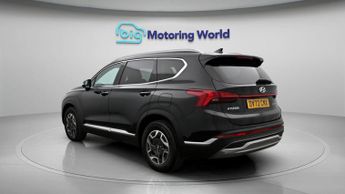
Typhoon Silver is the no-cost colour, while Abyss Black, fitted to our test car, Ecotronic Grey and Creamy White Pearl cost £795. Cyber Sage costs £995, while the matte finishes, Creamy White and Earthy Brass, cost £1,295.

Interior colour choices include Black Ink, Pecan Brown and Forest Green.

Hyundai Santa Fe trim and colour

How safe and reliable is the Hyundai Santa Fe?

Euro NCAP awarded the Santa Fe a four-star rating for standard variant and a five-star rating for the safety pack version (higher trims with driver assists). Detailed scores for the safety pack version are:

Adult occupant: 84%

Child occupant: 88%

Vulnerable users: 77%

Safety assist: 79%

Coming to the advanced driver assist and safety features, there is a full suite from radar cruise to advanced lane, collision and park assists. You get every advanced safety feature out there. However, some of these features such as the driver attention monitor can be too sensitive.

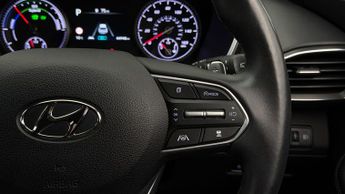
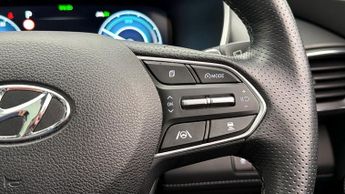
For instance, to change the seat/steering heater controls, you have to take your eyes off the road as it’s not a physical button. But when you do this, the car bongs at you, which is counterintuitive. Other safety features were less intrusive, and you can turn off the lane assist quickly using the steering mounted buttons.

In terms of warranty, Hyundai offers eight-year/100,000-mile high-voltage battery warranty and a five-year unlimited-mileage new-car warranty.

Hyundai Santa Fe safety and reliability

What are the MPG, emissions and tax like?

The standard hybrid is claimed to return 39–42mpg on the combined cycle, depending on whether it has front- or four-wheel drive. This was broadly consistent with our test result. The best figure we saw was more than 40mpg during a steady 60mph early-morning cruise. Compared with rivals, these figures are about average.

For better fuel efficiency, consider the plug-in hybrid, which is claimed to return 74.3mpg combined. However, its 33-mile electric range is not especially competitive. Unlike the Kodiaq, the Santa Fe plug-in hybrid is available with six or seven seats, whereas the Kodiaq PHEV is a five-seater.

CO₂ emissions range from 36–164g/km, depending on the powertrain. The plug-in hybrid emits just 36g/km, placing it in the lower tax band. However, the Kodiaq’s longer electric range places it in an even lower band. All Santa Fe versions cost more than £40,000 and are therefore subject to the higher VED rate during the first few years of ownership.

Hyundai Santa Fe MPG, emissions and tax
Browse 225 in stock