Specifications

Fuel types
Petrol, diesel, plug-in hybrid
No of seats
5
Boot space
488 litres
Dimensions
4,531 mm x 2,087 mm x 1,601 mm
Fuel economy
31.5 -53.2 mpg
Acceleration (0-62mph)
5.7 – 9.3 seconds
Insurance group
21-42
Body style
SUV
CO2 emissions
139-204 g/km
Browse 1,744 in stock

AA Mechanic review

When buying a used Audi Q3, choose a car with good service history and buy from a reputable dealer where possible. On a test drive, manual cars should have a smooth clutch bite, while S tronic automatic models should change gear cleanly without hesitation. Check the infotainment system, virtual cockpit, navigation, parking aids and driver assistance features all work properly. A used car inspection and extended warranty are worth considering if you are considering a used Q3.
Alex Gur
Alex Gur

Alexander Gur is a Roadside Patrol at The AA, with more than 20 years of hands-on experience across garage and roadside roles, as well as a strong personal interest in performance cars.

Read bio

4.0/5

Repairs

The Audi Q3 is generally a reliable premium compact SUV, especially the second-generation F3 model. Petrol, diesel and plug-in hybrid versions are available, along with front-wheel-drive and quattro models.

Common issues include:

• S tronic gearbox hesitation or faults on older or higher mileage cars

• Increased oil consumption on some engines with high mileage

• Diesel particulate filter issues on diesel models used mainly for short journeys

• EGR faults on some diesel cars

• Water pump wear, often around 60,000 to 80,000 miles

Major electrical failures are not common, but it’s still important to test every system before buying. Most infotainment or assistance system issues are usually software-related and can often be improved with dealer updates.

Maintenance

Most Audi Q3 models need servicing every 12 months or around 10,000 miles, depending on the engine, age and service schedule.

Key maintenance to keep on top of includes:

• Oil and filter changes using oil that meets Audi’s specification

• Brake inspections at regular service intervals

• Brake fluid replacement every 2 years

• Cabin and engine air filter replacement when due

• Spark plug replacement on petrol models at the correct interval

• S tronic gearbox servicing around every 40,000 miles

• Haldex or quattro system servicing around every 30,000 to 40,000 miles, where fitted

• Diesel particulate filter-friendly longer runs for diesel models

• Water pump checks as mileage increases

Running costs are reasonable for a premium SUV and are often close to a Volkswagen Golf with a similar engine. Buyers should still budget for gearbox servicing, quattro maintenance, tyres and dealer or specialist labour costs.

Is the Audi Q3 a reliable car?

The Audi Q3 is a practical compact SUV with a premium cabin and strong engine choices. The 1.5 and 2.0 petrol engines are good options, while diesel models suit higher mileage drivers.

With proper servicing, the Q3 can cover high mileage well. A well cared-for example with smooth gearbox operation, up-to-date software and evidence of regular engine, gearbox and quattro maintenance should be a solid used buy.

Browse 1,744 in stock

AA Cars review

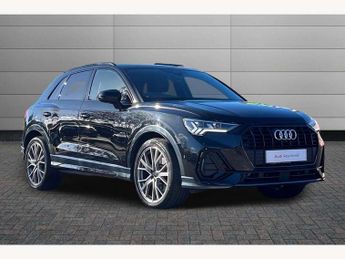
The refreshed Audi Q3 retains the qualities that have made it popular. Apart from a few minor flaws, it is still practical, good to drive and feels premium, while its broad range of engines means there should be a version for most buyers.
Adithya Gopal
Adithya Gopal

Adithya is the Content Editor at AA Cars and a Motoring Journalist, with over 1,000 published articles across numerous publications.

Read bio

4.2/5

How much does it cost?

Prices start from £39,065 for the base Sport trim with the 1.5 TFSI engine, rising to £45,415 for the range-topping Edition 1. Meanwhile, the 2.0 TDI diesel starts from £40,765 for the Sport and tops out at £47,115 for the Edition 1. The version we tested is the most powerful 265hp TFSI Quattro, priced between £50,000 and £53,000, whether you opt for S line or Edition 1 trim. If you’re looking to save money, we have 2025/2026 model-year nearly new and used Q3 models at great prices from certified and vetted dealers.

Engine and performance

Overview

Audi offers a wide range of engine options for the 2026 Q3:

TFSI 150: 1.5-litre turbo petrol + 7-speed S tronic (148hp/250Nm)

TFSI 204 Quattro: 2.0-litre turbo petrol + 7-speed S tronic (201hp/320Nm) AWD

TFSI 265 Quattro: 2.0-litre turbo petrol + 7-speed S tronic (261hp/400Nm) AWD

TDI 150: 2.0-litre turbo diesel + 7-speed S tronic (148hp/360Nm)

TDI 190 Quattro: 2.0-litre turbo diesel + 7-speed S tronic (190hp/400Nm) AWD

Q3 e-hybrid: 1.5-litre turbo petrol+ electric motor and 6-speed S tronic (270hp/330Nm)

Audi Q3 performance

Out on the road

We extensively tested the Q3 265 TFSI, which features a 2.0-litre engine sending power to all four wheels using Audi’s Quattro system, along with a 7-speed dual-clutch gearbox. Developing 261hp/400Nm, it is the fastest Q3, with 0-62mph coming up in 5.7 seconds. From behind the wheel, the Q3 does not feel blisteringly quick. Instead, the power delivery is progressive, which suits the character of the Q3.

The engine is refined and, once on the boil above 3000rpm, it pulls hard all the way to the redline. What’s noteworthy is the Quattro system, which puts down all 261hp without any struggles, even when the road is greasy. The 7-speed automatic gearbox is swift, and with light throttle inputs, it does not hesitate to drop down or shift up when needed. The paddles are also quick to react, and in S mode, or if you use the paddles, the Q3 is definitely more engaging to drive.

Although the headline power and torque figures of this engine are impressive, we recommend the standard Q3 150/204 TFSI versions. Yes, it’s nice to have that extra punch, but it’s also more expensive, the fuel consumption is below average (see below), and it doesn’t really feel exciting enough to justify the extra outlay. The Q3 TFSI 150 offers great value, while the TFSI 204 Quattro should work well if you need more power and all-wheel-drive support.

Audi Q3 on the road

Ride and handling

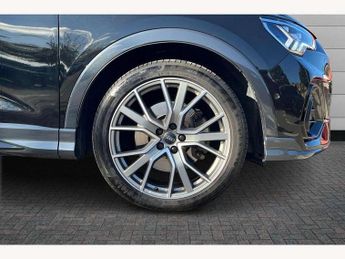
There is no doubt that the Q3 has a sportier edge to how it drives. There are different drive modes (Balanced, Dynamic, Comfort, Efficiency and Offroad+, with Offroad+ reserved for AWD models). We found the ride to be most compliant in Comfort mode, while in Dynamic it can feel a bit crashy, especially with larger wheels. Our test car was fitted with the optional adaptive dampers. We also noticed that the ride quality never settles fully at any speed and, as a result, the occupants are always aware of the quality of the road surface.

On the flip side, the Q3 drives and handles more like a hatchback than an SUV. Direction changes are quick and the SUV leans into corners with enough enthusiasm to keep you engaged. The steering does not offer much feel from the front axle, but there is just enough feedback from the chassis to make the Q3 somewhat enjoyable to drive.

The brake pedal has a solid feel with enough bite, but we found road noise to be on the higher side at motorway speeds. The suspension also produces more noise, and going over bumps or joints can induce a thud. This adds to the overall noise levels inside the cabin.

Audi Q3 ride and handling

Interior and features

Interiors

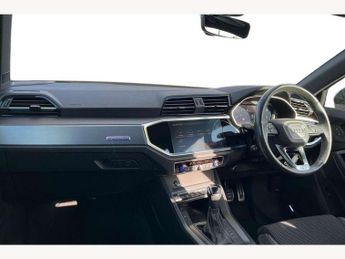
There’s a lot to like about the interior of the new Q3, mainly thanks to its interesting design and build quality. The highlight now is a design that is in line with what we’ve seen on modern Audis, including the squared-off steering wheel.

Overall, there are certainly many materials that feel top-notch. For example, the recycled polyester suede treatment in the interior, the door handles, the aircon vents and all the switchgear feel rich. However, there are also some bits on the lower dashboard, such as the glovebox shut line, that feel inferior to the rest of the cabin. Something that stands out is the new control unit that houses the indicator and wiper functions, as well as the gear selector, instead of actual stalks. It is fiddly at first, especially the wiper controls, but it’s only a matter of time before you get used to it.

The steering wheel on the 2026 Q3 features capacitive touch-sensitive buttons instead of actual buttons and rotary knobs. Although it feels high-quality, during our time with the car the buttons were accidentally getting triggered.

Audi Q3 interior

Boot space and practicality

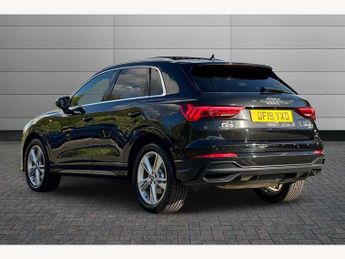
For a relatively small SUV, the Q3 does very well in terms of space and practicality. You get 488 litres of boot space; it is not class-leading, but it’s the right size, with a square boot that is easy to load. It also goes up to 575 litres if the seats are slid all the way forward. Up front, space is never an issue, with ample room throughout. The suede-finished seats are hugely supportive, with a wide range of adjustment and an extendable under-thigh support.

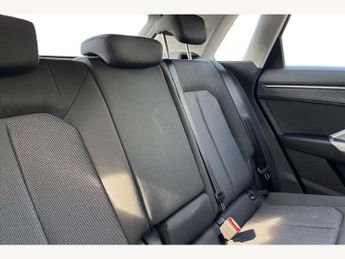
At the rear, the seats recline and slide, adding a lot to the practicality. The outright legroom is also welcome, with seats that offer good under-thigh support and headroom (in cars without the panoramic roof). Overall, the rear seats offer the right amount of space and comfort for passengers.

Elsewhere in the cabin, there are plenty of cubbies dotted around, while there is a large wireless charger recess in the middle of the cabin. The central tunnel also hosts more storage space now, as the gear selector resides behind the steering wheel.

Audi Q3 boot space and practicality

Features

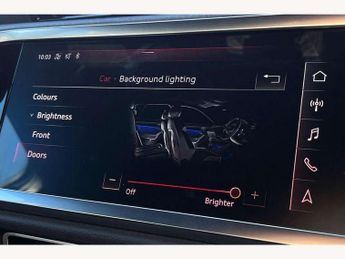
The 12.8in multimedia system is set high and forms a single unit where it is attached to the 11.9-inch Audi virtual cockpit plus, although it’s a more rectangular shape than a square one. The touchscreen unit is easy to use, with sharp graphics. The user interface lets you swiftly navigate to settings and it’s one of the better-designed units out there. There’s also an array of physical buttons below it that host important functions, along with a rotary knob and physical buttons for media control.

The aircon controls and seat-heating functions are built into the infotainment system. It is not as intuitive as having physical controls, but they still work as intended. Other feature highlights include the 12-speaker, 420-watt Sonos sound system, Matrix LED headlights, advanced driver assists, three-zone climate control, panoramic sunroof (optional), 4-way lumbar support for seats with memory, ambient lighting Pro, etc.

Audi Q3 feature

Trim and colour options

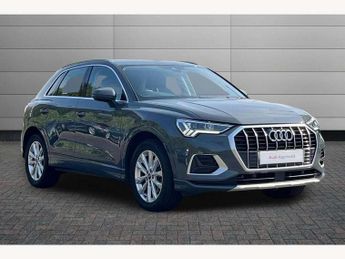
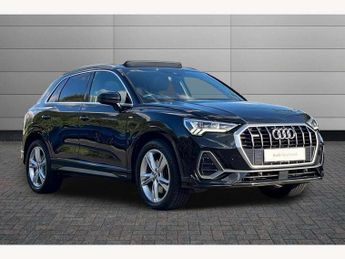
There are mainly three trims on offer with the new Q3: Sport, S line and Edition 1. Colours on offer are Arkona White (free); £675 options include Mythos Black, Navarra Blue, Glacier White, Progressive Red, Malpelo Blue, Sage Green, Daytona Grey and Arrow Grey (our test car). There is also an ultra-expensive matte Madeira Brown for £2,355.

Audi Q3 trim and colour

Safety and reliability

The latest Q3 scored a five-star rating from Euro NCAP in 2025, with scores of 87% for adult occupant protection, 86% for child occupant protection, 80% for vulnerable road users, and 78% for safety assist. After living with the Q3 for many days, we found the driver-assistance systems to be competent. The adaptive cruise, plus all the lane assists, worked flawlessly, while the overtake-prevention system proved useful on the motorway.

Audi Q3 safety and reliability

MPG, emissions and tax

The Q3 265 TFSI we had on test was not the most fuel-efficient, for obvious reasons. Audi claims 31.5-32.1 mpg and we struggled to hit 30 mpg on most days with the car. Compared to this, the standard Q3 150 with the 1.5-litre engine is claimed to return 44.6-46.2 mpg, while the more powerful Q3 204 returns anywhere between 34.0 and 35.6 mpg.

So, if fuel efficiency is non-negotiable for you, we recommend the smaller engines or the Q3 e-hybrid, which also comes with 73 miles of electric range. It is also the right pick for company car users, thanks to its lower tax band. Although somewhat of a left-field option, the diesels are also sensible, considering the fuel efficiency on offer (42-53mpg), and more relevant if you do frequent motorway miles. The CO2 emissions of the new Q3 range from 139 to 204 g/km.

Audi Q3 MPG, emissions and tax
Browse 1,744 in stock