Specifications

Fuel types
Petrol (mild-hybrid)
No of seats
5
Boot space
475 litres
Dimensions
4,373mm x 1,828mm x 1,573mm
Fuel economy
49.7 – 50.7mpg
Acceleration (0-62mph)
8.9 - 10.6 seconds
Insurance group
18 – 26
Body style
SUV
CO2 emissions
125–137 g/km
Browse 1,700 in stock

What does our motoring journalist think of the Volkswagen T-Roc?

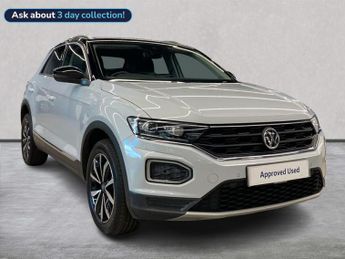
The Volkswagen T-Roc is a shining example of basics done right. It is easy to live with and comfortably to drive, while offering adequate space, modern features and a cabin that feels premium. It is everything a compact SUV buyer is looking for. So, even in a crowded space, the T-Roc stands out for its no-nonsense approach.
Adithya Gopal
Adithya Gopal

Adithya is the Content Editor at AA Cars and a Motoring Journalist, with over 1,000 published articles across numerous publications.

Read bio

4.4/5

How much does a Volkswagen T-Roc cost?

Prices for the entry-level ‘Life’ model start at £31,990, before a significant leap to the mid-range ‘Style’ trim, which will set you back £36,660, according to VW’s online configurator tool. The sportier-looking ‘R-Line’ version that we tested sits at the top of the range and pushes the price closer to the £40,000 mark, with prices starting at £39,155.

As the current T-Roc is new, used examples are only starting to appear. However, we have many 2026-model-year T-Roc R-Line cars priced at around £37,000. If you’re looking for the previous-generation T-Roc, three-year-old examples start at around £15,000 on AA Cars.

Engine and performance

Overview

The Volkswagen T-Roc is only available with one engine option:

  • 1.5-litre four-cylinder turbo petrol engine, with a 48-volt mild-hybrid system: 115/148 bhp, paired with a 7-speed DSG automatic. (0-62mph: 8.9 - 10.6 seconds).

Volkswagen has announced two full-hybrid T Roc versions for the fourth quarter of 2026, but these have not been launched at the time of writing.

Volkswagen T-Roc performance

Out on the road

When the industry is moving towards electrification and strong hybrids, the T-Roc manages with a normal petrol engine and a mild-hybrid setup. So, if you’re looking for a straightforward driving/ownership experience, the T-Roc suits the purpose.

We tested the 1.5 eTSI engine producing 148hp. The engine gets a minor torque boost from the mild-hybrid system, so response off the line is immediate, although not instant like an EV. There’s enough torque below 3,000rpm to get going, and the T-Roc is happy to potter around town. Although the engine offers enough punt, overtaking or quick acceleration requires it to spin at higher speeds. However, this is rarely an issue, as it does not sound strained at high revs.

The gearbox works efficiently to optimise the engine’s low-down torque and tries to change up quickly. Press the throttle, and the gearbox is also happy to drop down a gear without hesitation. At low speeds, the engine can deactivate two cylinders to improve fuel consumption or shut down while coasting. All of this happens smoothly in the background and never really affects driveability.

The T-Roc, even in 148hp form, is not a quick SUV. There are various driving modes on offer, but, in essence, its performance is adequate for everyday driving and most situations. We recommend the 148hp version over the 115hp version, as it offers noticeably more performance without drastically affecting fuel economy.

Volkswagen T-Roc on the road

What is the ride quality like?

The T-Roc’s ride and handling characteristics can be described as inoffensive. It doesn’t involve or engage the driver, nor does it offer a ride quality that can be described as plush. In a way, it strikes an acceptable balance. For instance, the ride quality is comfortable and compliant, and the T-Roc feels reassuring over broken surfaces and bumps. The ride never feels floaty at motorway speeds, and there’s a hint of firmness at all speeds. Large bumps tend to induce some vertical movement, but it doesn’t feel unsettling.

Meanwhile, around corners, the T-Roc feels natural and behaves exactly as you’d expect a compact SUV to. There’s body roll, but it is well contained, and the car offers just the right amount of grip and poise to keep everything safe and controlled. The handling is predictable, and the T-Roc deals with direction changes well without unsettling its composure. The steering weighs up with speed, but it is devoid of any feel from the front-end.

The brakes can initially feel a bit wooden due to the regeneration, but it’s only a matter of time before you get used to them. Nevertheless, there’s still a slight spongy feel, which may not suit every driver. Overall, the T-Roc does not sit at either extreme. That balance is remarkably difficult to achieve, and it allows the T-Roc to cater to a broad audience.

Volkswagen T-Roc ride and handling

What are the features of a Volkswagen T-Roc?

Interiors

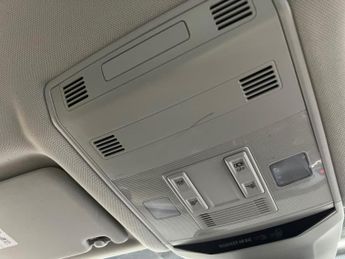
Volkswagen has taken a major step forward with the cabin of the new T-Roc, replacing the majority of the cheaper plastics found in the previous car. Straight away, everything feels more premium than before, with the highlight being the crisp 12.9-inch infotainment touchscreen, which dominates the dashboard. Life models get an 8-inch Digital Cockpit, while Style and R-Line receive a 10.25-inch Digital Cockpit Pro, adding to the cabin’s modern feel.

Elsewhere, there are enough soft-touch materials on show, with different textures used throughout the cabin instead of scratchy plastics. There is also a clever use of physical controls, such as a central dial for volume and drive-mode selection, which does a good job of reducing reliance on the touchscreen.

Volkswagen T-Roc interior

Boot space and practicality

The T-Roc offers a boot capacity of 475 litres, compared with 445 litres in the outgoing model. The space itself has an adjustable floor, which allows you to remove the load lip and makes it easier to get larger items in and out of the boot. The boot also includes a couple of tie-down points and a 12-volt socket for extra practicality.

Inside, there are plenty of storage solutions, including several well-thought-out cubbies and cupholders, which give the second-generation car greater everyday usability than its predecessor. Rear passengers also enjoy good headroom, decent kneeroom and reasonable under-thigh support for this segment, making longer journeys more comfortable than in some smaller rivals.

The front seats are also well sized, with the right amount of under-thigh and lateral support. Long journeys in the T-Roc should be comfortable, thanks to the supportive seats.

Volkswagen T-Roc boot space and practicality

Features

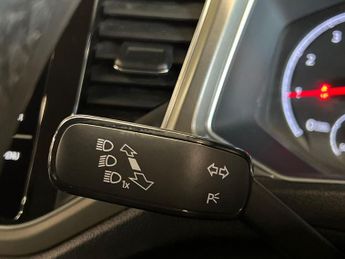
As with most modern Volkswagens, the new T-Roc offers a good level of kit. Standard equipment typically includes LED headlights and taillights, a digital cockpit display, a large central touchscreen infotainment system, Apple CarPlay, Android Auto, adaptive cruise control and Travel Assist, an advanced driver-assistance package that also supports lane changes.

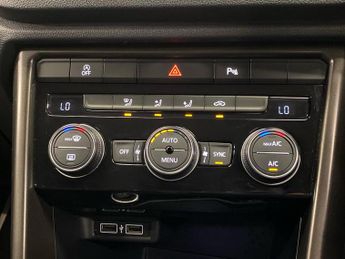
As you move through the trim levels, you begin to see even more premium touches. These include a heated steering wheel, heated seats, three-zone climate control, dynamic headlight-range control with a dynamic cornering light, and Park Assist Plus with Park Distance Control.

There’s also a wide range of options available. Highlights include adaptive chassis control (£775), panoramic roof (£1,170), Harman Kardon sound system (£600), which is a worthwhile upgrade if you appreciate a detailed soundstage, strong bass and crisp vocals, leather comfort pack (£2,285) and an electric tailgate (£345).

Volkswagen T-Roc feature

What are the trim and colour options?

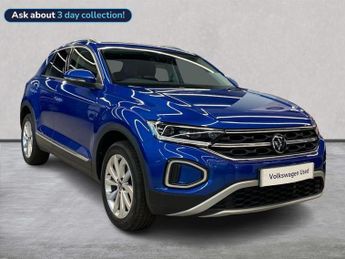
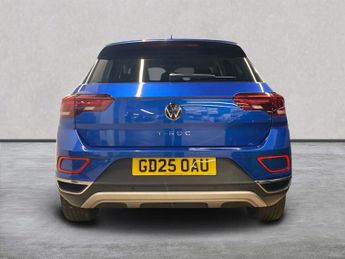
The T-Roc is currently available in Life, Style and R-Line trim levels, which each offer varying levels of tech. However, with even the basic cars coming well-equipped it could be worth considering the Life edition, given the hefty price gap to the next trim level. Colour options include Canary Yellow, which is free, as well as Celestial Blue, Flame Red, Grenadilla Black and Wolf Grey which each cost between £830 and £990.

Volkswagen T-Roc trim and colour

How safe and reliable is the Volkswagen T-Roc?

The T-Roc offers a good level of safety equipment as standard. All cars get autonomous emergency braking, Lane Assist and adaptive cruise control. The car recently underwent safety testing by Euro NCAP, where it was awarded a five-star rating.

All the driver-assistance features worked well during our test, without constant warning sounds or alerts. The adaptive cruise control also followed the car ahead effectively, while identifying different vehicle types, including lorries and motorcycles.

We also tried the Travel Assist driver-assistance system, which assists with steering inputs and supported lane changes. Although it worked well in most situations, we encountered an issue where the system made more steering corrections than seemed necessary at crawling speeds while following traffic on the busy M1. The car stayed within its lane throughout, but the behaviour felt unusual.

Volkswagen T-Roc safety and reliability

What are the MPG, emissions and tax like?

Volkswagen claims that the 1.5-litre engine in the new T-Roc will return between 47 and 51mpg. In our mixed-road test, we saw figures in the mid-40s. Meanwhile, CO₂ emissions range between 125 and 137g/km, placing the T-Roc roughly in line with most of its competitors.

Current T-Roc versions emitting around 127–129g/km attract £455 in first-year VED under 2026–27 rates. From the second licence, the standard annual rate is £200. Cars with a relevant list price above £40,000 also pay the £440 Expensive Car Supplement for five years.

Volkswagen T-Roc MPG, emissions and tax
Browse 1,700 in stock