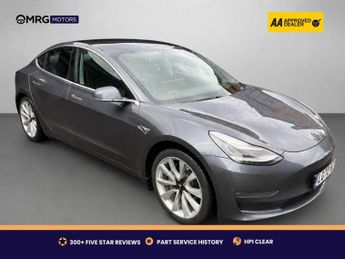
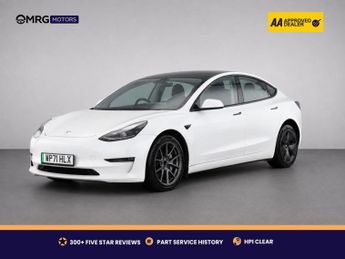
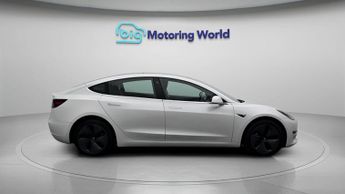
Specifications

Fuel types
Electric
No of seats
5
Boot space
425 litres
Dimensions
4,720 mm x 1,848 mm x 1,441 mm
Fuel economy
Up to 323–445 miles WLTP (Electric, depending on model)
Acceleration (0-62mph)
2.9 - 4.9 seconds
Insurance group
36 - 50
Body style
Saloon
CO2 emissions
0 g/km
Browse 311 in stock

AA Mechanic review

When buying a used Tesla Model 3, focus on battery health, software history, build quality and ownership records. Check the real-world range, charging behaviour, Supercharger access and remaining warranty. On a test drive, the car should accelerate smoothly, brake cleanly through regeneration and drive without suspension knocks, steering vibration or warning messages.
Allen Childs
Allen Childs

Allen Childs is a Regional Manager at The AA, with extensive experience in roadside assistance, vehicle repair, recovery operations, team development and operational leadership.

Read bio

4.5/5

Repairs

The Tesla Model 3 is generally reliable, with most issues linked to suspension, tyres, software or trim rather than the battery or drive unit.

Common issues include:

• Suspension wear, including control arms and wishbones with high mileage

• Knocking or clunking over bumps

• Uneven tyre wear, especially on Performance models

• Screen freezing, lag or camera faults

• Sensor or Autopilot calibration issues

• Charging port faults or inconsistent charging

• Wind noise, water ingress or trim alignment issues on some earlier cars

• Low-voltage battery issues if the car has been left unused for long periods

Battery failure is rare. Degradation is usually gradual, so sudden range loss or inconsistent charging needs further investigation.

Maintenance

Tesla Model 3 maintenance is different to a petrol or diesel car. Tesla says its vehicles do not need traditional oil changes, fuel filters, spark plug replacements or emissions checks, and the car can show maintenance information through its touchscreen.

Key maintenance to keep on top of includes:

• Tyre pressure, tread and alignment checks

• Tyre rotation at the recommended interval

• Cabin air filter replacement every 2 years

• Brake fluid health check every 4 years

• Brake calliper cleaning and lubrication where needed, especially in areas where roads are salted

• Software updates

• Heating, cooling and heat pump checks on 2021-onwards cars

Is the Tesla Model 3 a reliable car?

The Tesla Model 3 is a strong used electric car choice. It has quick performance, low routine servicing needs and a simple ownership experience once you’re used to the touchscreen-led interior.

After many years, most issues are likely to be tyres, suspension wear, software glitches, trim faults or low-voltage battery problems rather than major EV drivetrain failure. A Model 3 with good battery health, clean history, active charging access and no warning messages is a safe used buy.

Browse 311 in stock

AA Cars review

The Tesla Model 3 remains a clear tech leader in the electric vehicle market, offering plenty of interior room, an effortless drive, a reliable charging network and cutting-edge infotainment. However, the interiors can feel a bit soulless compared to other manufacturers and the technology can often be difficult to navigate
Jack Evans
Jack Evans

Jack is an experienced motoring journalist who has been covering the latest new-car releases for the last 10 years.

Read bio

4.1/5

How much does it cost?

The recently facelifted Model 3 now starts at £39,990 and extends to £59,990 for the range-topping Performance All-Wheel Drive version. However, the used car market is very tempting for those looking to snap up a bargain, with prices as low as £16,000 for a 2020 Standard Range Plus model on AA Cars. Recent reports suggest older electric vehicles retain more than 90% of their battery life, even at high mileage, so don’t be afraid to shop pre-owned.

Engine and performance

Overview

Tesla offers a broad selection of battery sizes and electric motor configurations, which in turn impacts the maximum possible range and the sort of performance you can expect. The 2019 Model 3 was initially available with a Standard version that, in its later UK specification, produced around 283bhp and approximately 450Nm of torque from its single rear motor and delivered around 254 miles of range.

The earlier Long Range version with dual motors developed roughly 346bhp and about 527Nm, extending the WLTP range up to around 410 miles in all‑wheel‑drive guise. There was also a Performance variant that combined dual motors for rapid acceleration and keen dynamics, producing around 460bhp and approximately 660Nm of torque, with a 0–62mph acceleration in the low 3‑second bracket. Updates in 2020 and in subsequent years introduced changes in battery chemistry and efficiency that shifted the balance further toward range and refinement.

The most recent 2025 update, which brings significant exterior design changes and improved overall build quality, now brings with it the most impressive WLTP ranges — around 332 miles for the entry‑level Rear‑Wheel Drive variants, around 410 miles for the Long Range dual‑motor all‑wheel‑drive option, and around 354 miles for the Performance model — while still retaining the strong performance figures that have become expected from Tesla’s engineering. Fans of breakneck acceleration can still opt for a Performance version that dispatches the 0–62mph sprint in just 2.9 seconds thanks to its high‑power dual‑motor layout.

Tesla Model 3 performance

Out on the road

Electric vehicles rarely want for additional performance and even the most basic Model 3 will feel surprisingly peppy compared with similarly‑sized combustion‑engine hatchbacks and saloons. Acceleration is strong but the Model 3 also makes a great motorway cruiser.

But while there is an impressive amount of interior roominess and a large boot across the line‑up, older Model 3 cars were never renowned for their ride quality or refinement. They can be noisy at higher speeds.

This has gradually improved over the years with several updates and the latest iteration is by far the smoothest and most refined to date. Although Performance models offer breathtaking acceleration, they are no replacement for a true sports car thanks to light and vague steering, relatively soft body control and very little brake feel underfoot. Great for sprints away from the traffic lights, but very little else.

Tesla Model 3 on the road

Ride and handling

As a tool to get from A to B, it is very difficult to fault early Model 3s, as they deliver a perfectly acceptable driving experience for most. Granted, the overall refinement, ride quality and build aren’t as strong in pre-2021 cars but things improve considerably after this point. In fact, the most recent version, particularly in Performance trim, does a much better job of tackling faster corners, offering more feel through both the steering wheel and the brake pedal thanks to the wider bandwidth of several driving modes.

For once, these make a tangible difference to steering, suspension and braking. But overall, the driving experience is designed to be as simple as possible, with ultra-lightweight steering making it a doodle to thread through busy cityscapes and a hushed, comfortable cabin ensuring those onboard arrive fresh from longer road trips.

Tesla Model 3 ride and handling

Interior and features

Interiors

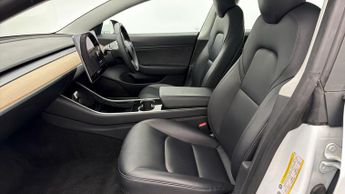
Tesla’s reductionism was revolutionary when it first appeared on the market, committing almost every conceivable function to he massive central touchscreen. It is now more commonplace among EV rivals but prodding around the touchscreen to adjust mirrors or activate windscreen wipers could still prove too much for some buyers.

Plus, it is undeniably distracting when trying to operate while driving. The sparseness continues throughout the remainder of the cabin, with a very simple dashboard, door handle and seat design.

Those that enjoy the flair of, say, the recent Renault 5 E-Tech, will likely be disappointed. But Tesla cabins are functional, comfortable and premium-feeling in higher trims, with many trim levels offering things like a touchscreen for rear passengers, a fantastic sound system and a beautifully airy panoramic glass roof that assists in both brightening the cabin and making it feel more spacious.

As with the overall build and ride quality, Model 3 interiors have received numerous updates over the years, with the most recent 2025 cars now featuring classier faux-leather seats with heating and ventilation, for example.

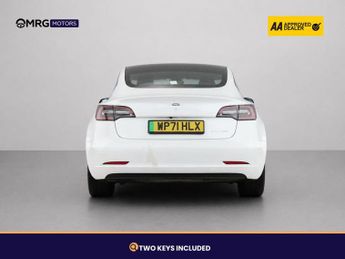
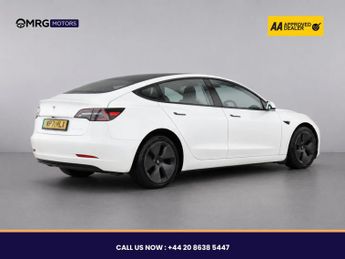
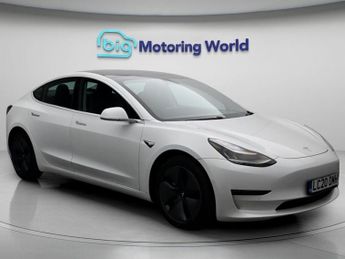
Tesla Model 3 interior

Boot space and practicality

Despite the Model 3 mixing it with rival executive saloons, which traditionally don’t have the largest or most practical boots, there is a surprising amount of stowage space on offer.

Depending on the model year, the rear boot offers between 425 and 591 litres of space, with an additional 88 litres available in the cavernous space underneath the bonnet, often referred to as the front trunk or ‘frunk’.

All doors open wide, making ingress and egress easy, although Tesla’s pop-out door handles have come under fire for their practicality. Prone to getting stuck in cold weather and generally confusing to operate, they are no replacement for a good old-fashioned door handle.

Tesla Model 3 boot space and practicality

Features

Tesla keeps its trim levels relatively simple, with the only real choice being from a small selection of paint finishes. Wheel designs change with the trim level, with the flashiest 20-inch Warp wheels only coming with Performance All-Wheel Drive models; everything else rides on 18-inch wheels as standard, with an optional 19-inch wheel available.

Ultra-suede interior fabric now comes standard across the range, with carbon-fibre elements added to Performance models, while power-adjustable seats, interior ambient lighting and an 8-inch touchscreen for rear occupants also come as standard on all trim levels.

Tesla’s main approach with optional extras focuses on software, with Enhanced Autopilot and (Supervised) Full Self-Driving offered as expensive cost extras. These introduce increasing levels of autonomy when it comes to cruise control, with the most advanced levels able to automatically change lanes on the motorway and stop at traffic lights. Arguably the purveyor of over-the-air updates, Tesla also promises to introduce new features as and when they are ready via software updates.

Tesla Model 3 feature

Trim and colour options

There is very little in terms of individual trim options when it comes to Model 3, with only the various battery sizes and motor outputs altering the wheel and interior finishes.

Customers can select from a number of paint options, a black or white interior, as well as the choice of larger 19-inch wheels across the range, but much of the decision comes down to the level of self-driving functionality you want. Tesla also offers a number of official accessories, which in use things like a tow hitch, roof racks and boot liners.

Tesla Model 3 trim and colour

Safety and reliability

Euro NCAP has consistently awarded the Model 3 a full five-star rating, with the most recent iteration scoring 90 per cent for adult occupant safety and 93 per cent for child occupant safety. However, build quality and reliability varies across the various generations and facelifts, with earlier vehicles susceptible to cosmetic wear, paint defects and panel gaps that can cause leaks. Many of these issues have been addressed over time and, thanks to being an EV, general maintenance and upkeep is much cheaper and easier than an internal combustion engine vehicle.

Tesla Model 3 safety and reliability

MPG, emissions and tax

Thanks to its use of electric motors and battery packs, the Tesla Model 3 emits nothing in the way of local CO₂ emissions. There is also no need to worry about an MPG figure, as real-world electric range is more important. Tesla is very good at maximizing efficiencies and its predicted range read-outs are reliable, meaning drivers can be assured that they will get to their destination if Tesla’s advanced route planning says so. Range varies widely among generations, though, with around 250 miles common on early cars, while the 2025 Model 3 can manage in excess of 445 miles.

Tax for electric vehicles can be confusing, especially now the government is touting a potential pay-per-mile tax for EV users. But for now, the first year of Vehicle Excise Duty (VED) is £10, followed by a standard rate of £195. There is also a £425 per year Expensive Car Supplement to consider for any new Model 3 that costs more than £40,000, although the government is lifting this to £50,000 in the future.

Tesla Model 3 MPG, emissions and tax
Browse 311 in stock