
Specifications
- Fuel types
- Petrol hybrid
- No of seats
- 5
- Boot space
- 319 litres
- Dimensions
- 4,355mm × 1,790mm × 1,582mm
- Fuel economy
- 52.3 mpg
- Acceleration (0-62mph)
- 10.6 - 10.7 seconds
- Insurance group
- 30 -31
- Body style
- SUV
- CO2 emissions
- ~122 g/km


These days, there are few segments more crowded and competitive than the compact SUV market. It seems like every carmaker is having a go at cracking this lucrative sector. And Honda’s trying to do the same with Honda HR-V. In a busy segment, it still manages to stand out for its clever interior layout, compact footprint, and smooth hybrid powertrain. While it may not be as sporty as others, the HR-V does represent a decent all-round package.
AA Cars Rating: 3.9/5
How we test carsWhen buying a used Honda HR-V, start with a full service history, ideally from Honda or a trusted specialist. On a test drive, the hybrid system should feel smooth around town, with no warning lights or hesitation from the e-CVT gearbox. Check the bodywork, tyres, brakes, infotainment and driver assistance systems, and consider a pre-purchase inspection before committing.

Alexander Gur is a Roadside Patrol at The AA, with more than 20 years of hands-on experience across garage and roadside roles, as well as a strong personal interest in performance cars.
Read bioThe third-generation HR-V is generally reliable, helped by Honda’s well-proven e hybrid system.
Most issues are minor, but a few checks are still worth making.
Areas to watch include:
The engine and hybrid system are usually dependable. If the car feels jerky, slow to respond or shows hybrid warning lights, get it checked before buying.
The HR-V benefits from regular oil changes, especially as the 1.5 petrol engine uses direct injection. Changing the oil every 5,000 to 7,500 miles can help reduce carbon build-up and keep the engine in good condition. It’s also sensible to change the CVT fluid around every 25,000 miles, even if the gearbox feels smooth. Clean gearbox fluid helps protect shift quality and long-term reliability.
Useful maintenance points include:
Insurance can be a little higher than some compact SUV rivals, and CVT fluid changes are an ownership cost buyer sometimes overlook.
A well-maintained HR-V should hold up well. The hybrid system reduces strain on the petrol engine in everyday driving, especially around town.
The best examples have clear service history, smooth e-CVT operation, no warning lights and a healthy 12-volt battery. The HR-V is not the most exciting SUV to drive hard, but as an efficient, comfortable and easy-going used car, it makes a lot of sense.
The Honda HR-V is a relatively practical, efficient, and sensible hybrid SUV. It prioritises real-world usability and comfort over sportiness, making it a strong contender for families and city drivers alike. While it may not impress with raw performance or maximum boot space, it delivers a reliable, well-equipped package for everyday life.

Jack is an experienced motoring journalist who has been covering the latest new-car releases for the last 10 years.
Read bioHonda has positioned the HR-V to sit in between small, budget SUVs and larger, more premium models and as such, the basic Elegance model kicks off at £31,495. There are then four subsequent trim levels, offering varying levels of safety, luxury and tech features, which get underway at £33,995; £37,195; £37,645 and £37,995. While these prices are higher than many of its compact rivals, the HR-V’s incredibly efficient hybrid powertrain does mean that running costs will be kept low.
If you are looking for value on the used market, second-hand versions of the pre-facelifted car can be picked up on AA Cars for as little as £16,000 with post-2024 models starting at closer to the £20,000 mark.
Since launching the current car in 2021, Honda has only offered the HR-V as a full self-charging hybrid. The system partners a 1.5 litre petrol engine with an electric motor, to produce 129 bhp. The performance is smooth and efficient, particularly at lower, inner-city speeds, but the engine does get incredibly loud when you put your foot down to build up speed. Overall the HR-V can do 0-62 in 10.6 seconds and achieve a top speed of 106mph.
The HR-V has been designed with city dwellers in mind and as such, the car is by far the most at home when it's in urban and suburban environments. The hybrid system’s electric motor provides excellent assistance in stop-start traffic, making short journeys effortless and quiet. At those inner city speeds the petrol engine also works well to provide a calm and predictable experience.
Where the Honda does begin to struggle is when you take it out of town and head for the motorways, where a lack of speed and acceleration does become a bit of an issue. Overtaking does take some forward planning and when you do push hard on the accelerator you are greeted by an almighty racket from the engine. This is a fairly common fault with hybrid cars like this one, but the noise is particularly noticeable and unpleasant in the HR-V.
Despite this, the Honda is competent enough for the majority of driving scenarios. It has light and responsive steering, which makes manoeuvring the car nice and easy, as well as an elevated driving position, which offers good visibility out onto the road. Overall, the HR-V feels composed and predictable, making it a viable choice for everyday driving.
Honda has set the HR-V up to be comfortable rather than sporty and for most drivers that is a good thing. It means that the car has been given soft and forgiving suspension which allows the car to pass over speed bumps, potholes, and uneven surfaces without too much jolting for those inside. The Japanese model is well-suited to everyday life and offers a ride that works perfectly whether you are on the school runs, commuting, or cruising along the motorway.
On the flip side, the car does have its limitations, which are clear to see when the road becomes tighter and bendier. Through the corners, the HR-V suffers from fairly noticeable body roll and a lack of feedback from the steering does little to inspire confidence. That being said, as long as you are sensible and drive the HR-V in the way it was designed to be driven, then you shouldn’t have too many issues.
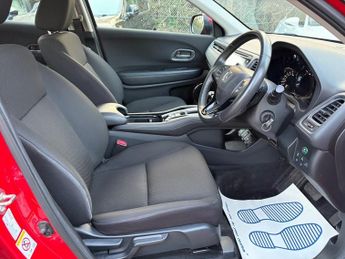
The HR-V has a modern and well-designed cabin, which varies noticeably depending on which trim level you go for. On lower spec cars, the interior materials are functional rather than luxurious and there are several cheap-feeling plastics throughout the cabin. However, as you move up the range this changes significantly, with higher spec cars given more premium touches including synthetic leather and soft-touch surfaces.
Up front, the dashboard is home to a 9-inch touchscreen infotainment display, while underneath are welcome physical dials for the climate control. The front seats are comfortable and supportive, offering an excellent view of the road without feeling as though you are towering over other motorists.
In the back, passengers benefit from Honda’s ‘Magic Seats’, which fold in multiple configurations to give maximum room. There is also adequate space for two adults to stretch their legs behind the front row of seats, although headroom is a concern for anyone over six feet tall. This is especially true in the raised middle seat, which is best reserved for short trips.
For a car aimed at the family market, the HR-V does struggle when it comes to practicality. Its 319 litre boot is closer to hatchback levels than an SUV, with space only marginally bigger than that offered in the significantly smaller Vauxhall Corsa (309 litres). This is largely as a result of the hybrid system’s battery pack, which sits at the rear of the car, eating up space that could otherwise be used for suitcases or a weekly shop. To get around this, you could fold the magic rear seats flat, which expands the load space to 1,289 litres. The bases of the magic seats can also flip up to create a tall vertical storage area behind the front seats. While this is a very helpful solution, it doesn’t entirely make up for the lack of boot space.
Inside the cabin itself, there are plenty of sensible storage solutions, but none of them are particularly generous. There are small, shallow door bins, cupholders, and various cubbies dotted around the car but overall the HR-V does lag behind a number of its competitors on this front.
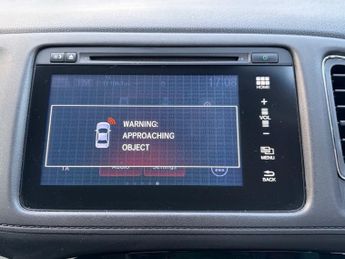
Japanese cars do tend to offer a good level of standard tech and the HR-V is no exception to the rule. Even the most basic models come with a 9-inch infotainment touchscreen, wireless Apple CarPlay and Android Auto, LED headlights, rear parking sensors and a reversing camera. This all works well, although the screen quality is perhaps a little short of what we have come to expect on modern cars.
On higher trims, Honda ramps up the comfort and convenience with options including synthetic-leather upholstery, a powered tailgate, heated front seats, upgraded infotainment, and additional driver aids.
The HR-V is available in Elegance, Advance, Advance Style, Advance Plus and Advance Style Plus trim levels, all of which get a good level of tech and comfort. Prices leap fairly significantly once you go past the standard Advance model but this is still the one we’d go for. The spec offers a few touches not seen on the most basic Elegance car – like a powered tailgate, dual- zone climate control and a heating steering wheel – but is priced far more reasonably than the more premium editions of the HR-V.
Exterior colour options include Crystal Black, Platinum White, Lunar Silver, Energy Blue, Passion Red, and Midnight Grey.
Safety is another of Honda’s major strengths and that has continued in the HR-V. The model comes with the brand’s standard ‘SENSING’ suite of features which includes autonomous emergency braking, adaptive cruise control, lane-keeping assist, lane departure warning and driver attention monitoring.
Reliability is also a strong point with existing owners reporting strong build quality and dependable service from Honda’s network of UK main dealers.
The hybrid powertrain is very much the feather in the HR-V’s cap, with an official mpg figure of 52.3 mpg. While drivers in the real world are unlikely to actually achieve this, owners have reported returns in the high 40s which is still an outstanding figure for a car of this kind. Combined with just 122 g/km of CO₂ emissions, the HR-V is one of the best cars in its segment for fuel economy.
As a result, owners are able to keep running costs down, which is also helped by affordable insurance groups, low maintenance bills, and modest tax implications. At a time when many car buyers want to do their bit for the planet, but have concerns about electric car charging, the hybrid HR-V is capable of offering the best of both worlds.

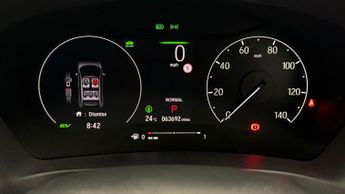
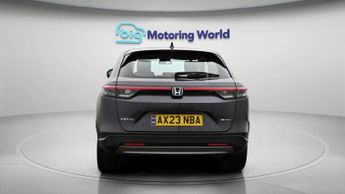
 London
AA finance available

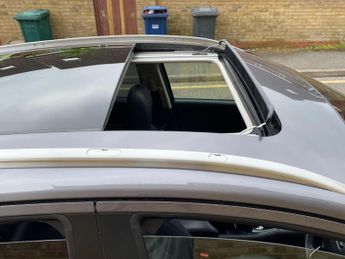
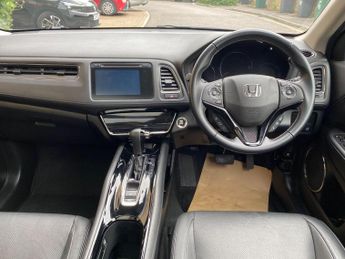
London
AA finance available

Wembley
Connect with us


