
Specifications
- Fuel types
- Electric
- No of seats
- 5
- Boot space
- 400 litres
- Dimensions
- 4,800 mm x 1,875 mm x 1,450 mm
- Fuel economy
- 354 miles
- Acceleration (0-62mph)
- 3.6 - 5.9seconds
- Insurance group
- 48 - 50
- Body style
- Saloon
- CO2 emissions
- 0g/km


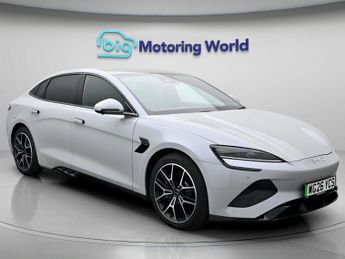
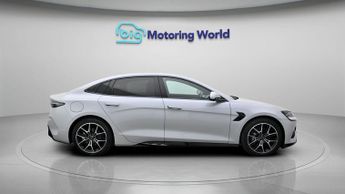
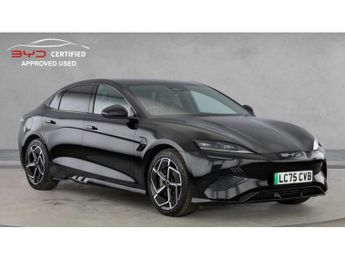
BYD has quickly risen to become one of the go-to names in the world of electrified vehicles, despite being a relative newcomer here in the UK. The Seal was one of its first offerings in this country and while being a more traditional saloon car compared with the brand’s mainly SUV-dominated line-up, it’s one which offers lots of range and a very comfortable interior.
AA Cars Rating: 4/5
How we test carsThe BYD Seal shows that the days of the humble saloon car definitely aren’t over, while with its good electric range and high level of refinement, it’s a model which gets a premium edge both inside and out.

Jack is an experienced motoring journalist who has been covering the latest new-car releases for the last 10 years.
Read bioPrices for the BYD Seal kickstart from £45,705 for a standard Design model, rising to a range-topping Excellence model, which comes in at £48,705. The former gets rear-wheel drive as standard, while the latter is a more performance-oriented version with all-wheel drive instead. There are some savings to be found by shopping on the used market, however. Check out AA Cars now and there are range-topping Excellence models with just 8,000 miles on the clock for £36,995, or Design cars which start from £33,699 with under 4,000 miles on the odometer.
The BYD Seal is a solely electric vehicle and unlike some of this brand’s other vehicles, it isn’t available with hybrid options. Things kick off with a single motor version, which powers the rear wheels alone. It’s got a range of up to 354 miles from a single charge, too, whereas the dual-motor version sees this drop to 323 miles instead. However, performance does differ between the two; the more powerful dual-motor version will get from 0-60mph in 3.5 seconds, besting its single-motor stablemate’s 5.6-second sprint time by some margin. Both cars get a maximum charge speed of 150kW, which will mean a 10 to 80 per cent charge in around 38 minutes. This is a little behind key rivals, however, with the Hyundai Ioniq 6, for instance, able to manage up to 220kW. The Seal does have some handy space under the boot floor to keep the charging cables neatly packaged away, too.
The Seal feels like the perfect example of how electric propulsion should be experienced. It’s a very refined car, with minimal wind noise when you’re travelling at speed. As a result, it’s very quiet and comfortable, and feels every bit the traditional executive saloon car. The single motor might be the slower of the two but its performance is still more than adequate, while the dual-motor version really does bring some sports car-like thrills overall. Visibility isn’t too bad, either, though your view rearward isn’t helped by the Seals rather small back screen. However, you do get plenty of cameras and sensors equipped as standard to help combat this problem.
The Seal offers a refreshing alternative to the usually firm-riding options that reside in this class. It’s comfortable and does a good job of absorbing those lumps and bumps in the road, though rougher surfaces do create quite a bit of tyre roar. However, once you’re at speed, the Seal feels very much at home and it’s a great car in which to travel long distances as a result. The steering is relatively light for a car of this type, too, but this helps it to feel more nimble through the bends. Body control is good, too, and because of the car’s lower centre of gravity compared to a typical SUV, it feels more natural when you’re cornering as well. Interior and features
There’s plenty of tech to explore inside the cabin of the Seal. Things are centred around the 15.6-inch infotainment system which sits in the middle of the dashboard, but the good news is that this is surrounded by good materials overall. You can also rotate the screen between landscape and portrait orientation, should you want to. The display itself also feels solidly mounted and doesn’t flex whatsoever when operated. Material-wise, the Seal does well, too, though there are some scratchier plastics dotted lower down the cabin. However, these are located in areas prone to grazes when exiting and entering the vehicle, so they’re not too bad and don’t disturb the otherwise well-finished feel to the interior.
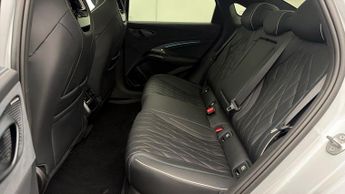
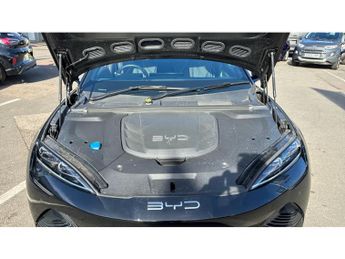
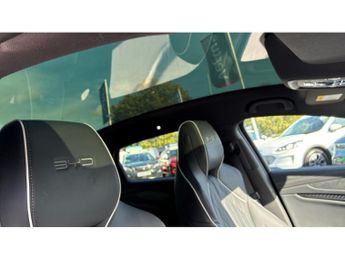
The Seal is a reasonably compact saloon car, but it still does well in terms of outright space. Up front, both driver and passenger have a good view of the road ahead and the seats themselves are comfortable and well-cushioned. In the back, a completely flat floor helps to boost legroom further and headroom isn’t bad either, despite a panoramic sunroof. Practicality is decent, too, with plenty of storage dotted throughout the Seal’s cabin. There are well-sized door bins, for instance, and a useful charging pad with space for two devices up front. In terms of boot space, the Seal offers up 400 litres and this is added to by the car’s useful 53-litre ‘frunk’ which can be either used as additional storage, or a spot to place the charging cables when not in use. There’s plenty of flexibility in this car’s storage solutions, that’s for sure.
BYD models are always jam-packed with features and it’s no different in the Seal. Standard equipment on the Design model includes 19-inch alloy wheels and a full-length panoramic sunroof, which really does help the cabin to feel lighter and more spacious. You’ve got that 15.6-inch rotatable touchscreen, too, which gets both Apple CarPlay and Android Auto as standard. It’s worth adding that both of these features can only be used when the screen is in landscape mode, mind you. Excellence cars build on this with a head-up display which relays all key information ahead of the driver. A clever addition that you get with this model is vehicle-to-load, too, which allows you to use the car’s on-board power supply for external devices, such as an electric air pump or even a small outdoor speaker system for a party.
Things are kept nice and simple with the BYD Seal’s trim levels - there are just two. However, both of these models get a similar standard of equipment, with the powertrain separating the pair instead. The Design model, as mentioned, has a rear-wheel-drive setup, whereas the Excellence gets dual motors for all-wheel-drive traction and more performance. All cars get a panoramic sunroof and 19-inch alloy wheels, as well as a 15.6-inch rotatable touchscreen which is jam-packed with features. All cars get a 12-speaker sound system, too.
The key difference equipment-wise in the switch to Excellence is the addition of a head-up display, which gives the Seal a more futuristic feel inside while helping to make key information easier to see. In addition, Excellence-grade cars get the vehicle-to-load functionality, so you’ll be able to use it to power external devices. Both cars also get the option of either Tahiti Blue or Black for the interior, too. When it comes to external colours, there are five to choose from, though they’re all rather subdued. Two greys, a blue, a white and a black make up the palette, so if you’re looking for something more outlandish, you might have to head elsewhere.
The BYD Seal gets an enormous amount of safety equipment as standard. As well as traditional features such as driver, front centre and side curtain airbags, it’s got ISOFIX child seat mounting points for the two outer rear seats and - as a bonus - one on the passenger seat, too. It’ll make it more flexible for people looking to take their kids along for the ride. You’ve also got blind spot detection, lane change assist and adaptive cruise control, alongside automatic emergency braking and forward collision warning. In essence, nearly every modern safety feature that you could think of is equipped to the Seal. In terms of reliability, the Seal is still in somewhat uncharted waters. However, though BYD is a newcomer to the UK, it has been a leading battery creator for decades, so can’t imagine this car’s key components suffering from many issues over time.
As an electric vehicle, the BYD Seal emits zero CO2, so it’s very friendly emissions-wise. When it comes to pricing, this will really depend on how you’re able to charge this electric car; make use of a special EV-friendly home energy tariff and it could be charged up for a fraction of the cost of what it would be to fill up an equivalent petrol or diesel car, though public charging prices are quite high in comparison. Since all versions of the Seal cost over £40,000, you’ll need to add the Expensive Car Supplment to the car’s road tax bill. This means you’ll be paying up to £620 a year for the first five years of registration, though it’ll drop considerably after that point.
 Camberley

Bedford
Worcester
Connect with us


