
Specifications
- Fuel types
- Plug-in hybrid
- No of seats
- 5
- Boot space
- 500 litres
- Dimensions
- 5,391 mm x 1,950 mm x 1,950 mm
- Fuel economy
- 282.5mpg
- Acceleration (0-62mph)
- 4.6 - 9.0 seconds
- Insurance group
- 50
- Body style
- Saloon
- CO2 emissions
- 23 - 27g/km


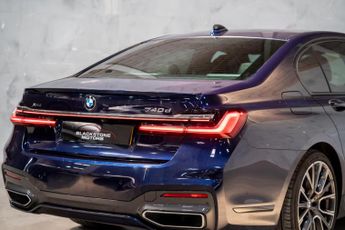
Well-known as one of the very top executive saloons, the BMW 7 Series has been a flagship in this brand’s range for decades. It has come to represent the very pinnacle of what this German brand is capable of, delivering technical innovations that dictate what future models will get. The latest 7 Series comes equipped with a plug-in hybrid, which combines efficiency and performance, too.
AA Cars Rating: 4/5
How we test carsThe 7 Series is the kind of flagship saloon that can make every journey feel extra special. While particularly focused on a First Class experience for those in the back, the person behind the wheel of this sleek BMW still has plenty to enjoy.

Jack is an experienced motoring journalist who has been covering the latest new-car releases for the last 10 years.
Read bioWhen buying new, the BMW 7 Series represents quite an expensive option. Prices start from £101,865 for the Excellence model, rising to £106,365 for the M Sport and topping out at £121,445 for the range-topping M model. As with all BMW models, the 7 Series can quickly become even more expensive through a comprehensive range of optional extras, which are there to choose from.
However, 7 Series models do suffer from quite heavy depreciation, so there’s a definite incentive to shop for a second-hand model. For instance, we found a 2025 model-year 750e xDrive in Excellence trim with just 1,500 miles on the clock for a remarkable £79.975. An M Sport model, meanwhile, with just over 8,000 miles on the clock, could be found on AA Cars for £72,500, too, showcasing a huge saving over a brand-new model.
At present, the standard 7 Series is only available as a plug-in hybrid model. There is an electric version of the 7 Series - badged i7 - but this is seen as a standalone version. It combines a petrol engine with an electric motor and battery. Combined, it brings well over 450bhp, giving the 7 Series all-wheel-drive performance. Plus, with a fully charged battery, the 7 Series can deliver up to 49 miles of electric-only power, making it ideal for driving through the city.
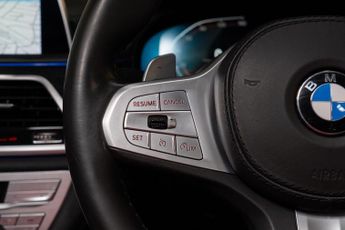
The 7 Series uses an automatic gearbox as standard, though there are also paddles mounted to the steering wheel column if drivers want to change through gears themselves. Earlier examples of the 7 Series were available with standard petrol and diesel engines, so if you need an alternative, you’ll need to look at the used market.
Comfort and refinement are the primary focus in the BMW 7 Series. As a long executive car, it’s designed to whisk across big distances without creating the slightest disturbance inside the cabin and that’s just what this car does. Those in the rear of the 7 Series are treated to a high-quality experience, with the interior of this car being kept incredibly hushed no matter the speed.
It’s good news for the person behind the wheel, though. The 7 Series isn’t too difficult to drive, while the plug-in hybrid setup helps to give this car a little extra ‘zip’ when accelerating. In fact, for quite a lot of the time, the 7 Series feels more like a fully electric model instead of a petrol.
The BMW 7 Series brings an incredibly refined driving experience. The standard air suspension means that the 7 Series practically floats over lumps and bumps in the road, while larger potholes do very little to unsettle things. While the 7 Series is seen primarily as a car to take passengers around in tip-top comfort, it’s still an enjoyable car for the person behind the wheel.
Find a set of corners, and the 7 Series handles things well. However, with its long wheelbase and relatively wide proportions, it’s a car that does take some getting used to. Navigating city streets or getting through tighter lanes requires some patience.
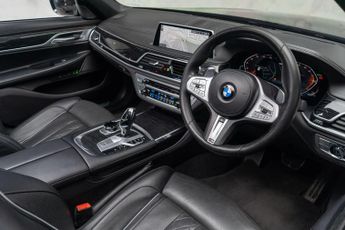
As BMW’s flagship saloon, the 7 Series is finished to a very high standard. There’s a really good combination of high-tech screens and old-school quality building techniques, too, so that each part of the interior that you interact with feels and looks special. The huge curved display which brings together media and navigation functions with a driver’s display behind the wheel looks sharp and is easy to navigate, though it would be nice to have a few more physical controls for elements such as the heating and ventilation.
The 7 Series also incorporates a vast number of coloured elements which can be configured to show a different shade depending on your personal preference. They also reflect certain controls inside the car. For instance, if you activate the hazard warning lights, these lit elements glow red.
There’s loads of space inside the 7 Series in which to stretch out and relax. Those sitting in the back get plenty of legroom and headroom, while certain models also come with premium seats with electric adjustability and a centre console incorporating a variety of media functions. There are also control panels on the door handles, controlling aspects such as the blinds and some interior lighting sections.
Boot space for the 7 Series stands at 500 litres, which is plenty enough for suitcases or some shopping bags. It’s worth bearing in mind that you’ll need to keep the car’s charging cables in here, too, as there’s no dedicated storage for them elsewhere in the 7 Series.
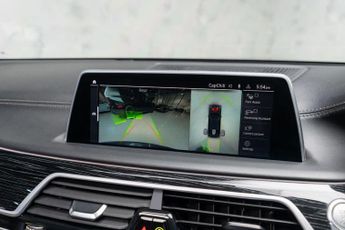
Much of the tech offering in the 7 Series is focused on the large central screens. It’s absolutely packed with features and uses a tile-style setup, which helps to make things a little easier to work out. In truth, the sheer number of apps and features included in the infotainment system can be a little bewildering at times, but you soon get used to it. There’s also a prominent search bar to help you find certain apps more quickly when you need to.
Being a luxurious saloon means that the 7 Series can be equipped with plenty of other features. Rear-seat screens can be included to allow back-seat passengers to watch films, but there’s one extra which really tops the rest. Called ‘Theatre Screen’, it brings a 31.3-inch 8K screen which folds down from the headlining of the car to take up nearly the whole width of the car. Sitting just behind the front seats, this bit of tech feels particularly next-level and provides a theatre-grade way for rear-seat passengers to watch streaming services, downloaded media, or even do work via a connected laptop.
The specifications list for the 7 Series starts with Excellence. This brings four-zone automatic climate control as standard, as well as the aforementioned wraparound infotainment system and a full Bowers and Wilkins surround sound system. Front and rear seat heating also means that everyone on board gets a cosy setup for cold weather, while on the outside, automatic LED headlights and soft-close doors add some extra luxury. A panoramic sunroof is also included on this grade.
Step up to M Sport, and you get a more dynamic-looking 7 Series courtesy of a redesigned grille and 20-inch M alloy wheels. M Sport brakes and a chunky M Sport steering wheel add to that sporty feel, while this grade’s interior camera means you can monitor the interior of the car remotely via a smartphone.
M Sport Pro brings 21-inch alloy wheels, a larger glass sunroof and additional sun protection for the rear windows. After this grade, you’re looking at the range-topping M models, which are only available in electric-only i7 form. It brings added performance and a range of mechanical tweaks in areas such as the chassis and brakes.
As with any BMW, the range of colours available on the 7 Series is extensive. If you’re after more customisation, then BMW also offers a full personal palette of shades to choose from, albeit at an extra cost.
The 7 Series is equipped with plenty of standard safety features, including autonomous emergency braking and a range of cameras and sensors to help make driving this car easier and safer. As you might expect, there’s a broad range of airbags fitted throughout the 7 Series as well.
As is usually the case with previous 7 Series models, the reliability of this latest car is likely to be mixed given its complexity. Given the sheer number of high-tech features and systems, there’s a good chance that upkeep in the future will be relatively expensive. It’s also worth checking that all of these features work properly if you’re looking at a second-hand model.
For such a large car, the 7 Series has quite low running costs thanks to the plug-in hybrid setup. When kept fully charged, the 7 Series can return over 280mpg, though this really will only be achieved through running on electric-only power for nearly all of the time. Emissions of between 23 and 27g/km CO2 are also incredibly low for a car of this size, meaning that taxation shouldn’t be quite as high as you’d usually expect on a car like this.
Of course, the big matter with the 7 Series is its high upfront cost. While lower emissions mean it won’t be as expensive as some premium executive models, its pricing pushes it well beyond the £40,000 threshold for the Expensive Car Supplement, so the first five years after registration will be quite expensive indeed.
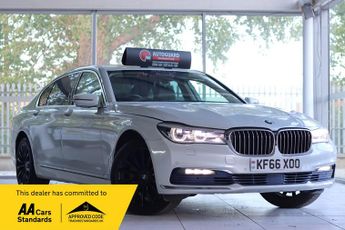
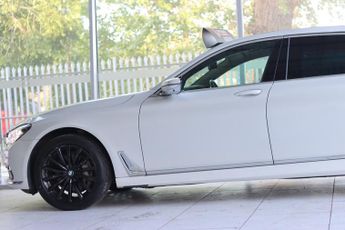
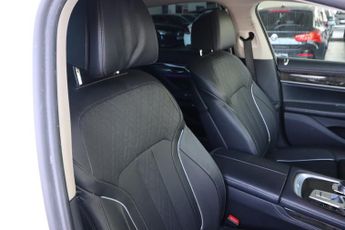
 London
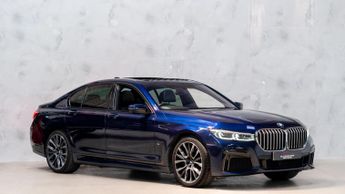
London
London
Connect with us


