Specifications

Fuel types
Petrol, mild-hybrid petrol, diesel, mild-hybrid diesel, petrol plug-in hybrid
No of seats
5
Boot space
480 litres (Saloon) / 500 litres (Touring)
Dimensions
4,714 mm x 1,827 mm x 1,446 mm (Saloon)
Fuel economy
40.4 - 353.1mpg
Acceleration (0-62mph)
3.9 - 8.4 seconds
Insurance group
28 - 42
Body style
Saloon/estate
CO2 emissions
19 - 182g/km
Browse 1,536 in stock

AA Cars review

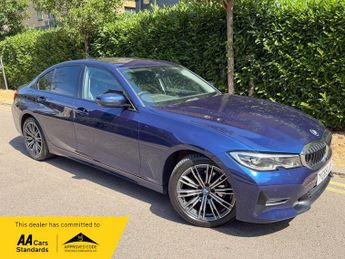
There are only a handful of truly great cars, and the BMW 3 Series is one of them. Not only is it a great all-rounder, it exceeds expectations in every department.
Jack Evans
Jack Evans

Jack is an experienced motoring journalist who has been covering the latest new-car releases for the last 10 years.

Read bio

4.3/5

How much does it cost?

Prices start at a little under £42,000 for the entry-level 320i in Sport trim, rising to £62,425 for the M340i xDrive performance model. The practical Touring estate variant commands between an £1,800 and a £2,650 premium over the saloon.

Used prices are more affordable, with the oldest 2019 cars coming in at around £10,000. These cars tend to have high mileages of around 100,000 miles on the clock; for more commensurate mileage with age (50,000 miles for a five-year old car, for example) you'll need to budget around £16,000. Indeed, most 2019 and 2020 cars will be priced between £16,000 and £25,000, depending on trim and engine specification, while 2021 and 2022 cars will be between £20,000 and £35,000. Newer models start around £26,000, again depending on trim and engine spec.

Engine and performance

Overview

The seventh-generation 3 Series offers one of – if not the – broadest line-up of engines ever offered in the model's history. There's everything from frugal diesels to powerful petrols – there's even a plug-in hybrid for maximum efficiency.

For petrol, there's a 2.0-litre four-cylinder engine in 154bhp, 181bhp and 245bhp guises, badged 318i, 320i and 330i, respectively. Then there's a performance model called M340i xDrive that uses a 369bhp 3.0-litre six-cylinder unit.

Diesels comprises the 148bhp 2.0-litre 318d, the 3.0-litre six-cylinder 330d (261bhp) and M340d xDrive (335bhp). But the backbone of the 3 Series range has long been the 320d, which uses a 187bhp version of the 2.0-litre diesel engine. Both this and the 320i petrol are the most numerous on the used car market.

The 3 Series also came with plug-in hybrid power, which was very popular as it offered ultra-low company car costs. It uses a 2.0-litre petrol engine paired with an electric motor; early cars had a pure-electric range of 37 miles, while later facelifted cars from 2024 saw the range climb to an impressive 63 miles.

BMW added mild-hybrid engines in 2020, but slimmed down the engine line-up from 2022 with the 318i disappearing from the range. Diesel power was ditched completely in 2024.

The 3 Series comes in standard rear-wheel drive or xDrive four-wheel drive forms.

BMW 3 Series performance

Out on the road

The 3 Series has long been the benchmark when it comes to driving dynamics, and this goes for the seventh-generation car, too.

It's a car that excels in every environment. It's as happy flying along the motorway, giving passengers maximum comfort and refinement, as it is on a twisting country road. It feels well-suited to congested city streets, too, thanks to its light controls and punchy engines.

The large six-cylinder engines offer glorious levels of grunt, and their muscular torque delivery is in perfect step with the 3 Series' sporty character – the diesel, in particular, is also a great choice if you regularly need to tow. But the 2.0-litre engines are more than decent enough for the majority of buyers, beautifully balancing power and efficiency.

The plug-in hybrid uses the smooth 2.0-litre engine as its base, but adds the beauty of silent electric power. In urban environments, this makes the 3 Series fantastically refined and efficient.

BMW 3 Series on the road

Ride and handling

While there are sharper cars to drive in the executive car class such as the Jaguar XE and Alfa Romeo Guilia, the 3 Series is the benchmark by which all rivals are judged and offers a broader appeal than those two models.

The car's steering is sharp, and while it doesn't give the best feel of what the front tyres are doing, it is well-weighted. Body control is excellent, and the car feels agile and balanced.

Ride comfort can depend on which trim you opt for. SE and Sport cars have the plushest ride thanks to their standard suspension and smaller alloy wheels, while M Sport models feature a stiffer suspension set-up that can make the ride a little uncomfortable on some surfaces. Adaptive suspension is standard on the performance M340 models, and can be selected as an option on M Sport cars.

BMW 3 Series ride and handling

Interior and features

Interiors

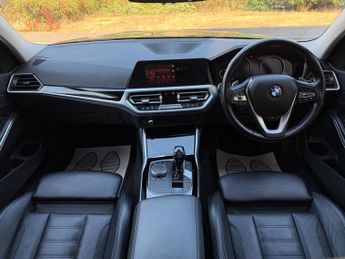
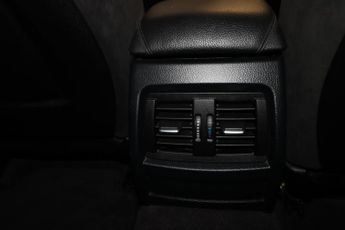
The cabin is a strong point of the 3 Series. It feels very solid and pretty plush, with a very tech-heavy feeling, particularly in later models.

The car has the type of interior and dashboard design that is reflected in many models across the BMW range. It's simple, uncluttered and easy to use. The latest round of updates removed some physical controls, though, placing more emphasis on the touchscreen system. Happily, the latter is still controlled with a rotary dial on the centre console, in contrast to newer BMW models that have moved away from this.

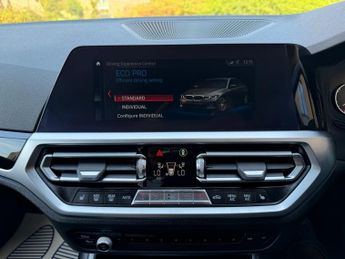
The infotainment system has, again, been a strong point for the 3 Series. The iDrive system is intuitive and very easy to use; post-2024 cars feature a new 'Curved Display' screen set-up that's crisper and more modern looking. However, with the deletion of some buttons, the infotainment system is now home to a bewildering array of controls, and operating on these on the move can be distracting at times.

BMW 3 Series interior

Boot space and practicality

There's 480-litres boot space on offer in the 3 Series Saloon, which is more than the equivalent Audi A5 and Mercedes-Benz C-Class, but behind the Tesla Model 3. Go for the plug-in hybrid, and this shrinks to around 300 litres, while the back seats split in a handy 40/20/40 format, boosting practicality.

Boot room rises to 500 litres in the Touring estate model, offering more space than the Audi A5 and Mercedes-Benz C-Class, but not the Volvo V60. All cars get an electric tailgate as standard, as well as opening tailgate glass. The plug-in hybrid sees boot space fall to 410 litres.

There's plenty of room in the back seats for taller passengers, but carrying a third occupant in the middle seat will be a squeeze. The doors open pretty wide and the Isofix points are easy to locate. Cars fitted with the optional panoramic glass roof do lose some headroom, so it's worth remembering that if you need to carry lankier passengers.

BMW 3 Series boot space and practicality

Features

Depending on year, the entry-level trim was SE or Sport, with standard equipment comprising items such as 17- or 18-inch alloy wheels, LED headlights, dual-zone climate control, cruise control and BMW’s iDrive infotainment system with sat-nav and smartphone mirroring. M Sport models get a sportier look inside and out along with stiffer suspension, and the M-developed M340 cars build on the racy feeling even further while adding more luxurious features.

BMW offers a comprehensive options list, ranging from extra luxuries to body kits and sporty styling packs. Look out for the desirable Technology Package and Visibility Package when searching for a used 3 Series as these feature upgraded tech.

BMW 3 Series feature

Trim and colour options

As previously mentioned, the BMW 3 Series comes in a small range of trims. SE and Sport trims will be fine for most buyers as they offer all the basics, along with some luxuries and have the benefit of smaller wheels and standard suspension for maximum comfort. By far and away the most popular trim is the M Sport as it adds some sportier styling to the mix, but ride comfort does suffer. The M340 cars – which are developed by BMW’s M motorsports division – add even further sporting and luxury features.

The options list is vast, and ranges from tech and convenience equipment, to extra sporty styling packs. It’s worth doing your research on what is available when searching for your used 3 Series, as often no two cars are the same.

As for colour, naturally the 3 Series comes in trademark greys, blacks and whites, along with more interesting blues and reds. Interior choices are pretty good, and can include tan, red and brown options along with standard black.

BMW 3 Series trim and colour

Safety and reliability

As you might expect, the BMW 3 Series is a safe car. It has a five-star safety rating from Euro NCAP, with high scores across the board of protection. The car is generally regarded as very reliable, beating key rivals.

BMW 3 Series safety and reliability

MPG, emissions and tax

Running costs depend heavily on engine choice. The smaller petrol engine variants should all return in the mid-40s mpg, while the M340i petrol will be closer to 30mpg in normal driving. The 330e plug-in hybrid offers the best fuel economy on paper, with BMW quoting figures as high as 353-plus-mpg, but you'll only see economy like this if you charge it regularly and run the car in EV mode as much as possible.

The diesels will offer the best fuel economy for most, however, particularly the 318d and 320d. High-50s mpg is easily achievable, while the 3.0-litre variants will only drop to the 40s.

VED (road tax) will be expensive for the majority of 3 Series models, especially as most exceeded the £40,000 threshold for the Expensive Car Supplement. That means that along with the flat £195 rate, a supplementary £425 was added, bringing annual VED to £620. This is only payable for the car's first five years, however.

BMW 3 Series MPG, emissions and tax
Browse 1,536 in stock