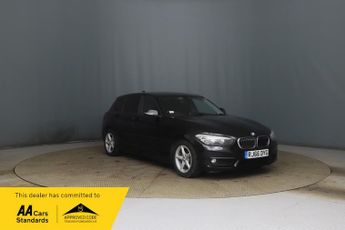
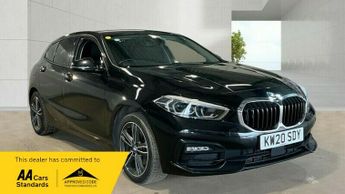
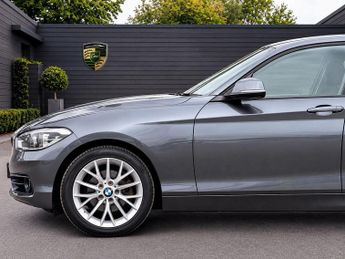
Specifications

Fuel types
Petrol, diesel
No of seats
5
Boot space
300 - 380 litres
Dimensions
4,361mm x 1,800mm x 1,459mm
Fuel economy
34.4mpg – 53.3mpg
Acceleration (0-62mph)
4.9 – 7.8 seconds
Insurance group
21 - 26
Body style
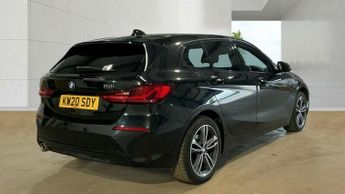
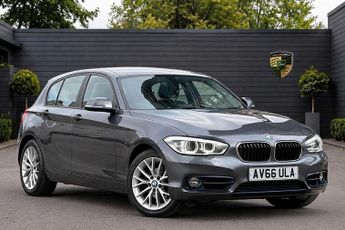
Hatchback
CO2 emissions
121– 185g/km
Browse 1,707 in stock

AA Mechanic review

When buying a used BMW 1 Series, condition and service history matter most. Listen for timing chain rattle on start-up, especially on older petrol and diesel models, and check for oil or coolant leaks. It’s also worth checking the MOT history, as repeated advisories can show how well the car has been maintained.
Jamie Webb
Jamie Webb

Jamie Webb is a Roadside Patrol at The AA, with hands-on experience developed through motorsport, roadside work and practical vehicle maintenance, along with a growing specialism in hybrid and electric vehicles.

Read bio

3.8/5

Repairs

The BMW 1 Series is generally reliable, but some faults can become expensive if they’re ignored.

Common issues include:

  • Timing chain wear on some older petrol and diesel models
  • Ignition coil failure on petrol models, causing misfires or rough running
  • Turbo problems on higher mileage or poorly maintained cars
  • Suspension wear, including bushes, arms and dampers
  • Cooling system leaks as the car ages
  • Parking sensor or reversing camera faults
  • iDrive infotainment glitches, lag or freezing on older cars

Timing chain replacement can cost around £800 to £1,500 if caught early. If the chain fails and causes engine damage, the repair bill can be much higher. Turbo repairs can also cost more than £1,000, so regular servicing is important.

Maintenance

BMW 1 Series service schedules vary by engine and model year, so owners should follow the car’s service display and service book. In general, expect maintenance every 12 months or around 10,000 to 12,000 miles.

Key maintenance to keep on top of includes:

  • Oil and filter changes using oil that meets BMW’s specification
  • Brake fluid replacement every 2 years
  • Spark plug replacement on petrol models when due
  • Air, fuel and cabin filter replacement
  • Cooling system checks
  • Suspension checks at each service
  • Timing chain inspections on older models
  • Software updates for iDrive and driver assistance systems

Run-flat tyres, insurance and servicing can cost more than on mainstream hatchbacks. Diesel models may also need AdBlue top-ups, depending on age and engine.

Is the BMW 1 Series a reliable car?

After 5 to 7 years, suspension wear, minor electrical faults, cooling system leaks and timing chain concerns on earlier cars become more likely. A well-serviced BMW 1 Series should hold up well, but buyers should avoid neglected and heavily modified examples.

Browse 1,707 in stock

AA Cars review

The BMW 1 Series is perfect if you’re looking for a premium hatchback that offers the right mix of performance and efficiency. It also remains reasonably fun to drive with cabin quality that’s arguably the best in its class.
Adithya Gopal
Adithya Gopal

Adithya is the Content Editor at AA Cars and a Motoring Journalist, with over 1,000 published articles across numerous publications.

Read bio

4.2/5

How much does it cost?

The 2026 BMW 1 Series starts from £32,640 for the entry-level 120 Sport, with prices rising to approximately £37,540 for the higher-spec M Sport Pro trim. The BMW 123 xDrive is priced from £37,840 for the M Sport and £40,740 for the M Sport Pro, while the range-topping M135 will set you back £45,630.

If you’re open to buying used or nearly new examples, there are some good deals. For instance, 2026 model-year 120 models in Sport trim, with less than 5,000 miles are available for under £27,000, while nearly new M135s are priced around the £40,000 mark.

Engine and performance

Overview

For 2026, BMW is offering three engine/powertrains for the 1 Series:

  • 120: 1.5-litre, three-cylinder petrol and 7-speed DCT – 170hp/280Nm
  • 123 xDrive: 2.0-litre, four-cylinder petrol and 7-speed DCT – 218hp/360Nm
  • M135 xDrive: 2.0-litre, four-cylinder petrol and 7-speed DCT – 300hp/400Nm
BMW 1 Series performance

Out on the road

Our test car is the BMW 123 xDrive, which hits the sweet spot between the base 120 and the rather expensive and focused M135xDrive. With 218hp/360Nm on tap, acceleration is brisk, with 62mph coming up in a rather quick 6.3 seconds. The 2.0-litre B48 engine is no stranger, as it’s featured in many BMW/MINI models. As expected, the unit is refined and delivers a strong wave of torque from low down.

The biggest highlight, however, is the traction on offer, thanks to the xDrive AWD system. Even demanding acceleration on damp roads is dispatched with ease. The 123 xDrive does all the hard work, resulting in a reassuring feel, as the performance can be fully extracted. The 7-speed DCT adds to this with smooth shifts, while also being ready to drop a few gears when you ask.

There are three drive modes on offer: Sport, Normal and Efficient. Pick the latter, and throttle response is lethargic, making pulling away from roundabouts feel tricky. Normal is the pick for everyday driving, while Sport sharpens things up.

If you feel the 120 is underpowered for your needs, the 123 xDrive is brilliant, as it’s that much more effortless in how it drives without being as hardcore as the M135. It also makes a difference in everyday driving, thanks to a good spread of torque and the grip from the xDrive AWD system.

BMW 1 Series on the road

Ride and handling

The BMW 1 Series is widely regarded as the pick if you want the most fun-to-drive premium hatchback. This is a notion cemented throughout the early years, when the 1 Series was a rear-wheel-drive hatchback. With the new front-wheel drive 1 Series, there is definitely some engagement, but it is not quite as fun as you’d expect. Everything feels moderately agile, with sharp steering and taut body control. Approach a corner and the 1 Series turns in with enthusiasm.

However, there is a degree of body lean and not much feedback from the car or the steering to make it a thoroughly engaging experience. There is adequate rotation and enough dynamic ability to make it entertaining. But everything feels a bit muted down. In its defence, the ride quality remains accomplished. There is no bounciness, and the 1 Series flat at high speeds with a likeable composure. There is a hint of vertical business to the ride at all speeds, but it’s not pronounced enough to be an annoyance.

The brake-pedal is consistent with a strong bite, making it easy to reduce speed and come to a stop. Overall, the 1 Series, particularly the 123 xDrive, offers a good driving experience but lacks the final polish in terms of driver engagement or handling balance, both of which the Audi A3 offers.

BMW 1 Series ride and handling

Interior and features

Interiors

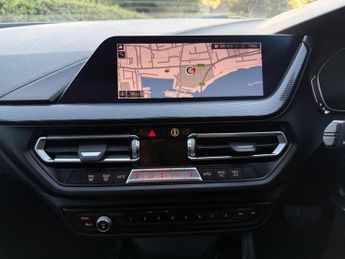
BMW has opted for a simple cabin layout, with the curved touchscreen/driver’s display doing much of the heavy lifting. The cabin design is definitely clean and modern, but it could also be excessively minimalistic for some. There are no physical buttons, apart from those on the centre console, and the aircon vents are oddly shaped with separate controls. So, to access most functions, you have to navigate through the touchscreen, which can be non-intuitive. Thankfully, the centre console hosts a rotary volume controller and other media controls. In contrast, the Audi A3’s cabin is clearly ahead in terms of user-friendliness.

In terms of cabin quality, it is right up there with the best in its class, with everything feeling plush. The steering wheel, although a bit large for our liking, is high quality, as are the door pads and everything you touch. You will be hard-pressed to find any scratchy plastics in the main areas, and all the touchpoints are built well.

BMW 1 Series interior

Boot space and practicality

With a boot space of 380 litres, the 1 Series is competitive in its class. However, there’s a catch. The M135 is the only version that offers 380 litres; the 120 and 123 only boast 300 litres (the mild-hybrid system eats into the boot space). You could also fold the seats to open up 1,200 litres.

In the M Sport variant, the front seats are large, supportive and offer a pull-out under-thigh support for good measure. They support well and also feel perfect for longer stints. Space up front is also a highlight, thanks partly to the less fussy cabin design.

Move to the back and you’ll notice the space is tight, and you do sit with your legs up high due to a tall boot floor. Knee room and headroom are also average. In terms of storage, there are many spaces, two front cupholders, a large wireless charging recess and reasonably large door bins.

BMW 1 Series boot space and practicality

Features

The 1 Series is a well-equipped car, with the twin 10-inch curved touchscreen being the standout. It is a sharp and colour rich system, with a clean user interface. But since almost everything is hosted in it, it can take a while to figure out what’s happening. There’s also a slight delay when switching between screens, especially when starting up the car. The driver’s display feels premium, and the heads-up display is customisable with an easy layout.

Other feature highlights include the Technology and Technology Pro packs, with LED headlamps, comfort access, high beam assist, wireless charging, live cockpit, park assist plus, etc. There are also other options such as the £550 Harman Kardon sound system, active seats, electric seats, an electric tailgate, and a panoramic roof (£1050), etc.

BMW 1 Series feature

Trim and colour options

Trim levels include Sport, M Sport, and M Sport Pro. As for colour choices, you can select from a wide palette including Alpine White (free) and metallic options (£650): Black Sapphire, Portimão Blue, Brooklyn Grey, Skyscraper Grey, Thundernight, Cape York Green, and Fire Red. More expensive Individual options are Storm Bay/Tanzanite Blue (£1350), and Frozen Pure Grey/Portimão Blue (£2100).

BMW 1 Series trim and colour

Safety and reliability

The BMW 1 Series was tested by Euro NCAP in 2019, with a full five-star rating. The testing body awarded the 1 Series 83% for adult occupant protection, 87% for child occupant safety, 76% for pedestrian protection, and 72% for safety assist features during its assessment.

BMW 1 Series safety and reliability

MPG, emissions and tax

In all engine configurations, the BMW 1 Series is an efficient car within its class. The 120i is the efficiency champ, with a claimed 53.3mpg. The 123 xDrive is not far off at 47.9 mpg. Our testing showed the 123 can actually achieve figures close to that without much effort, especially in the Efficient drive mode. Of course, the M135 is the least efficient at 36.7mpg, but you have to expect that when it develops 300hp.

CO2 emissions range from 110 – 156 g/km, with the lowest number for the 120, with the 123 at a respectable 135 g/km. With no plug-in hybrid on offer, company car drivers may want to look at the A3 TFSI e plug-in hybrid to get lower benefit-in-kind rates. Don’t tick too many boxes and you can avoid the luxury car supplement in some 1 Series models (under £40,000).

BMW 1 Series MPG, emissions and tax
Browse 1,707 in stock