
 Updated 03/09/2026
Read Time 8 mins
Updated 03/09/2026
Read Time 8 mins

But as vehicle technology has evolved, so have our tastes. Automatic gearboxes are now much more common in new and used cars, helped by the growth of hybrid and electric vehicles, which are typically automatic by design. Modern automatics are also smoother, quicker to respond and easier to live with than many older systems.
That does not mean the manual gearbox has disappeared. There are still plenty of manual cars on the used market, especially among smaller hatchbacks, budget-friendly models and certain sports cars. For some drivers, a manual still offers the most satisfying connection to the car.
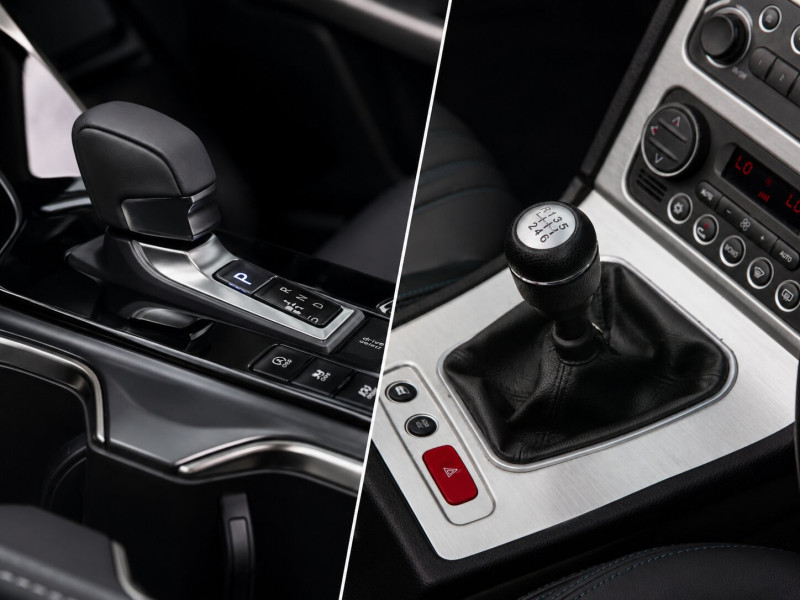
So, is now the time to buy a manual while you still can, or is automatic the right choice for your next car? This guide explains the pros and cons of manual and automatic cars, how different automatic gearboxes work, and what to consider before you buy.
Manual and automatic cars at a glance
| Question | Manual cars | Automatic cars |
|---|---|---|
| Ease of use | More involvement, but more work in traffic | Easier in stop-start traffic and everyday driving |
| Driving feel | More direct control over gear changes | Smoother, with less effort from the driver |
| Availability | Common on older used cars and many small cars | Increasingly common, especially in newer models, hybrids and EVs |
| Running costs | Often simpler and can be cheaper to maintain | Modern systems can be efficient, but repairs may cost more |
| Best for | Drivers who enjoy control or want a lower-cost used car | Drivers who prioritise comfort, convenience or newer technology |
What are the pros and cons of manual and automatic cars?
When it comes to deciding between manual and automatic transmissions, the answer depends on your driving habits, budget and personal preference.
Automatic cars offer greater convenience, especially in heavy traffic. You do not need to keep pressing the clutch or changing gear, which can make everyday driving feel calmer and less tiring. This is one reason automatics have become more popular with drivers who spend a lot of time in towns, cities or motorway congestion.
Manual cars can still provide a more engaging driving experience. They give you greater control over gear selection and can feel more rewarding on winding roads or in performance cars. Some drivers also prefer the familiarity of a manual gearbox, particularly if they learned to drive in one and have owned manuals for years.
For most drivers, automatic cars are now the easier choice. They suit modern driving, work well with hybrid and electric technology, and are widely available on the used market. But if you enjoy a hands-on approach, or you want a straightforward used car with lower purchase costs, a manual can still make sense.
What types of automatic gearbox are there?
Not all automatic gearboxes work in the same way. The type fitted to a car can affect how it feels to drive, how smooth it is in traffic and how much it may cost to repair.
The traditional torque converter automatic uses hydraulic fluid to transfer power between the engine and the wheels. These gearboxes are often known for smooth, relaxed changes, which can make them well suited to larger cars, luxury models and comfortable cruisers.
A dual-clutch transmission, often called a DCT, uses 2 clutches to manage odd and even gears. This can allow quick shifts and strong efficiency, which is why this type of gearbox is often used in performance-orientated cars as well as many mainstream models. Volkswagen Group DSG, BMW SMG and Porsche PDK transmissions are examples of this idea in different forms.
A continuously variable transmission, or CVT, uses a belt and pulley system rather than fixed gears. It can provide seamless acceleration and is widely used in hybrid cars. Some drivers like the smoothness, while others prefer the more familiar stepped feel of a conventional automatic.
Some cars also use automated manual gearboxes. These are based on a manual gearbox but use electronics and actuators to change gear automatically. They can be efficient, but some older versions may feel less smooth at low speeds than other automatic systems.
Why are electric cars usually automatic?
Electric cars are usually automatic because electric motors deliver power differently from petrol and diesel engines. An internal combustion engine needs several gears to work efficiently across different speeds. An electric motor can deliver strong torque from very low speeds and operate across a broad power band.
That means most electric vehicles do not need a traditional multi-speed manual gearbox. Instead, they use a single-speed transmission that delivers smooth acceleration without gear changes. From the driver’s seat, this makes an electric car feel simple and immediate to drive.
For buyers looking at hybrid or electric vehicles, an automatic gearbox will usually be the only option. That should not be seen as a drawback. In many cases, the smooth power delivery is one of the reasons these cars feel so easy to use.
Why would I still consider a manual car?
Despite the growth of automatics, manual cars still have clear strengths. For driving enthusiasts, a manual gearbox offers a more direct connection to the car. Choosing the right gear yourself, timing a downshift and feeling more involved can make the drive more enjoyable.
Manual cars can also appeal if you want to keep costs down. They are often less expensive to buy on the used market, especially in smaller cars and older models. Because the gearbox itself is usually simpler than an automatic, some repairs may also be less costly, although clutch wear should still be factored into any used car purchase.
There is also the question of choice. Manuals remain common among small hatchbacks, older family cars and some sports cars. If you want a simple petrol supermini, a budget-friendly first car or a more traditional driving experience, a manual may still be the better fit.
Before buying any used manual car, pay close attention to how the clutch feels. A high biting point, slipping under acceleration or difficulty selecting gears could point to wear that may need attention.
Does the manual gearbox have a future?
The future of the manual gearbox looks more limited than it once did. Modern cars increasingly use hybrid, plug-in hybrid and electric powertrains, and these are usually paired with automatic transmissions. As more buyers choose these vehicles, fewer new manuals are likely to be offered.
Even so, manual gearboxes are unlikely to disappear from the used market any time soon. The UK has a large supply of manual cars already on the road, and many drivers still value the control and simplicity they offer. Manuals may also remain popular in enthusiast circles, particularly where driving enjoyment matters more than convenience.
If you actively enjoy driving a manual, now may be a good time to choose one while there is still plenty of choice. If you do not mind either way, an automatic is likely to give you more options among newer used cars.
Is an automatic car better for everyday driving?
For many drivers, yes. Automatic cars are easier to drive in stop-start traffic, simpler on hill starts and more relaxing on longer journeys. You can focus more on the road and less on gear changes, which can make the car feel easier to live with day to day.
Modern automatics are also far better than many older versions. They can shift quickly, respond smoothly and work well with driver assistance systems. In hybrids and electric cars, automatic transmission is part of the overall driving experience, helping the car feel quiet and effortless.
That said, not every automatic feels the same. A torque converter automatic may feel smooth and relaxed, while a dual-clutch gearbox may feel sharper. A CVT may feel different again, particularly when accelerating hard. A test drive is the best way to decide whether a particular gearbox suits you.
Is a manual car cheaper to run?
A manual car can be cheaper to buy and may be simpler to maintain, but the overall cost depends on the car, its condition and how it has been driven. Clutch replacement can be expensive, so do not assume every manual will be cheaper in practice.
Automatic cars can cost more to repair if the gearbox develops a fault, but modern systems are generally designed to be durable when maintained properly. It is important to check the service history and understand whether the gearbox oil should have been changed at a set interval.
Fuel economy is no longer a simple manual win. Older automatics were often less efficient than manuals, but modern automatics can be highly efficient and, in some cases, may perform better than a manual equivalent. The best option depends on the specific model and engine.
Manual or automatic for new drivers
For new drivers, the choice also affects the driving licence. If you pass your test in a manual car, you can drive both manual and automatic cars. If you pass in an automatic, you can only drive automatics unless you take another test in a manual.
That makes a manual licence more flexible, especially if you may need to drive a wider range of vehicles in future. But if you know you only want to drive automatics, and you value an easier learning experience, an automatic can still be a sensible choice.
On the used market, younger drivers may also find plenty of affordable manual small cars. Automatic small cars are available too, but the choice and pricing can vary by model, age and location.
Which gearbox should I choose?
The choice between manual and automatic transmission ultimately depends on your driving needs, personal preferences and future plans.
If you enjoy direct control, want a more involved driving experience or are looking for a lower-cost used car, a manual gearbox may still be the right choice. It is especially worth considering in small petrol cars, older hatchbacks and enthusiast models where the gearbox is part of the appeal.
If you prioritise comfort, ease of use or spend most of your time in traffic, an automatic is likely to be more suitable. It is also the natural choice if you are looking at a hybrid, plug-in hybrid or electric vehicle.
There is no single right answer. The best gearbox is the one that suits how you drive every day. If you are unsure, test drive both. A short drive in traffic, on faster roads and while parking will usually tell you which feels more natural.
Find your next manual or automatic car with AA Cars
Whether you are looking for a manual hatchback, a smooth automatic SUV or an electric car with effortless acceleration, AA Cars can help you compare used cars from trusted dealers.
Before you buy, check the service history, take a proper test drive and look carefully at how the gearbox behaves. If you want extra confidence before committing, The AA recommends an AA Cars Vehicle Inspection before purchasing.


