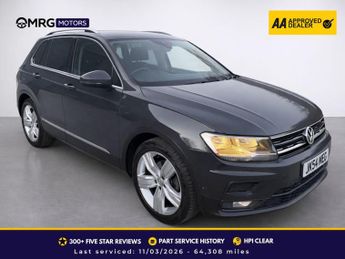
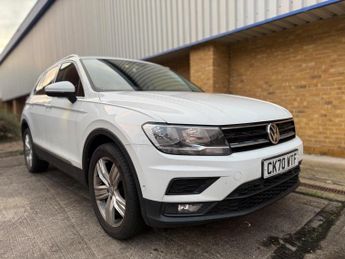
Specifications

Fuel types
Petrol, diesel, hybrid
No of seats
5 or 7
Boot space
652 litres
Dimensions
4,539 mm x 1,859 mm x 1,660 mm
Fuel economy
36.2 mpg - 187.9 mpg
Acceleration (0-62mph)
5.7 - 10 seconds
Insurance group
18-32
Body style
SUV
CO2 emissions
38-190 g/km
Browse 2,497 in stock

AA Mechanic review

When buying a used Volkswagen Tiguan, check the mileage, service history and whether key maintenance has been done on time. DSG automatic models may need gearbox servicing, while 4MOTION versions need the all-wheel-drive system checked and maintained. If the car has a panoramic sunroof, inspect it for leaks, damp carpets or blocked drains. Also check the panel gaps and interior condition, as many Tiguans are used as family cars.
Jamie Webb
Jamie Webb

Jamie Webb is a Roadside Patrol at The AA, with hands-on experience developed through motorsport, roadside work and practical vehicle maintenance, along with a growing specialism in hybrid and electric vehicles.

Read bio

4.3/5

Repairs

The Volkswagen Tiguan is generally a dependable family SUV, but some faults can appear as the car gets older or covers higher mileage.

Common issues include:

  • DSG gearbox hesitation, often improved with servicing or a software update
  • Timing belt or timing chain wear on some engines
  • Oil separator diaphragm faults on some later petrol models
  • Panoramic sunroof leaks caused by blocked drains or worn seals
  • Carbon build-up on some TSI petrol engines
  • Parking sensor or driver assistance warnings caused by dirty or misaligned sensors

Timing work can be expensive, so buyers should check whether the correct belt or chain maintenance has been done for the specific engine. Sunroof drain cleaning is often simple, but water damage can become costly if ignored.

Maintenance

Tiguan servicing depends on the engine, age and service schedule, so buyers should check the car’s service record, handbook or Volkswagen’s service information for the exact requirements. Volkswagen also advises owners to use the correct maintenance schedule for their vehicle.

Key maintenance to keep on top of includes:

  • Oil and filter changes using oil that meets Volkswagen’s specification
  • DSG gearbox servicing where required
  • Haldex or 4MOTION servicing on all-wheel-drive models
  • Tyres, brakes and servicing can cost more than some buyers expect, especially on larger-wheel models.
  • Diesel versions may also need AdBlue top-ups.

Is the Volkswagen Tiguan a reliable car?

The Volkswagen Tiguan is a practical, well-built SUV that works well for family use, commuting and longer journeys. It usually holds up well if it’s serviced properly and repairs are dealt with early. After 5 to 7 years, most issues are linked to wear, servicing gaps or overlooked maintenance rather than major failure. A well-maintained Tiguan with clear history, a smooth DSG gearbox and no signs of water ingress should be a strong used buy.

Browse 2,497 in stock

AA Cars review

It feels as though every inch of the Volkswagen Tiguan was designed with families in mind. From its spacious boot and robust interior to its fuel-sipping engines and handy safety features, this is a car for all the family - but drivers can still have a good time thanks to the Tiguan’s decent road-holding ability, too.
Jack Evans
Jack Evans

Jack is an experienced motoring journalist who has been covering the latest new-car releases for the last 10 years.

Read bio

4.0/5

How much does it cost?

Today, prices for the Volkswagen Tiguan start from £38,080 for an entry-level Life specification car with a 1.5-litre turbocharged petrol engine and a seven-speed automatic gearbox. This is the least-powerful car in the range, too, with around 128bhp and a combined fuel consumption of around 47mpg. However, if you’re looking to save money, then there are plenty of great options on the used market. For the same price as that brand-new model, you can get a 2025-model-year car in popular R-Line specification - which gets a higher level of standard equipment than ‘Life’ trim - with a mild-hybrid version of the 1.5-litre petrol engine. It gets more power, too, and has just 9,000 miles on the clock. It’s worth remembering, however, that given their high demand, older Tiguans command a higher price tag than many key rivals.

Engine and performance

Overview

Volkswagen has included a lot more hybrid tech across the Tiguan range than before. Today, you’ve got the option of standard petrol, mild-hybrid, plug-in hybrid and diesel - so there really is something for everyone. One of the most popular engines is the 1.5-litre turbocharged unit and it’s one that you’ll see in many Tiguan specifications. For more power, there’s also a 2.0-litre turbocharged petrol which can be specified in four-wheel-drive for those who need more traction. The diesel is also a 2.0-litre unit and, again, it can be had with all-wheel drive. The plug-in hybrid, meanwhile, is a very efficient setup. Again, it has a 1.5-litre turbocharged petrol engine at its heart, but thanks to a battery and electric motor, it can manage up to 72 miles on electric-only power, so you can save a lot of money by running on plug-in power for as much time as possible.

Volkswagen Tiguan performance

Out on the road

The Tiguan brings the kind of all-rounder ability that you’d expect from a family SUV. It’s quite a square car on the road, so it’s easy to park and position, while decent levels of visibility mean it’s intuitive for those getting behind the wheel for the first time. The suspension leans towards the firmer side of things but it’s certainly not distracting and, when you’re at motorway speeds, things settle down well. As for refinement, the Tiguan is just as you’d expect - quiet and comfortable. The steering has some nice weight to it and though it’s not an out-and-out sports model, it does well through the bends. In reality, it brings a good middle-ground between comfort and sportiness, so it should suit lots of drivers.

Volkswagen Tiguan on the road

Ride and handling

You can get the Tiguan with either standard suspension or optional adaptive suspension, called DCC Pro by Volkswagen. With the latter enabled, you can tweak the car’s setup, allowing it to offer a softer or firmer ride on the fly. In its softest setting the Tiguan really is impressive and practically floats over bumps and road imperfections. It’s a great option for drivers who want the comfiest Tiguan possible. That said, even the standard suspension is pretty decent comfort-wise. Just watch out for cars with large alloy wheels. As with nearly all cars of this type, bigger alloys tend to make the ride a little harsh.

Volkswagen Tiguan ride and handling

Interior and features

Interiors

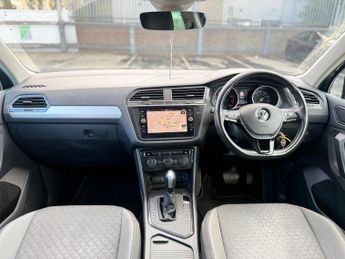
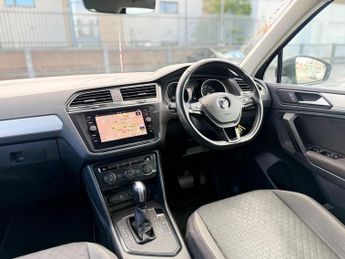
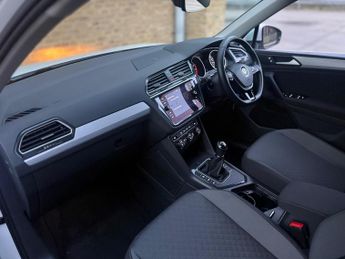
The Volkswagen Tiguan launched as a new model in late 2023, but the Tiguan’s key values have remained the same for some time. At its core, the Volkswagen Tiguan’s interior is all about practicality, which is why those sitting up front have a nice clear view of the road ahead, and the passenger has a decent amount of room to stretch out. There are solid materials used throughout and though there are some harsher plastics lower down, they’re in areas that would be prone to scuffs and marks - so you’re quite happy to not have higher-end materials down there. Rear-seat space is good, too, with a good amount of room for your feet underneath the front seats. Headroom is plentiful as well and taller passengers shouldn’t have a problem getting comfy back there. There is a chunky transmission hump in the middle, mind you, so whoever gets that central seat is going to find their feet feeling a little squashed.

Volkswagen Tiguan interior

Boot space and practicality

It’s worth mentioning that the seven-seat Tiguan model - called the Allspace - is no longer available on the new market and has been replaced by the new Tayron. However, there’s a good availability of Tiguan Allspace models on the used market, should you want. In terms of boot space, the Tiguan does well. In fact, you’ve got 652 litres of luggage space to play with if you slide the rear seats as far forward as they can go. Plus, you can fold them down to expand the boot area even further. However, plug-in hybrids do suffer a penalty as a result of their batteries, with boot space in these models falling to 490 litres - it’s still respectable, mind you.

Volkswagen Tiguan boot space and practicality

Features

All versions of the Tiguan come well-equipped as standard. On the most recent model, features such as a 12.9-inch infotainment system come equipped from the off, alongside a 10.25-inch screen ahead of the driver which can be configured to show a variety of different readouts. There are a variety of USB-C charging points dotted throughout the cabin, too, so everyone should have a spot to top up their devices when needed. A popular specification is R-Line and it’s one you’ll see most used models finished in, too. These cars get a sportier design overall, with 20-inch alloy wheels and redesigned front and rear bumpers helping to make the Tiguan stand out. Black Edition, meanwhile, brings a range of gloss black elements for a more stealthy look, but it’s also one of the highest-equipped models in the range, so it’s a good option for drivers after all of the bells and whistles you could want.

Volkswagen Tiguan feature

Trim and colour options

Currently, the Tiguan is available in Life, Match, Elegance, R-Line and Black Edition trim lines. Entry-level cars get 18-inch alloy wheels, ambient interior lighting and adaptive cruise control, as well as a full suite of driver assistance aids and parking sensors. Mid-range Elegance remains a popular option thanks to its 19-inch alloy wheels, LED headlights and keyless entry, as well as its heated front seats which also get a massage function. There’s a range of relatively subdued exterior shades to choose from, too, including traditional greys and whites alongside more eye-catching blue and red colourways.

Volkswagen Tiguan trim and colour

Safety and reliability

All Tiguan models come equipped with a lot of safety equipment and, unlike many other family-focused SUVs, have three individual ISOFIX mounting points for child seats - two on the rear seats and one at the front passenger. It certainly brings some extra flexibility if you need to transport a few children with you. Tested by Euro NCAP in 2024, the Volkswagen Tiguan was awarded the maximum five-star rating for safety. It scored well across the board, in fact, with ratings of 83 and 88 per cent given for its adult and child occupant protection, respectively.

Volkswagen Tiguan safety and reliability

MPG, emissions and tax

There are plenty of engine options available with the Tiguan and nearly all of them do well in terms of efficiency. Naturally, with its claimed electric range of up to 72 miles, the plug-in hybrid model will be great for those who can charge at home, or those who often do shorter trips. Volkswagen quotes a fuel consumption figure of 172.3mpg for the PHEV, too, but you’ll need to run on electric-only power for most of the time to get anywhere near this. Standard 1.5-litre hybrid eTSI cars should still return up to 45.6mpg and CO2 emissions of 141g/km, mind you, and we’d expect this to be a big hit among most drivers.

On paper, the 2.0-litre diesel model with its 50.9mpg is one of the most efficient and, if you do longer journeys, it probably will be. But as with all diesels, this model is best for long-distance drivers. At the top of the range is the most powerful 2.0-litre petrol which will get the Tiguan from 0-60mph in under six seconds, but which will only return just over 33mpg. Watch out for the list price of the Tiguan, too; many cars will come in over £40,000, which means they’ll be hit with the Expensive Car Supplement for the first five years after registration.

Volkswagen Tiguan MPG, emissions and tax
Browse 2,497 in stock