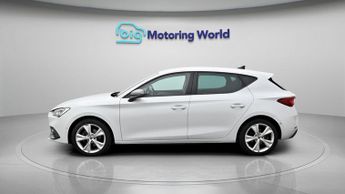
Specifications

Fuel types
Petrol, mild-hybrid petrol, diesel, petrol plug-in hybrid
No of seats
5
Boot space
380 litres (hatchback) / 620 litres (estate)
Dimensions
4,368 mm x 1,800 mm x 1,456 mm
Fuel economy
42 - 235mpg
Acceleration (0-62mph)
7.4 - 10.9 seconds
Insurance group
14 - 24
Body style
Hatchback, estate
CO2 emissions
28 -158g/km
Browse 638 in stock

AA Cars review

The Seat Leon offers a great cocktail of an enjoyable driving experience and good efficiency, all wrapped in a boldly-styled and practical body. It’s an excellent family hatchback.
Jack Evans
Jack Evans

Jack is an experienced motoring journalist who has been covering the latest new-car releases for the last 10 years.

Read bio

4.0/5

How much does it cost?

New prices start at just over £25,600 for the base-spec SE 1.5 TSI 115PS rising to above £40,000 for the FR Black Edition 1.5 e-Hybrid. Opt for the practical estate, and prices rise by around £1,500 depending on the version.

The Leon is very affordable on the used car market, with prices starting in the region of £9,500 for the oldest 2020/21 cars on platforms such as AA Cars. These are most likely powered by the 1.0-litre turbocharged petrol engine. The more desirable 1.5-litre turbo petrol starts at around £11,000, while nearly new examples are now below £30,000, representing excellent value compared to new.

Engine and performance

Overview

With this generation being on sale for the last five years, there has been some chop and change in the engine line-up.

When it originally launched, the Leon came in 1.0-litre three-cylinder turbo petrol, 1.5-litre four-cylinder turbo petrol, mild-hybrid 1.5 turbo petrol and 2.0-litre diesel forms. Within a year, a powerful 187bhp 2.0-litre turbo petrol arrived, as did a 1.4-litre plug-in hybrid (PHEV).

Over the years, however, the 1.0-litre and 2.0-litre petrols were dropped, and the PHEV was revised with a 1.5-litre engine and a larger battery to give a longer pure-electric range of 85 miles. As of 2026, the engine range comprises a 113bhp 1.5 mild-hybrid petrol, a 148bhp 1.5 turbo petrol, a 148bhp 2.0-litre TDI diesel, and the aforementioned 'e-Hybrid' PHEV.

The Leon comes in six-speed manual and DSG automatic forms, and is front-wheel drive only.

SEAT Leon performance

Out on the road

Being a family hatchback the Leon feels at home in the city, on fast-flowing country roads, and cruising on the motorway. It can do pretty much everything, but naturally some engines are more suitable than others for certain drives.

Earlier Leons with the 1.0-litre, three-cylinder petrol engine are excellent around town, and don't embarrass themselves on faster roads. The 1.5-litre engines are the best all-rounders, though, while the 2.0-litre diesel is ideal for those who travel vast distances on the motorway. The PHEVs are brilliant for those who seek ultimate low running costs, and perhaps like the idea of an electric car but don't have the lifestyle for a full-EV. Bear in mind, though, that for the best running costs the PHEV cars’ batteries have to be topped up frequently and driven on EV power.

The six-speed manual gearbox is a delight to use, while the DSG automatics are smooth for the most part. They can, however, feel a little hesitant in urban environments.

The Seat Leon isn’t quite as refined as you might expect. It’s not loud and raucous on the move but road and wind noise do make themselves known, with cars like the Skoda Octavia and Honda Civic offering a quieter ride.

SEAT Leon on the road

Ride and handling

The Leon has a slightly more engaging feel behind the wheel compared to its sisters, the Skoda Octavia and Volkswagen Golf. The steering is light and accurate, and the car strikes a nice balance between good handling and a comfortable ride. It's very composed on fast, flowing roads.

Bear in mind, though, that the sportiest driving experience is from the FR models. Not only does these cars tend to come with larger alloys, but stiff sports suspension is fitted as standard. This improves body control on twisty roads, but does result in a firmer ride, especially around town on potholed-roads.

SEAT Leon ride and handling

Interior and features

Interiors

The Leon's interior design took a big step forward when this generation launched in 2020, with a greater focus on sharp, angular lines, and a large touchscreen that controlled most of the car's functions – for better and for worse.

The design doesn't have a homely, cosy feel, but it certainly looks modern and industrial. Material quality is decent, but not fantastic – it trails a Skoda Octavia for solidity and a Mazda 3 for plushness.

The removal of the majority of buttons for simple things like the climate control is an annoyance, as these are now operated with 'sliders' that lie beneath the touchscreen. The infotainment systems in earlier Leons of this generation were particularly laggy – the screen was slow to inputs, for example. The software has been gradually updated over the years, and a small facelift in 2024 saw a much improved system. All cars bar the entry-level SE get a digital driver's display.

The 2024 facelift also saw the addition of larger screens. Before, entry-level SE cars made do with an eight-inch display while higher trims had a 10-inch screen. But the update saw the SE getting the 10.4-inch screen, with a 12.9-inch screen fitted to more expensive models.

SEAT Leon interior

Boot space and practicality

The Seat Leon scores well for practicality. Taller drivers will easily find a comfortable driving position, and lanky rear-seat passengers will still have plenty of room, too. Kneeroom is especially good as is headroom, and three passengers have room to sit side by side. Isofix points are easily reachable, and even the front passenger seat has Isofix, too.

Boot space is average at 380 litres, but the loading area is of a good shape; there are 60:40 split-folding seats and a handy 'ski hatch' for longer items. The Estate version, naturally, offers more space at 620 litres (with the seats up), although the plug-in hybrid sees this dip to 470 litres.

SEAT Leon boot space and practicality

Features

Just like with the engine range, the Seat Leon has had a selection of trims over the years. The main versions, however, have been the SE, SE Dynamic, and FR. There has been a posher Xcellence model in the past, while the current range is topped off with an FR Black Edition.

The basic SE is pretty well-equipped, though, despite its entry-level status. It gets 16-inch alloys, LED headlights and rear lights, an eight-inch (or 10.4-inch) touchscreen (depending on year) with wireless Apple CarPlay and Android Auto, air conditioning, keyless start, and cruise control. Even metallic paint is thrown in.

Many customers when buying new chose the sportier FR models with their sports suspension, larger alloy wheels, and racier body styling.

SEAT Leon feature

Trim and colour options

The Seat Leon range is relatively easy to get your head around. The entry-level model has always been the SE; it's well equipped, coming with 16-inch alloys, LED headlights and rear lights, an eight-inch (or 10.4-inch) touchscreen (depending on year) with wireless Apple CarPlay and Android Auto, air conditioning, keyless start, cruise control, and metallic paint.

SE Dynamic adds more tech, such as a digital cockpit and online connectivity for the infotainment system, along with larger alloy wheels, privacy glass, and three-zone climate control.

FR ramps up the style with racier-looking bumpers, sports suspension, driving modes, ambient interior lighting, and a wireless phone charger. FR Sport adds larger 18-inch wheels, clever matrix LED headlights, wraparound LED interior ambient lighting, heated front seats, an electric driver's seat, and microsuede upholstery.

Other trim levels, available at various times during this generation of Leon's life, comprise Xcellence, which gets the FR Sport's interior features but a less racy exterior design, and FR Black Edition that adds black exterior trim to the FR model.

All Leons come with metallic paint as standard, which is unusual. Colour options range from a selection of greys, a black and a white, along with more vibrant Desire Red and Sapphire Blue.

SEAT Leon trim and colour

Safety and reliability

When it was tested by Euro NCAP in 2020, the Seat Leon was awarded the organisation's full five-star safety rating. Euro NCAP tested the car again in 2025, and it retained its five-star score. Adult occupant protection came to 92 per cent in 2020 (2025: 88 per cent), and child occupant protection was rated as 81 per cent in 2020 and 86 per cent in 2025.

The Leon has a bit of a mixed reputation for reliability. Industry surveys reveal customers have found issues with the car's on-board technology, and PHEVs can throw up warning messages.

SEAT Leon safety and reliability

MPG, emissions and tax

The 1.0-litre and 1.5-litre petrols offer a great balance between zesty performance and fuel efficiency – you can expect in the late-40s/early-50s mpg for these engines, which is very impressive. The mild-hybrid 1.5-litre engines (badged 'eTSI') can improve on this further.

The diesels can easily return 50-plus mpg, even 60mpg, making them very suitable for drivers who frequently drive long distances. The PHEVs are the real stars of the show, with Seat claiming as much as 235mpg and CO2 emissions as low as 28g/km. However, you'll only achieve these high fuel efficiency figures if you plug into a charging point very frequently and drive in electric mode as much as possible, otherwise 30-40 mpg is more likely.

With the exception of the plug-in hybrids in the highest trim levels, the Leon attracts the flat VED rate of £195 a year. Choose one of those lofty PHEVs, though, and you will be slapped with the Electric Car Supplement, which sees VED of £620 for the car's first five years on the road (since first registration).

SEAT Leon MPG, emissions and tax
Browse 638 in stock