
Specifications
- Fuel types
- Electric
- No of seats
- 5
- Boot space
- 440 litres
- Dimensions
- 4,210mm x 1,790mm x 1,505mm
- Fuel economy
- 285 miles EV range
- Acceleration (0-62mph)
- 7.4 - 8.3 seconds
- Insurance group
- 28 - 33
- Body style
- Hatchback
- CO2 emissions
- 0 g/km


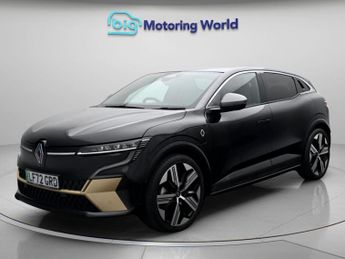
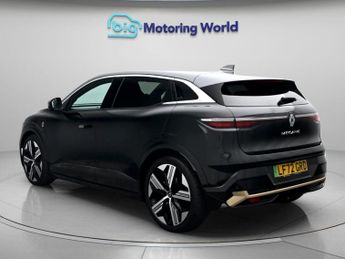
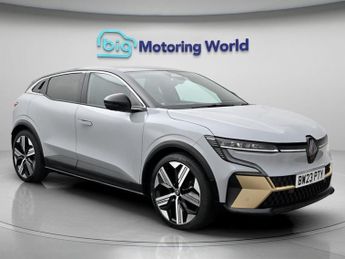
Built on the same platform as the Nissan Ariya, the Megane looks to offer a futuristic flair both inside and out while also offering a strong combination of practicality, driving enjoyment, and efficiency. But in a crowded market that also includes the likes of the Volkswagen ID.3 and Peugeot e-208 is the Megane worth considering? We’ve been taking a closer look to find out.
AA Cars Rating: 4/5
How we test carsThe Megane E-Tech proves that Renault’s approach to electric cars is about more than just zero emissions. It delivers a comfortable, modern hatchback that’s perfectly suited to daily use, whether you’re commuting, running errands, or heading out on longer trips. The interior is stylish and intuitive, and the ride is smooth and composed, making it a relaxing car to spend time in.

Jack is an experienced motoring journalist who has been covering the latest new-car releases for the last 10 years.
Read bioA look at Renault’s online configurator shows that prices for the most basic, entry-level Megane start at £31,295, with the mid-spec car getting underway at £34,095. For those who want to push the boat out a little further, the most expensive range-topping car starts at £35,495 before any optional extras. All these prices include a £1,500 discount under the government’s Electric Car Grant, which aims to encourage buyers to ditch their old petrol cars for a new EV. On the used market, second-hand versions of the Megane E-Tech can be picked up for as little as £15,000 with prices rising to close to £30,000 for the newest, lowest-mileage examples on AA Cars. While this may sound like a bargain on the face of it, it is worth being aware that the EVs depreciate much faster than their petrol counterparts, which could have an impact when the time comes to sell it on.
After almost three decades as a traditionally-powered car, the Megane went all-electric back in 2022, with the arrival of the E-Tech. Renault now offers it in a choice of two setups. Basic cars get a 40 kWh battery paired with a 129 bhp motor, which takes the car from 0–60 mph in 10.3 seconds. Moving up the range, that battery is swapped for a 60 kWh unit which offers better acceleration and range. With that battery, the Megane can go from 0–62 mph in an official time of 7.5 seconds, although some tests show 6.9 seconds. Charging speeds are competitive for its class, especially in higher-spec models that support up to 130kW DC fast charging, adding 120 miles in around 30 minutes.
As a small hatchback, the Megane E-Tech has primarily been designed with urban driving in mind. As a result, it excels around town where its instant torque makes stop-start driving effortless. The car has also been given light steering for increased manoeuvrability, which makes squeezing into tight spaces an absolute breeze. There is also a slightly raised driving position, offering excellent visibility out onto the road ahead. Whilst all this is great, the Megane does start to come a little unstuck on the motorway, where it feels heavier and a touch more cumbersome than a traditional petrol-powered hatchback. Getting up to speed can take a little while and once you get there, wind and road noise become more noticeable than you might expect in a modern car.
As mentioned, the Megane has been dreamt up with cities – and everyday family life – firmly in the forefront of Renault’s mind. As a result, the car feels very much more set up for comfort than anything sporty or agile. While this may disappoint pure driving enthusiasts, it suits the car’s target audience down to the ground. The suspension feels soft and floaty, absorbing potholes and imperfections with ease, and the steering is light and predictable. While all this is excellent around town, it does mean the car lacks a little excitement when the road gets twisty. If you find yourself on a bendy bit country road, in the Megane, it is best not to push things too far. Through the corners there is noticeable body roll and the steering – so helpful around town
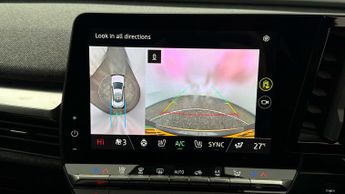
Inside, the Megane E-Tech feels distinctly French – which is to say that it does things slightly outside of the box. The cabin design is bold and futuristic with a dashboard dominated by a large, 12.3-inch digital driver display and a central 9.3-inch touchscreen angled towards the driver. Renault has also resisted the temptation to do away with physical controls and decided to keep real buttons for key functions like the climate control – avoiding the over-reliance on touchscreens we see in most modern cars. Elsewhere, the materials feel pretty premium for the segment, with soft-touch plastics, satin-finish panels, and optional cloth or leather upholstery. Despite being at the compact end of the automotive market, things don’t feel too cramped and there is a nice sense of spaciousness that defies the car’s small stature. While perhaps not class-leading, the design of the interior is skillfully thought out with everyday usability in mind.
With a focus on the family market, it is perhaps unsurprising to say that practicality ranks among the Megane E-Tech’s biggest strengths. At the back, there is 440 litres of boot capacity – strong for a car of this size – with the space itself easy to access and more than capable of swallowing up your weekly shop or a couple of suitcases. For more heavy-duty trips, such as runs to the tip, the back seats can be folded flat to create a hefty 1,350 litres of space. Elsewhere, there is also a small frunk, where the engine would be in a traditional Megane, which is perfect for charging cables or smaller items. Inside the cabin, storage options include door bins, a central armrest compartment, and cupholders. Meanwhile, rear passengers will appreciate the reasonable legroom, though taller adults may find headroom limited due to the sloping roofline.
These days, Renault is very much trying to position itself as being vibrant, funky and cool. As a result, the Megane E-Tech gets a good level of equipment as standard, as the brand tries to uphold its more youthful image. All trims come with keyless entry, LED headlights, and a suite of driver assistance technologies. Higher spec cars add adaptive cruise control, parking sensors, and wireless Apple CarPlay/Android Auto, as well as a panoramic glass roof, heated steering wheel, and a premium sound system.
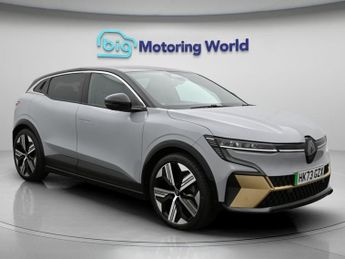
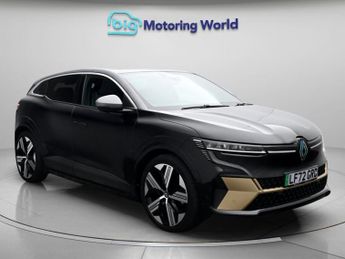
The Megane E-Tech is offered in three main models: Techno, Techno Alpine Spirit and Iconic Alpine Spirit. The latter two versions of the car lean on the expertise of Renault’s motorsport division Alpine, which also operates as its own standalone brand, selling some of the most exciting electric cars around. While each trim level brings improvements in tech, comfort, and battery range, we think it really is worth trying to reach for the Iconic Alpine Spirit, which is clear as the best all-rounder in the range. Colour options include Glacier White, Ceramic Grey, Shadow Grey, Diamond Black, Midnight Blue and Flame Red – some of which can be teamed with a Diamond Black roof for a stylish two-tone scheme.
Renault has equipped the Megane E-Tech with a strong safety package. Standard features include autonomous emergency braking, lane-departure warning, driver attention alert, and traffic-sign recognition. Euro NCAP awarded the car a full five-star safety rating, highlighting its particular safety for child occupants. With fewer moving parts than traditionally-powered cars, EV reliability is generally high, and the Megane E-Tech has a solid reputation among owners. For those who do require extra peace of mind, Renault offers a generous battery warranty, covering eight years or 100,000 miles.
As a fully electric vehicle, the Megane E-Tech produces 0 g/km of CO₂ emissions. In years gone by, this would have made it exempt from UK road tax but, with that benefit now lifted, it is now subject to the normal rate of £10 in the first year, then £195 from year two. For those who need to travel to London, it also qualifies for a 25% discount when driving in London’s congestion charge zone. When it comes to range, Renault claims that the basic car will do 285 miles between trips to the charger, while higher specs will return around 280, according to official figures. Those numbers are broadly in line with most of its rivals, although it is worth noting that EVs rarely live up to the claimed figures.
 London
London

London
Connect with us


