
Specifications
- Fuel types
- Electric
- No of seats
- 5
- Boot space
- 300 litres
- Dimensions
- 4,079 mm x 1,754 mm x 1,514 mm
- Fuel economy
- 191 – 251 miles
- Acceleration (0-62mph)
- 6.4 - 7.9 seconds
- Insurance group
- 20, 23, 29
- Body style
- SUV
- CO2 emissions
- 0g/km


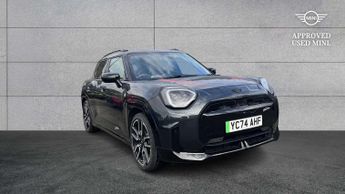
The Mini Aceman may fit the relatively small gap between the Cooper and the Countryman, but it's a big car for the brand. When it arrived in 2024 it took over from the strong-selling Clubman estate, but more importantly it was the first Mini to be designed exclusively as an electric car from the outset. While the Clubman was an estate car based on the Cooper hatchback, the Aceman follows the more fashionable SUV trend. It's a small SUV and rivals models like the Ford Puma Gen-E, Alfa Romeo Junior and Volvo EX30.
AA Cars Rating: 3.8/5
How we test carsThe Mini Aceman stands out thanks to its design and fun driving characteristics. It’s just a shame that the ride is on the firm side and the interior practicality is merely average.

Jack is an experienced motoring journalist who has been covering the latest new-car releases for the last 10 years.
Read bioThe range starts off at just under £29,000 for the smaller battery 'Aceman E' model, rising to around £32,000 for the larger-batteried 'Aceman SE'. The John Cooper Works (JCW) model comes in at a little under £37,000 and uses the SE's larger battery but offers more performance.
On the used market, the Aceman seems to be holding onto its value pretty well. On platforms such as AA Cars, used prices start at around £24,000 for the oldest models with around 10,000 miles on the clock. It means the Aceman has a slight premium over rivals from more mainstream brands such as Ford, Vauxhall and Peugeot.
Unlike many similarly-sized SUVs from Alfa Romeo, Ford, Vauxhall and Peugeot, the Aceman is electric-only – there are no petrol, hybrid or plug-in hybrid versions.
It's a very easy decision when choosing which Aceman to go for as there are just three options. The Aceman E uses a 38.5kWh battery pack paired with a 181bhp electric motor, while the SE packs a larger 49.2kWh battery and is mated to a 215bhp electric motor. The SE is slightly faster from zero to 62mph than the E, getting there 0.8 seconds quicker at 7.1 seconds; it also has a higher top speed – 105mph versus 99mph.
The JCW is the quickest of the lot thanks to its 227bhp electric motor. It has a 'Boost' mode that unlocks 254bhp, slashing the 0-62mph acceleration time to 6.4 seconds. For most of the time, however, the JCW runs in 227bhp form, and it uses the larger battery pack from the SE model.
All Acemans are front-wheel drive and offer up to 251 miles of range. Naturally the smaller battery delivers the shortest range, with Mini claiming a driving range of 191 miles between recharges, 251 for the SE, and 221 miles for the JCW.
Charging speeds are pretty poor, with the E only managing a maximum DC rate of just 70kW, and the SE and JCW peaking at 95kW. It means a 10-to-80-per-cent top-up at an on-street ultra-rapid charger will take around 30 mins, while an overnight charge takes between seven and nine hours. A heat pump comes as standard, though, making the Aceman more efficient in colder temperatures.
Just like all modern Minis, the Aceman prioritises fun over comfort.
The steering is nicely weighted and quick to react, and allied to a stiff suspension set-up and sharp throttle responses it means the Aceman feels alert – it's quick to change direction, giving the car a sporting feel. There are an array of different driving modes, including a 'Go Kart' setting that replaces a 'sport' mode. This makes the steering heavier, the throttle response even sharper, and adds a futuristic sound effect when the accelerator is pressed. But even in the default 'Core' mode the Aceman feels engaging to drive.
The Aceman is an easy car to drive around town with good visibility. It’s also pretty quiet, which is in keeping with the premium feel Mini tries to achieve. Impressively, this refinement continues on the motorway – there is a little wind noise, but it's nothing to complain about.
Along with that accurate steering, a stiff suspension set-up gives a really sporting feel. Through fast and twisty corners, the Aceman has minimal body roll. It's a very reactive and engaging small electric SUV to drive, and matches the Ford Puma Gen-E in this department.
The downside to stiff suspension is ride comfort. It's not too bad around town, particularly on the entry-level E model with its smaller 17-inch alloy wheels, but the Aceman does judder over potholes and speed humps more than rivals. Even on faster roads with smooth tarmac, the Aceman never feels settled. This feeling is only exacerbated in the John Cooper Works model, which delivers an especially hard ride.
In many ways, the Aceman is a classic Mini driving experience – it's more engaging to drive than rivals, but this drive fun comes at the expense of ride comfort.
It's not just the driving experience that's typically Mini, but the same goes for the interior look and feel. Design is a big thing for any Mini, as is a quality feel, and the Aceman is no exception.
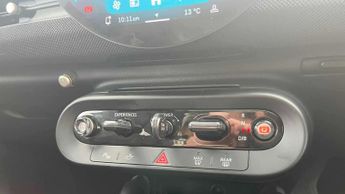
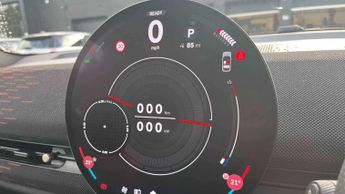
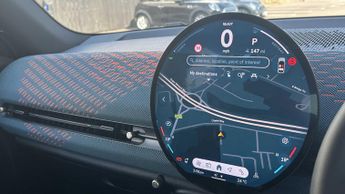
The cabin is very similar in layout to the smaller Cooper hatchback, with the dashboard dominated by a large circular OLED touchscreen that references the central speedo of the original 1959 Mini. The vast majority of the car's functions are controlled through the screen, but a small row of physical switches remain underneath it and the steering wheel has big, chunky buttons.
Most of the interior's surfaces are covered with a knitted material that gives an upmarket feel. Quality fixtures and fittings have long been a Mini hallmark, and the Aceman feels a cut above rivals in this respect.
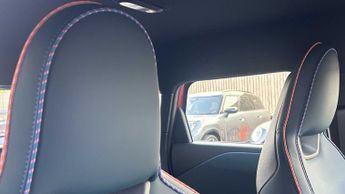
The Aceman has an elevated driving position and room up front is excellent, but space in the back is at a premium – a couple of six-footers can fit, but they probably won't be comfortable on a long journey. The back seats are better suited to a pair of passengers rather than three, but there are easily reachable Isofix child seat mounting points.
At 300 litres, the boot isn't especially big either. It is comfortably beaten by rivals like the Ford Puma and Skoda Elroq, but it can take the weekly shop or a pair of carry-on suitcases once you've hauled items over the high boot lip. The rear seats fold down pretty flatly, and split in a 60:40 format – once folded, there's 1,005 litres on offer.
It's simple to get your head around the Aceman's trim range as there are only three versions – E, SE and John Cooper Works. Within those there are Classic, Monochrome, Exclusive, and Sport versions, with the John Cooper Works only being offered in the latter.
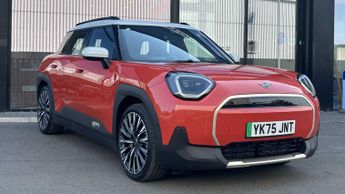
When buying new, many customers opted for the Classic version as it's very well-equipped. As standard it gets LED headlights, 17-inch alloy wheels, keyless start, dual-zone climate control, rear parking sensors, and the OLED touchscreen with in-built sat-nav and wireless Apple CarPlay and Android Auto phone connectivity. Higher trim levels like Exclusive and Sport offer a wider range of wheel designs, more tech such as a head-up display and adaptive cruise control, and the option to change the roof colour – there's even a distinctive colour fade variation.
When it comes to options, Mini has kept things simple and given the Aceman 'Levels'. These bundle together desirable optional equipment, so look out for these when sifting through used car listings.
Entry-level Classic models are well-equipped, with many owners choosing this version for this very reason. It gets LED headlights, 17-inch alloy wheels, keyless start, dual-zone climate control, rear parking sensors, sat-nav and wireless phone connectivity as standard. Monochrome adds black paint and black trim finish along with some other extra features, while Exclusive ramps up the luxury and tech equipment. Sport gives a racier look, while JCW models get a distinctive racy look all of their own.
The Aceman is available in an assortment of darker and brighter paint shades, plus there's the option to change the roof colour.
The Aceman received a full five-star safety rating from crash testers Euro NCAP thanks to its strong suite of safety systems fitted as standard. Adult occupant protection was rated as 83 per cent, and child occupant protection at 87 per cent. The Aceman is too new to feature in reliability surveys, but the Mini brand generally ranks averagely for owner satisfaction.
As it's a pure-electric car the Aceman could potentially offer rock-bottom running costs, particularly if you are a business user.
Mini claims up to 192 miles WLTP range for the E model and up to 252 miles for the SE, depending on wheel size. Due to its more potent power levels and larger wheels, the JCW manages 221 miles between top-ups. In real-world driving, however, you should expect between 160 and 180 miles for the Aceman E, 200-220 miles for the SE, and around 190-200 for the John Cooper Works.
Install a home charger and opt for an EV-friendly electricity tariff for the lowest running costs, while maintenance costs will be cheaper than an equivalent petrol car. Acemans registered after April 1, 2025, pay £10 a year VED for the first year and £195 thereafter (as long as the car didn't exceed £40,000 when new – if so, it’s £620 a year).
 Doncaster

Doncaster
Kingston-Upon-Hull
Connect with us


