Specifications

Fuel types
Electric
No of seats
4
Boot space
308–1,004 litres
Dimensions
3,701mm x 1,583mm x 1,519mm
Fuel economy
up to 140 miles WLTP (EV)
Acceleration (0-62mph)
13.7–19.1 seconds (0–62mph)
Insurance group
24A–25A
Body style
Hatchback
CO2 emissions
0 g/km
Browse 24 in stock

AA Cars review

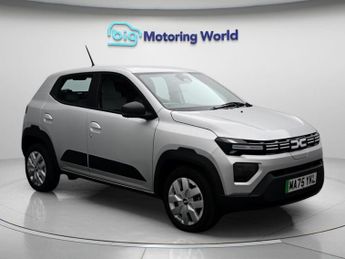
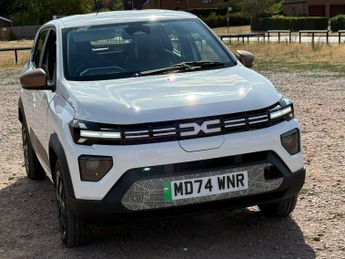
For those looking to get on the road for a minimal outlay, the Dacia Spring ticks a lot of boxes. Its simplicity is refreshing and imbues it with the sort of cheeky character that makes it a very loveable car to live with. Being a Dacia, it’s also very practical, if a little basic inside, with enough room for four adults. Driving it around town is fun, with plenty of power to navigate busy city streets, but things start to unravel on faster roads. The range and slow charging speeds limit road trips, and the average crash‑test performance are the downsides.
Jack Evans
Jack Evans

Jack is an experienced motoring journalist who has been covering the latest new-car releases for the last 10 years.

Read bio

3.8/5

How much does it cost?

All Dacia Spring models come with the same 24.3 kWh battery pack, with the only choice being how much power the single electric motor delivers.

As of early 2026, all UK‑spec Dacia Spring cars receive a revised powertrain that now delivers either 70 hp (51 kW) in Expression trim or 100 hp (74 kW) in Extreme trim, which cost £15,990 and £16,990 respectively. There’s also a £3,750 UK Plug‑in Car Grant (PICG) contribution that reduces the cost further for eligible buyers.

The 2026 cars also sport a refreshed chassis, retuned suspension and an upgraded braking system, with capability of charging at speeds of up to 40 kW DC. Previous models delivered either 45 hp or 65 hp and could only charge at speeds up to around 30 kW.

Despite the low price, even Expression cars come as standard with air conditioning, cruise control with speed limiter, electric front windows and rear parking sensors.

Engine and performance

Overview

The powertrain option in the Dacia Spring is modest, as that 51 kW or 74 kW motor develops just 137 Nm of torque. Despite the Spring being comparatively light, the 0–62mph time is 19.1 seconds in the lower‑powered option, or 13.7 seconds in the 74 kW model.

On slower roads or around town, the Spring easily keeps up with traffic and is actually fairly sprightly off the line, but with a top speed of just 78 mph, it runs out of puff on dual carriageways and motorways, so owners have to get used to sharing the inside lane with HGVs and slower-moving vehicles.

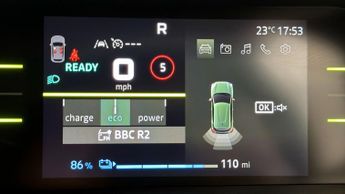
The small battery capacity of just 24.3 kWh also means that range is limited to 140 miles according to the official WLTP figure, but expect that to drop in colder weather and during adverse conditions. During our mixed‑road testing, it averaged around 90 miles on a single charge.

Dacia has increased the maximum DC rapid charge rate to 40 kW, which the company says is good enough to see a 20–80 per cent charge take around 29 minutes under ideal conditions.

Dacia Spring performance

Out on the road

For short trips and around town, the Dacia Spring is more than capable, with its diminutive footprint and sprightly handling making it excellent for threading through traffic.

Naturally, it’s very easy to park, with excellent visibility and the additional parking sensors ensuring it is simple to manoeuvre. When dashing away from the traffic lights or overtaking slower moving cyclists, it has enough power to feel sprightly, but the power very quickly runs out once the clocks reach around 30 mph.

With smaller wheels and low‑cost, narrow tyres all round, grip isn’t exactly a strong point, which some might find entertaining but the vast majority of drivers will consider it a concern.

The steering is very light, which is great for manoeuvrability but doesn’t do much for feel through faster corners, while the suspension is soft and spongy — great for soaking up bumps, not so good for controlling body roll.

While it is not impossible to tackle longer motorway trips, the Dacia Spring isn’t naturally at home on national speed limit roads. It takes a long time to get to 70 mph and sitting at that speed eats into range rapidly.

Surprisingly, the cabin is fairly quiet at higher speeds and the interior is generally well put together, with very few rattles or creaks.

Dacia Spring on the road

Ride and handling

As previously mentioned, the ride and handling are both designed for slower speeds around town. The steering is light but quick, while the turning circle is just 9.63 m, allowing rapid U‑turns.

The suspension is soft, soaking up speed bumps and imperfections in the UK’s often patchy road surfaces. As a result, it rolls around a lot through corners that, for anyone with any experience of a Citroën 2CV, can either be viewed as fun and quirky, or simply not good enough.

But customers have to remember this is a sub‑£16,000 car, so it’s never going to ride like a Rolls‑Royce. What’s more, the Spring handles and rides better than many of its closest competitors, with a footprint that suits basic urban driving without unnecessary complication.

Dacia Spring ride and handling

Interior and features

Interiors

The interior of the Dacia Spring brings with it plenty of learnings from its larger Duster sibling. That’s to say it feels robust, well put together and simple, even if many of the materials are cheap and scratchy.

The entry‑level Expression cars don’t come with a central touchscreen, instead offering a handy smartphone cradle and USB‑C inputs for drivers to charge and use their devices.

That said, they still get things like a tyre pressure monitoring system, lane keep assist and rear parking sensors, which feel especially generous given the price. Step up to Extreme and the Spring receives a simple 10‑inch touchscreen with built‑in navigation, a reversing camera and electrically adjustable door mirrors. Otherwise the interiors are almost identical, with robust plastics and basic fabrics taking the place of anything that feels even remotely premium.

Dacia Spring interior

Boot space and practicality

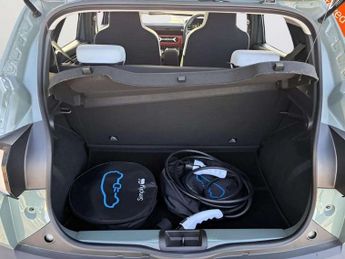
Let’s not beat around the bush here, the Dacia Spring is absolutely tiny, having to make do with just 308 litres of space in the boot with seats up.

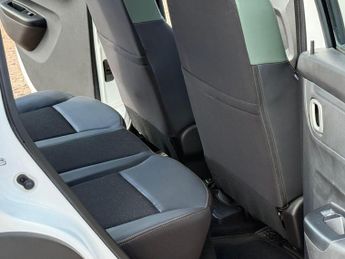
It is also only a four‑seater, although two adults will still be rubbing shoulders in the rear quarters. Stowage space increases to a much more practical 1,004 litres if you fold those two rear seats flat, though.

The front of the cabin feels slightly more spacious for the driver, but transporting a taller front passenger will quickly make things feel a little claustrophobic.

Dacia does a good job of adding a number of clever cubby holes and storage options inside the cabin, with cupholders and additional storage spots delivering an extra 33 litres of space to keep loose items secure.

The marque’s YouClip system is also compatible here, which allows owners to purchase accessories that clip into designated spots. These range from cable tidies to a 3‑in‑1 cupholder, lamp and bag hook.

Dacia Spring boot space and practicality

Features

As you would expect from one of the cheapest EVs currently on sale, the list of features that come with the Dacia Spring is fairly short, but that’s not to say it is bereft of creature comforts.

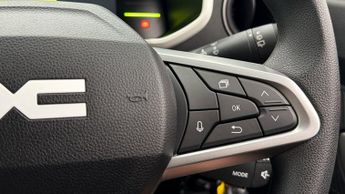
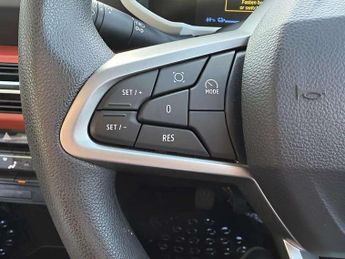
All models receive manually adjustable air conditioning, a media control stalk behind the steering wheel and USB‑C inputs for charging devices on the go.

Wing mirrors are manually adjustable in the Expression models, but Extreme receive electrically powered units. There’s also a large 10‑inch touchscreen infotainment system in the latter that is Apple CarPlay and Android Auto compatible.

This is a good thing, because the built‑in navigation can be slow to respond and often gets confused. Much better to just plug in a smartphone and use Google Maps, Waze or Apple Maps instead.

Dacia Spring feature

Trim and colour options

Only two trim levels are available and these have an impact on both the power output of the electric motor and the amount of additional features the car receives.

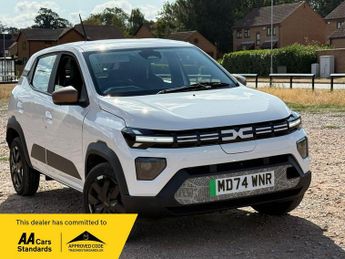
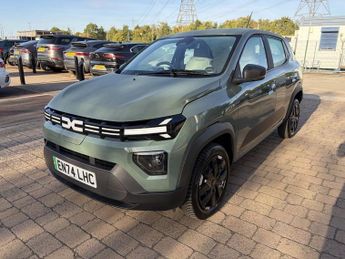
Expression comes with a choice of six colours, although only Polar White is standard and the others cost around £650extra. There is just one set of 15‑inch wheels with simple plastic covers and the upholstery is decked out in basic dual‑colour cloth.

Extreme models come in the same colour palette, but feature a slightly different 15‑inch wheel design sporting more stylish Danube copper and black wheel covers. The fabric is slightly upgraded with a TEP coating, which is more durable, water resistant and easier to clean.

Dacia also offers a number of official accessories for Spring, which range from the YouClip system of holders and clips inside the car to a power‑to‑object adaptor that allows owners to charge larger electrical devices using vehicle‑to‑load technology and the Spring’s battery.

Dacia Spring trim and colour

Safety and reliability

Despite offering some advanced driver assistance systems, such as lane keep assist, traffic sign recognition and autonomous emergency braking, the Spring performed poorly in Euro NCAP’s 2021 tests.

It scored just 49 per cent for adult occupant protection, 56 per cent for child occupant protection and 39 per cent for vulnerable road users. Euro NCAP criticised the Spring’s structural protection, noting that it lacked the rigidity to withstand higher‑speed collisions compared with other vehicles in the compact city car segment.

Dacia is a brand generally respected for reliability in budget segments, such as the Duster, but the Spring is still relatively new in UK ownership terms so comprehensive long‑term reliability data is limited. However, its simple drivetrain and fewer mechanical parts mean there’s inherently less to go wrong.

Dacia Spring safety and reliability

MPG, emissions and tax

Being an electric vehicle, the Dacia Spring doesn’t emit anything in the way of CO2, while miles per gallon also isn’t a consideration. Instead, prospective buyers need to look at the WLTP official range figures.

In both the Expression and Extreme models, this number is pegged at 140 miles on the combined cycle, which is intended to represent a mix of urban and higher‑speed driving. Dacia claims the battery is good for up to 195 miles in purely urban conditions, which can be typical for town‑only usage. Charging speeds have now increased so it can charge via DC fast chargers up to 40 kW, seeing typical 20–80 per cent sessions in around 29 minutes.

In terms of Vehicle Excise Duty (VED), the Spring falls under the same zero‑emission category as all battery EVs, meaning £0 VED in the first year and small standard rates thereafter (typically £195 per year). Given the low sticker price, buyers needn’t worry about the £425 Expensive Car Supplement, as the Spring is below the threshold.

Dacia Spring MPG, emissions and tax
Browse 24 in stock