
Specifications
- Fuel types
- Petrol
- No of seats
- 5
- Boot space
- 525 litres
- Dimensions
- 4,687mm x 1,903mm x 1,671mm
- Fuel economy
- 23.9 - 33.6 mpg
- Acceleration (0-62mph)
- 3.8 - 8.8 seconds
- Insurance group
- 33 - 50
- Body style
- SUV
- CO2 emissions
- 161 - 231 g/km


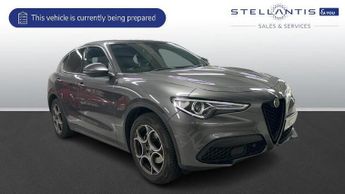
When Alfa Romeo first put the Stelvio on sale back in 2017, it represented something of a gamble for a brand that had built its reputation with stylish saloons and pretty little sports cars. The Stelvio was the outfit’s first attempt to dip its toe into the SUV market, with the Italian manufacturer looking to take on the likes of the BMW X3, Audi Q5 and Mercedes-Benz GLC. While the car has never sold in the same volumes as some of its competitors, it has proved popular with buyers who want an SUV that is still fun to drive. Fans will tell you it is a more interesting and left-field choice than the more established offerings from BMW, Audi and Mercedes, but is it one worth taking? We’ve been having a closer look to find out.
The Alfa Romeo Stelvio proves that an SUV doesn’t have to be dull. It’s one of the sharpest-driving cars in its class and delivers genuine personality in a market dominated by safe choices. While it isn’t the most practical or tech-heavy option, the Stelvio rewards drivers who still care about how a car feels from behind the wheel.

Jack is an experienced motoring journalist who has been covering the latest new-car releases for the last 10 years.
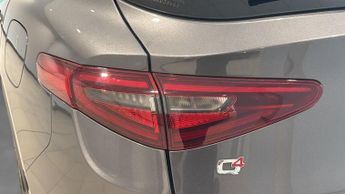
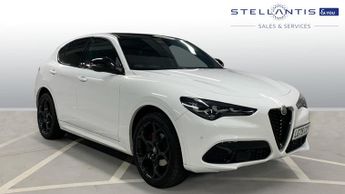
Read bioThe Stelvio is priced largely in line with most of its key rivals, with a look at Alfa’s online configurator showing prices for the most basic entry-level ‘Sprint’ cars kicking off at around £52,000. Elsewhere, mid-level ‘Veloce’ cars get underway at £57,000 and range-topping Intensa cars at £61,400. Meanwhile, the sportier ‘Stelvio Quadrifoglio’ has a list price of £95,890, pushing it firmly towards the more premium end of the market. Alfa also offers a wide range of optional extras which have the potential to rapidly push prices up if you’re not selective with what you want. On the used market, second-hand Stelvios can be found on AA Cars for around £14,000, although post-facelift cars will set you back at least £40,000. While those numbers may sound appealing from a buyers’ perspective, it is worth noting that the big Italian SUV is likely to depreciate at a faster rate than its German rivals, which could become an issue when the time comes to sell the car on again.
Standard versions of the Stelvio come with a 2.0-litre turbocharged engine, producing 280 bhp, while the prestigious Stelvio Quadrifoglio has a 2.9 V6 Bi-Turbo which throws out a whopping 520 hp, making it one of the most powerful SUVs on the market, with a 0–62 mph speed of just 3.8 seconds. Whichever version you do go for, the setup will be paired with an eight-speed automatic gearbox which feels smooth and responsive. Unlike Alfa’s smaller SUV – the Junior – the Stelvio has no electrified powertrains, although older cars were available with a choice of 2.2-litre diesel engines that offered impressive torque and improved fuel economy.
When you start driving the Stelvio, it is immediately clear that the car has a different feel to the majority of family SUVs. While most put a premium on comfort and refinement, the Alfa targets pure driving pleasure and a sporty approach. This results in a particularly agile feel, which helps no end around town, where the car is easy to manoeuvre and precise. There is also good visibility from the raised driving position. When you leave town and head for the open roads of the motorway, the Alfa’s strong acceleration and eight-speed automatic gearbox make it an excellent long-distance cruiser. All versions of the car feel well-powered, although the Quadrifoglio in particular offers truly outstanding pace that would rival even some sports cars. While not as soft as many cars in this class, on the motorway it still feels comfortable, with wind and road noise kept to a minimum as part of a largely refined and stable driving experience.
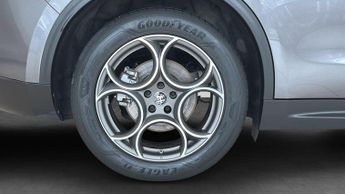
This is where the Stelvio undoubtedly comes into its own when compared to other cars of this size. The car has a balanced chassis and excellent weight distribution, which make the car feel composed and confidence-inspiring through corners. For a big, heavy SUV, body roll is kept impressively in check and there is a sharpness to the handling that very few rivals can come close to. The trade-off for this precision and excitement is a slightly firmer ride than you would expect from many of its rivals – especially if you opt for higher-spec cars with larger alloy wheels. However, by and large, the Stelvio does feel comfortable enough, with adaptive suspension, available on higher trims, allowing drivers to soften things for everyday use. Overall, the Stelvio feels like something of a break from the norm in the SUV market, and a very welcome one at that. While some buyers may prefer the softer setup of a Mercedes-Benz GLC, for example, anyone looking for pure driving pleasure could do a lot worse than taking a look at the Alfa.
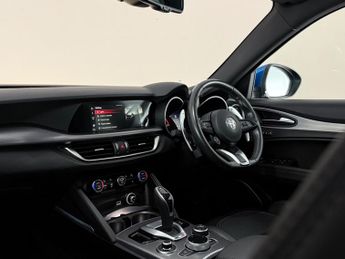
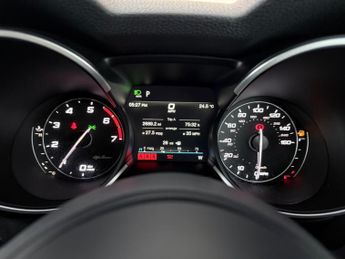
Alfa’s focus on driving precision continues when you take a look around the cabin of the Stelvio. Up front, the dashboard has been angled towards the driver for a better view of the instruments, which are clear and analogue, rather than the digital units often seen in this segment. There is also an 8.8-inch infotainment screen, which feels significantly smaller and less distracting than the set-ups seen in the equivalent German cars. Over the years, Alfa has had a long-running reputation for poor build quality and cutting corners
signs of improvement, with leather upholstery, aluminium trim and soft-touch surfaces used throughout much of the cabin. That said, the Stelvio’s interior still does not quite match the plushness of some rivals and when you look more closely, quite a few cheaper-feeling plastics have still made the cut. While this is disappointing, especially on a car with this price tag, the overall package is still a good step forward compared to some of the brand’s historic efforts.
When it comes to boot space, the Stelvio offers a respectable capacity of 525 litres, placing it towards the middle of its class, but below a number of its key competitors. The opening is wide and well shaped, making it easy to load bulkier items into the back and the space itself is more than enough for most family needs. Inside the cabin, passenger space is generally good, with plenty of headroom in both the front and back of the car. While legroom in the front is pretty good, taller passengers will find the rear seats a bit of a squeeze – particularly on longer journeys. Elsewhere, storage throughout the cabin is solid enough with cubbies in the centre console and door bins.
The Stelvio gets a decent level of kit as standard, with all models getting the touchscreen infotainment system, Apple CarPlay and Android Auto, cruise control and a range of driver assistance systems. Higher trims add features such as heated seats, premium audio, adaptive cruise control and larger alloy wheels. While the infotainment system has improved with recent updates, it still lags behind the very best in this class. As a result, most buyers will likely rely on smartphone connectivity, as opposed to using Alfa’s own systems.
The standard Stelvio is offered in three trim levels – Sprint, Intensa and Veloce. While each model adds additional luxury touches, the mid-range Intensa represents the sweet spot when it comes to blending costs and tech. Elsewhere, the Quadrifoglio is available in one trim, which includes all the bells and whistles. Colour choices include Alfa Red, Etna Red, Montreal Green and Vulcano Black.
In years gone by, Alfa Romeo has been a byword for poor reliability and mechanical headaches. While that stigma does continue to hang over the brand, recent times have seen a marked improvement, with several buyers reporting trouble-free ownership when the car is properly maintained. When it comes to safety, the Stelvio has a five-star Euro NCAP rating, with strong results for adult and child occupant protection. Standard safety features include autonomous emergency braking, lane departure warning and stability control, while higher trims add blind spot monitoring and adaptive cruise control.
Performance SUVs are never going to rank among the best cars on the roads for fuel efficiency and the Stelvio is no exception. Standard cars have an official mpg figure of 33.6 mpg, although real-world figures are likely to drop even lower than that. Meanwhile, Quadrifoglio cars will return just 23.9 mpg so get used to trips to the pump! When it comes to CO₂ emissions, the standard car throws out 192 g/km, rising to 267 g/km in the Quadrifoglio, which pushes the Stelvio into higher tax brackets. All versions of the car are also subject to the government’s Expensive Car Supplement, which applies to vehicles over £40,000. The tax costs £425 a year for five years, applied from the second year of registration.
 London
London
AA finance available

London
Connect with us


