
 Updated 03/09/2026
Read Time 7 mins
Updated 03/09/2026
Read Time 7 mins

The SUV market has boomed in recent years, with almost every car manufacturer now offering not just one SUV, but a whole range of them. That choice is useful, but it can also make it harder to work out which model genuinely fits your day-to-day needs.
The Peugeot 2008 and Peugeot 3008 are two of Peugeot’s most popular SUVs. Both offer chunky styling, useful practicality and a broad mix of petrol, hybrid and electric options, but they sit in different parts of the range.
The 2008 is the smaller, more urban-friendly SUV. The 3008 is larger, more refined and better suited to families or drivers who regularly travel longer distances. Here, we compare design, performance, practicality, technology, running costs and overall value to help you decide which Peugeot SUV is the right fit.
Peugeot 2008 vs 3008 at a glance
| Area | Peugeot 2008 | Peugeot 3008 |
|---|---|---|
| Best for | Drivers who want a compact, efficient and stylish SUV for city use and occasional longer trips | Families or regular motorway drivers who want more space, comfort and premium features |
| Size and space | More compact, with around 434 litres of boot space | Larger cabin, with boot space exceeding 520 litres |
| Power options | Petrol, petrol-hybrid and electric e-2008 | Petrol-hybrid, plug-in hybrid and electric e-3008 |
| Driving feel | Agile, easy to manoeuvre and well suited to urban driving | More planted, smoother over longer journeys and better for carrying heavier loads |
| Running costs | Lower running costs and generally lower insurance than larger SUVs | Higher costs, but more space, comfort and long-distance ability |
Design and styling
Both the Peugeot 2008 and 3008 are instantly recognisable as Peugeots thanks to the brand’s distinctive design language, which blends sharp lines with bold features and stand-out light signatures.
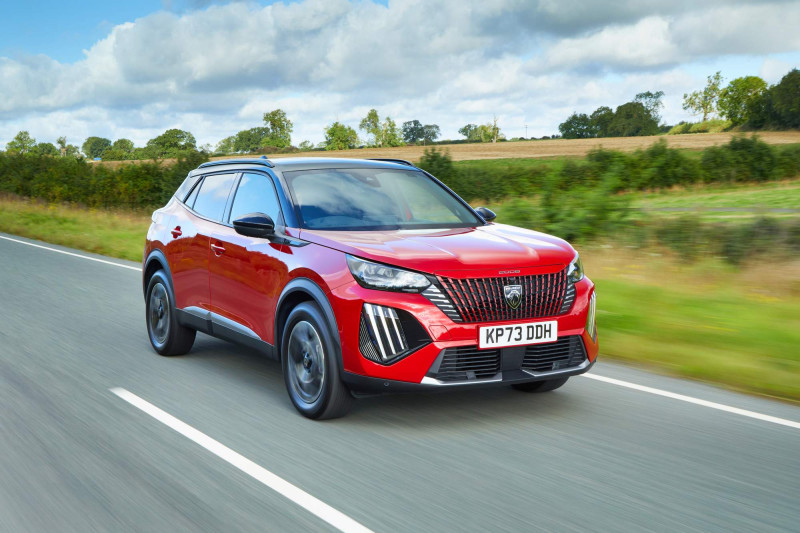
Being the more compact of the two, the 2008 offers a sportier, more youthful appearance. Its smaller stature gives it an agile look, with a prominent grille, signature LED lighting and sculpted sides. It suits drivers who want the SUV look without moving into a larger family car.
By contrast, the 3008 is its larger and more imposing sibling. It features a broader stance, a higher bonnet and a more pronounced grille, giving it a premium presence on the road. The 3008’s design tends to attract those who want their SUV to make a statement, while its refined lines and chrome accents contribute to a more upmarket feel.
Interior and comfort
Climb inside either the 2008 or 3008 and you’ll be greeted by Peugeot’s i-Cockpit layout, which features a compact steering wheel, a raised digital instrument panel and a central touchscreen. It gives both cars a distinctive cabin feel compared with more conventional SUVs.
The 2008’s interior is surprisingly spacious for a compact SUV, offering comfortable seating for up to five and a boot capacity of around 434 litres. Materials are of high quality, with soft-touch plastics, metallic accents and, in higher trims, ambient lighting and advanced upholstery.
Rear seat space in the 2008 is adequate for adults on shorter journeys, though taller passengers may find legroom a bit tight on longer trips. It’s an ideal car for small families, with more room than you might expect from a compact SUV.
The 3008 raises the bar for comfort and space. Its larger footprint translates to more generous legroom and headroom, especially in the rear seats, which are comfortable for most adults. The boot is significantly bigger, exceeding 520 litres, making it better suited to family luggage, pushchairs or regular long-distance trips.
The overall ambience in the 3008 is more upmarket, with higher-grade materials, larger infotainment screens and optional features such as a panoramic sunroof and heated and cooled massage seats. For those who value creature comforts and a more premium feel, the 3008 clearly has the edge.
Performance and driving experience
The Peugeot 2008 is designed for urban agility. Its smaller size makes it easy to manoeuvre through tight city streets, car parks and narrow residential roads.
Engine options include a 1.2-litre PureTech three-cylinder turbocharged petrol engine with either 100bhp or 130bhp, paired with either a six-speed manual or an eight-speed automatic gearbox. There’s also a recently added 145bhp petrol-hybrid unit, which uses the same PureTech engine with an added electric motor.
If you’d rather have an electric car, there’s also the e-2008. It comes with a 50kWh battery and an electric motor delivering approximately 136hp, offering zero-emissions driving and a range of up to 247 miles under the WLTP test cycle.
The 3008, thanks to its larger size, offers a more planted and stable ride. It is better suited to motorway cruising and long-distance journeys, with superior sound insulation and more powerful engine options.
Petrol options include the 1.2-litre PureTech turbocharged three-cylinder hybrid, as found in the 2008. There’s also a plug-in hybrid, which combines a 1.6-litre PureTech petrol engine with one or two electric motors, providing power outputs of either 225bhp in front-wheel-drive form or 300bhp with four-wheel drive.
.jpg)
The plug-in hybrid models offer an electric-only range of up to approximately 39 miles under the WLTP cycle, making them well suited to short commutes or urban driving if you can charge regularly. These powertrains help the 3008 deliver both efficiency and strong performance, catering to a wide range of driving needs.
For drivers interested in going fully electric, Peugeot also offers the e-3008. It uses a choice of 73kWh or 97kWh batteries, with a WLTP range of either 326 or 435 miles. Performance is brisk, with instant torque delivery and smooth acceleration typical of electric vehicles.
The e-3008 supports rapid charging, allowing for a significant recharge in as little as 30 minutes at fast-charging stations. Peugeot claims you can add 62 miles in 10 minutes.
The 3008’s ride quality is smoother over rough roads than the 2008’s. Its handling is not as nimble, but it remains composed and confidence-inspiring. For those who frequently travel long distances or carry heavier loads, the 3008 is the more capable all-rounder.
.jpg)
Technology and features
Peugeot has packed both the 2008 and 3008 with a strong level of technology. The 2008 comes with a digital cockpit, a touchscreen infotainment system, Apple CarPlay and Android Auto, plus a suite of driver assistance features such as lane keeping assist, adaptive cruise control and automatic emergency braking.
Higher trims add features such as wireless charging, a premium audio system and advanced navigation. For a compact SUV, the 2008 feels well equipped and easy to live with.
The 3008 builds on that with a larger digital instrument cluster, multi-zone climate control and a wider array of safety technology, including adaptive LED headlights and blind spot detection. It feels more grown-up and better suited to drivers who want a cabin with a stronger premium feel.
.jpg)
Running costs and practicality
One of the main attractions of the Peugeot 2008 is its low running costs. Thanks to efficient engines and its lighter weight, fuel consumption is modest, and insurance premiums are typically lower than those for larger SUVs such as the 3008.
The e-2008 is especially appealing for urban commuters, with zero tailpipe emissions and lower day-to-day maintenance needs than a petrol model.
The 3008 offers more space and power, so it naturally comes with higher running costs. Fuel economy is still competitive, but it is not as frugal as the 2008. Plug-in hybrid and electric models can help reduce day-to-day expenses, but higher purchase prices and insurance costs should be considered.
For families or those who need more versatility, the extra outlay may be justified by the added practicality and comfort. But if the 2008 is big enough for your lifestyle, it may well be all you need.
.jpg)
Value for money
In terms of pricing, the 2008 is positioned as a more affordable entry into Peugeot SUV ownership. That makes it ideal for singles, couples or small families who want a stylish SUV with a generous list of standard equipment.
The 3008 is a step up in size and luxury, so it commands a higher price. However, its superior refinement, extra space and additional technology may be enough to make you stretch your budget, especially if you regularly carry passengers or luggage.
Both models retain their appeal well, thanks to Peugeot’s popularity in the SUV market. As with any used car, condition, mileage, service history, battery health on electric models and overall specification will all influence value.
Which Peugeot SUV should you buy?
Ultimately, the choice between the Peugeot 2008 and 3008 comes down to your personal priorities.
If you need a compact, efficient and stylish SUV for city driving and occasional longer trips, the 2008 is hard to beat. It’s affordable, easy to live with and packed with features.
If you require more space, comfort and premium touches, perhaps for family duties or regular motorway travel, the 3008 is well worth the extra investment.
Peugeot offers two excellent options that cater to a wide range of buyers. The 2008 is the practical compact SUV, while the 3008 gives you more room, refinement and long-distance comfort.


