Our comprehensive guide explains the key rules and requirements for driving in France – from essential documents and road laws to fuel, parking, and fines.
Before you travel, it's also worth considering European breakdown cover for added peace of mind.
In this article
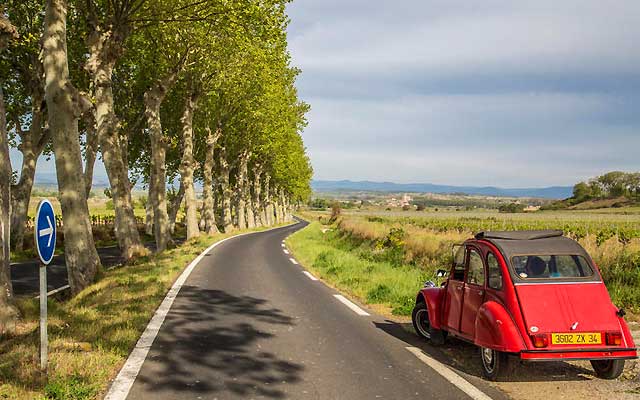
Important information for driving in France
- In an emergency, call 112 for ambulance, fire or police services.
- On motorways, use the orange emergency phones where possible.
Documents and items required to drive in France
You must carry certain documents and items when driving in France. Failure to comply can result in on-the-spot fines or even vehicle confiscation.
- Driving licence: A full, valid UK licence is required (minimum age 18). You don't need an international driving permit (IDP) to drive in the EU.
- Passport: The driver and passengers must have passports valid for at least 3 months beyond your stay.
- Insurance documents: UK policies provide the necessary minimum third-party cover.
- Vehicle logbook (V5C) for your vehicle or VE103 for a hired vehicle.
You must also have:
- UK sticker on the rear of your vehicle (if not already on the number plate).
- Reflective jackets easily accessible inside the vehicle - if you have to stop in an emergency or break down, put it on before getting out of the vehicle.
- Warning triangle – if you have to stop in an emergency or break down, place the triangle at least 30 m behind the vehicle, when safe to do so. On motorways, use the orange emergency phones or call 112.
- Headlamp beam deflectors fitted for driving on the right.
- Crit'Air sticker for driving in low emission zones.
Additional compulsory requirements can include:
- Angles Mortes blind spot stickers for vehicles over 3.5 tonnes.
- Winter tyres or snow chains in certain regions.
- Reflective stickers on motorbike helmets for driving at night.
EU entry requirements
EES (Entry/Exit System): Introduced in April 2026, it replaces passport stamps with digital records for non-EU nationals. You may need to register biometric details at the border. More about the EES.
ETIAS: Expected late 2026. UK travellers and other visa-exempt nationals will need an ETIAS travel authorisation before travelling to France or other participating European countries once live. More about ETIAS.
Low-emission zones – Crit'Air sticker
Many French cities require a Crit'Air vignette (clean air sticker). This applies to UK vehicles.
- Permanent restricted traffic zones, known as Zones à circulation restreinte (ZCR): such as Grenoble, Paris, Lyon, Strasbourg, Nice and Toulouse; new cities can be added at any time.
- Temporary air protection zones, known as Zones de protection de l'air (ZPA): activated when pollution levels are high.
Order your Crit'Air sticker only from the official French government website. Failure to display a valid sticker can result in fines of up to €450.
Crit'Air categories
- Green – Crit'Air E (electric and hydrogen vehicles, no emissions)
- Purple – Crit'Air 1 (gas and rechargeable hybrid vehicles)
- Yellow – Crit'Air 2 (Euro 5 and Euro 6 vehicles)
- Orange – Crit'Air 3 (Euro 4 vehicles)
- Burgundy – Crit'Air 4 (Euro 3 vehicles)
- Dark grey – Crit'Air 5 (Euro 2 vehicles)
Each urban zone sets its own minimum sticker requirement for entry.
Cars registered before January 1997 and motorbikes or scooters registered before June 2000 can't be driven in any low emission zone.
Driving rules in France
- Drive on the right-hand side.
- Priority is usually given to traffic from the right unless indicated by road signs.
- As in the UK, traffic on a roundabout has priority.
- Overtake on the left.
- When overtaking a bicycle, leave a space of at least 1 metre in built-up areas and 1.5 m outside of built-up areas.
Speed limits in France for cars
- Motorways: 130 km/h (110 km/h in wet conditions)
- Dual carriageways: 110 km/h (100 km/h in wet conditions)
- Main roads: 80 km/h
- Built-up areas: 50 km/h
In fog, the limit is 50 km/h on all roads.
For the first 3 years of their licence, new drivers must display a white disc bearing the red letter 'A' (apprentissage) at the rear of the vehicle. They must also keep to these lower speed limits:
- 110 km/h on motorways
- 100 km/h on urban motorways
Speed camera detectors
Devices that show the location of speed cameras are illegal in France.
If you're caught using one, you could face a fine of up to €1,500, 6 penalty points and possible vehicle confiscation.
And bear in mind, French speed cameras are not always signposted.
Speeding fines in France
Fines range from €135 to €1,500. Severe offences may result in 6 penalty points, and even licence suspension and vehicle confiscation.
Traffic lights in France
France uses green, amber, and red lights like the UK.
A flashing amber light means slow down, or proceed but give way to vehicles on the right.
Driving through a red light in France typically results in a fixed fine of €135.
Seat belt rules in France
Seat belts must be worn at all times by occupants in the front and rear seats. Drivers are responsible for ensuring that passengers under 18 are properly restrained.
In older vehicles not fitted with rear seat belts, rear passengers may be exempt.
Failure to wear a seat belt can result in a fine of €135.
Child seat regulations
Children under 10 must use an approved child restraint suitable for their size, weight and age. Child seats should normally be fitted in the rear.
Child restraints are divided into the following categories:
- Group 0 (under 10 kg): a rear-facing seat placed on the front passenger seat with airbag switched off, or on the back seat. Babies may also be placed in a carry cot on the rear seat only.
- Group 0+ (under 13 kg): a larger version of Group 0 with the same installation rules.
- Group 1 (9–18 kg): a child seat with a 5-point harness or protection tray.
- Group 2 (15–25 kg): a booster seat or cushion with an adult seat belt.
- Group 3 (22–36 kg): a booster seat or cushion with an adult seat belt.
Children may only travel in the front seat if:
- There are no rear seats.
- The rear seats are already occupied by children under 10.
- No rear seat belts are fitted.
If a rear-facing child seat is placed in the front, the passenger airbag must be deactivated.
Drink- and drug-driving laws in France
The legal drink-drive limit is 0.05% blood alcohol content, which is lower than in the UK.
The fines for exceeding the drink-drive limit are:
- 0.05% to 0.08%: fine of €135 and possible licence suspension.
- Above 0.08%: a criminal offence, with fines up to €4,500 and possible imprisonment.
Drivers with less than 3 years' experience and coach drivers have a lower limit of 0.02%. Drivers who exceed this limit may face a fine of up to €135 and a driving licence suspension.
Police can carry out random breath tests, which are mandatory following serious offences or injury-causing accidents.
Drug testing may also be carried out using saliva tests. Serious offences can lead to fines, licence suspension or imprisonment.
Mobile phones and headphones
Using a hand-held mobile phone while driving is illegal. Hands-free systems are permitted.
Headphones and earbuds, including Bluetooth devices, are also prohibited.
Offences typically result in a €135 fine.
Vehicle lights in France
Dipped headlights are recommended at all times.
UK vehicles must have headlamp beam deflectors fitted for driving on the right to avoid dazzling oncoming traffic.
It’s advisable to carry spare bulbs. Driving with faulty lights can result in a fine or vehicle immobilisation.
Tyre requirements in France
Tyres must have a minimum tread depth of 1.6mm across the surface.
If replacing a tyre, both tyres on the same axle may need to be changed if they're incompatible or if the difference in tread depth between them exceeds 5mm.
Winter tyres requirements
From 1 November to 31 March, vehicles in certain mountainous regions must either:
- Fit winter tyres on all wheels
- Or carry snow chains or snow socks for at least 2 wheels
The regions include the Alps, Massif Central, Jura Mountains, the Pyrenees, the Vosges and Corsica.
Road signs indicate when these rules apply.
Approved tyres must display the alpine symbol and appropriate markings (such as M+S, M.S or M&S).
Motor insurance in France
All vehicles must have at least third-party insurance, and UK policies provide this minimum cover.
Remember to carry proof of your insurance with you.
On-the-spot motoring fines in France
French authorities can issue fines immediately for traffic offences.
Fines typically range from €11 to €1,500. Reduced rates may apply for early payment, while late payment can increase the penalty.
Standard fines can be paid electronically in post offices and newsagents with a dedicated terminal, or online.
If the offence results in a driving ban, court appearance or prison sentence, visiting motorists may be required to pay a financial guarantee.
Parking rules in France
Follow local signs and markings when parking.
- Continuous yellow lines: no stopping or parking
- Broken yellow lines: no parking
- Two-way roads: park on the right only
- One-way streets: parking allowed on both sides where space permits
Vehicles parked illegally may be clamped, towed or impounded.
Disabled parking
Disabled parking is widely available, often free and time-unlimited, although some areas may impose time caps.
Recognition of UK Blue Badges can vary, so check local guidance before travelling.
Fuel in France
Unleaded petrol ((95-E10, 95 or 98 octane), diesel and LPG are widely available across France.
Check your vehicle is compatible with the available fuel, particularly E10 petrol.
LPG vehicles without safety valves may be restricted in underground car parks.
You can carry up to 10 litres of fuel in a spare container.
Most stations accept credit and debit cards. Many operate automated pumps, which may temporarily hold a deposit (typically €100–€150), which is refunded after fuelling.
Cash may only be accepted at staffed stations.
Electric cars in France
France has an extensive EV charging network. Locations can be found via apps or websites such as:
Payment for charging an electric car
Charging points may require apps, cards or access badges. Some retail locations even offer free charging.
Charges may be based on time rather than energy used.
Tips for driving an electric car in France
- Plan charging stops in advance.
- Use apps for access and payment.
- Charge overnight where possible.
- Avoid periods of high traffic congestion, which can drain your electric car battery.
Riding a motorcycle in France
- Helmets are mandatory for riders and passengers.
- All motorcycle helmets used in France must have a reflective sticker on the front, the rear and on each side. Each sticker must have a minimum surface area of 18 square cm.
- Dipped headlights must be used at all times.
- CE-approved gloves are required at all times.
- Reflective clothing must be worn in emergencies.
Towing a caravan or trailer in France
You can tow trailers up to 750 kg with a standard licence.
Passengers must not travel in caravans while in motion.
Speed limits for gross combination weight – car and caravan or trailer
- Under 3.5 tonnes: standard speed limits apply.
- Over 3.5 tonnes: 90 km/h on motorways, 80 km/h on dual carriageways and other roads, and 50 km/h in built-up areas.
Tolls in France
Many French motorways ('A' autoroutes) are toll roads (péage). You pick up a ticket as you enter and pay as you leave the autoroute.
Payment methods include card and cash. Some routes now use barrier-free systems with payment by electronic toll tags ('t' or Télépéage symbol).
Electronic toll tags are available through a toll-tag account or subscription from providers such as Emovis Tag UK.
If you're not in a hurry, the long straight D roads between major towns are a pleasure to drive.
Accident reporting in France
In the event of an accident:
- Turn on the hazard lights
- Put on a reflective jacket
- Where safe, place a warning triangle 30 m behind the car (not on motorways)
- Exchange details with other parties
- Notify your insurer within 5 days
- In an emergency call 112
On motorways, use the orange emergency phones to call the emergency services.
Roadside assistance in France
If you break down:
- Switch on the hazard lights
- Put on a reflective jacket
- Exit the vehicle safely
- Where safe, place a warning triangle 30 m behind the car (not on motorways)
On motorways you can't call your own breakdown provider directly. Instead use the orange emergency phones to contact a recovery service. If there is no emergency phone nearby, call 112.
Get everyone behind the safety barrier if it is safe to do so.
Your vehicle will usually be towed to a safe location, where your breakdown provider may then be able to help.
If you're planning a driving trip through France, check out our European breakdown cover.
Our cover ensures driving in France is never a worry – if your vehicle breaks down, we'll help. We offer alternative accommodation and travel arrangements, recovery of your vehicle back to the UK, and up to £50,000 in legal costs


