Chase the stars: the UK’s best stargazing sites for 2026
Data shows an increase in stargazing-related searches. In the past year UK Google searches for 'stargazing UK' are up 30%, while queries for 'go stargazing' have increased 50%. Searches for 'stargazing locations near me' have jumped even further, doubling since 2025.
While curiosity for stargazing is growing across the country, many people may not be aware that some car insurance policies might not offer full cover in certain remote locations.
For example, some stargazing spots might only be accessible by driving off-road, which may not be covered by your policy. So it's worth checking your policy details before you set off on your next stargazing adventure.
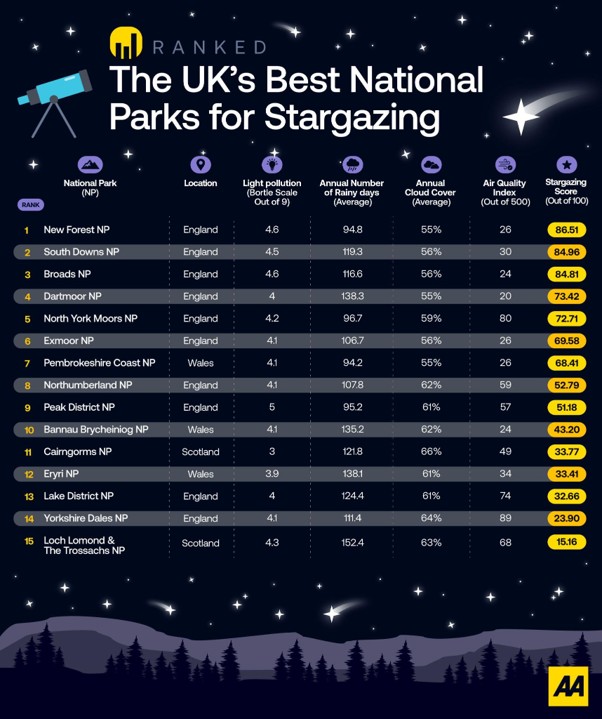
Yet we don't want to put you off from sky watching. It's perfectly possible to go stargazing while staying fully insured. To help you decide where to visit to spot constellations, we've researched the UK's best stargazing spots by analysing the locations' light pollution levels, cloud cover, air quality and the average number of rainy days.
The top stargazing spots by region
We assessed 15 national parks across England, Scotland and Wales to see which ones rank the best for stargazing.
If you're heading out on a UK road trip soon, why not try several stargazing spots on our map to compare them for yourself?
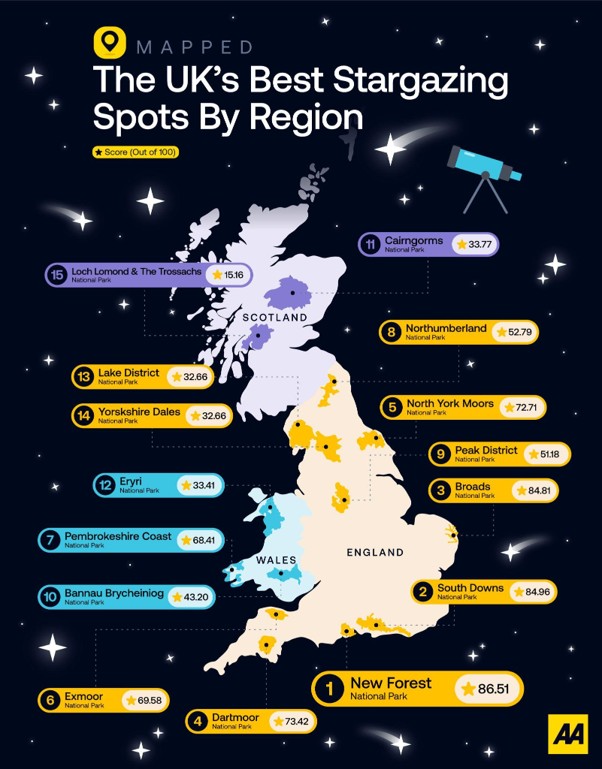
The UK's best national parks for stargazing
Based on our research, here are the top five stargazing locations.
1. New Forest National Park
Claiming the top spot, the New Forest National Park in the south of England is famous for its free-roaming ponies. So you can spot wildlife alongside stars. Of our top five, it has the fewest rainy days annually. On average it will rain for just under 95 days a year, so you're less likely to get soggy while stargazing.
Primarily located in Hampshire, it's easily accessible for drivers as it's bisected by the A31 road, which meets the M27 motorway at Cadnam (Junction 1).
2. South Downs National Park
Also in the South of England, the South Downs is England's newest national park – officially becoming one in 2010. Stretching from Winchester in Hampshire to Eastbourne in East Sussex, the area includes the natural landmarks of the Seven Sisters chalk cliffs and Beachy Head.
With only a marginal difference in light pollution and cloud cover levels to our number one, the South Downs makes a great stargazing spot with the bonus of sightseeing.
3. Broads National Park
The Broads National Park encompasses a network of rivers and lakes across the east of England in Norfolk and Suffolk. With an average of 56% cloud cover, it offers a good chance of seeing the stars.
The park is well served from various major roads from London, the south-east, the Midlands and the north.
4. Dartmoor National Park
South-west England is home to Devon's Dartmoor National Park. It's a vast moorland with deep river valleys, forests, wetlands and wild ponies. You'll also find Neolithic tombs, Bronze Age stone circles and abandoned medieval farmhouses, so it's an area with lots of history.
As for its stargazing credentials, it has the lowest amount of light pollution out of our top five picks. The darker sky makes it easier to see the Milky Way.
You can get to the park via the M5 motorway or the A30.
5. North York Moors National Park
Situated in North Yorkshire in northern England, the North York Moors National Park is the largest expanse of heather moorland in the UK. It offers popular cycling routes and hikes for day-time visitors, and idyllic spots for stargazing at night. With considerably better air quality than our other top spots, you can enjoy the freshness of country air.
You can drive straight across the North York Moors, with many scenic roads along your journey.
How to stay safe when stargazing
Stargazing often involves driving at night and parking in remote locations, which can increase certain risks. However, there are things you can do to keep yourself, your car and your belongings safe – and insured. Take care by taking note of these expert tips from Jack Cousens at AA Car Insurance.
Rest before your journey and plan breaks
Going stargazing might involve driving later and for longer than you're used to. This can affect your alertness. According to National Highways,1 fatigue is a factor in 13% of serious road incidents that happen during night drives.
You should never drive when tired, so it's important to be fully rested before you set off and stop for breaks. It's a good idea to take at least a 15-minute break every 2 hours. If you're concerned about your return journey, consider staying somewhere overnight and heading home the next day.
Keep your valuables with you
Don't leave any expensive equipment, such as binoculars or telescopes, in your car unattended. Leaving valuables in your car can increase the risk of theft.
Park in a well-lit area
When you're stargazing, you want as little light pollution as possible. However, you ideally want to leave your vehicle in a well-lit area. Lighting can deter some would-be thieves. Look out for official car parks which may have sufficient lighting and surveillance cameras.
Always lock your car
It may sound obvious but it's surprising how many people forget to lock their cars and close their windows. Take a moment to check that your vehicle is secure before you head off on your stargazing excursion.
Be honest when you apply for car insurance
If you plan to take your car to rural locations, let your insurer know when you apply for car insurance. You want to make sure that you'll still be covered in these areas. If you're using a roof rack, roof box or a tent box you should also tell your insurer. It's important to declare any accessories.
Methodology
The AA analysed 15 national parks across the UK by comparing:
- Light pollution (Bortle scale 1–9) – Lightpollutionmap
- Average number of rainy days per year – Weatherspark.com
- Average % of cloud cover per year – Weatherspark.com
- Air quality index (1–500) – weather.com (data for August 2026)
Each metric was then evaluated using an index system across these key metrics. A formula was applied to normalise each metric on a scale of 0 to 100.
For light pollution, average number of rainy days, average cloud cover and air quality index, the lower values received higher scores.
The final rankings were determined by averaging these index scores on a scale of 0 to 100, with the highest scoring national park ranked as the 'best for stargazing' overall. Data collected in August 2026.
1 National Highways data for serious road incidents and night and summer road deaths vs. winter road deaths caused by fatigue. Source: BBC.