If you’re planning a trip to Spain, it’s important to make sure you’re fully aware of the rules of the road and how they differ from the UK. It’s also a good idea to ensure that you prepare for any unexpected eventualities that could happen by purchasing AA European breakdown cover before you go.
Our comprehensive guide will take you through some of the laws for driving in Spain, covering everything you need to know, from required documents to general road rules and information about fuel, parking, and fines.
Important information for driving in Spain
In an emergency, dial 112. You can also call 092 for local police, 062 for guardia civil, 061 for ambulance or 080 for fire brigade assistance.
What documents and items do I need to drive in Spain?
There are certain documents that you must have in your car when driving in Spain. If you don’t have these documents (and other legally required items listed below) you might get a fine or penalty.
- Valid UK driving licence. The legal age to drive in Spain is 18, and you must hold a full, valid driving licence – provisional licences aren’t valid in Spain. If you plan to rent a vehicle in Spain, car-hire companies set their own minimum-age and licence-held requirements. Young-driver surcharges may apply, so check the supplier's terms before booking.
- Vehicle insurance documents. Always carry your insurance certificate with you in case you’re stopped and asked to present proof of insurance. UK insurers should provide the minimum third-party cover in Spain, but you should always check the duration of your policy with your provider.
- Proof of identity. A form of identification, such as a valid passport. The driver and passengers must have passports valid for at least 3 months beyond your stay.
- Vehicle log book (V5C) V5 registration log book (or a VE103 document for rented vehicles).
- Written authorisation if you are not the vehicle owner. If you’re driving a vehicle that doesn’t belong to you, you should carry written authorisation from the owner to take the vehicle to Spain.
- Hire vehicle documents. If you’re hiring a car, the rental company may need to register your passport details when you collect the vehicle. Always keep your hire agreement and vehicle documents with you.
There are also other items you will need to have in your vehicle when driving in Spain. These include:
- A UK sticker. A UK sticker must be clearly visible on the rear of your vehicle in Spain, even if your number plate already has a UK identifier.
- Warning triangle or V-16 emergency beacon. Spain has been phasing in the V-16 emergency beacon as a safer alternative to warning triangles. For vehicles registered in Spain, the DGT-certified V-16 beacon became compulsory on all roads from 1 January 2026. For foreign-registered vehicles, you do not have to have a V-16 beacon and can continue to carry and use a warning triangle or equivalent device as required by the country of registration.
- Spare wheel or puncture repair kit. You must carry a spare tyre, and the tools needed to change it, or a puncture repair kit and the equipment needed to use it.
- Reflective vest. You must carry and use a reflective vest if you need to leave the vehicle after a breakdown or accident. It is sensible to carry one for each person in the vehicle.
- Headlamp beam deflectors. UK headlamps are aligned to the left, so they can dazzle oncoming traffic when driving on the right in Spain. Beam deflectors can correct this.
- Fire extinguisher if towing. A fire extinguisher is compulsory if you're towing a caravan or trailer.
A first aid kit is recommended but not mandatory.
Do I need a green card to drive in Spain?
UK drivers don’t need to carry an insurance green card when taking their vehicle into Spain.
EU entry requirements
Entry/Exit System (EES). The EU's EES became fully operational on 10 April 2026. It replaces manual passport stamping with a digital record of entries and exits for non-EU nationals, including UK travellers. You do not need to apply for EES before travelling but may need to register biometric details at the border. For further information, check the latest official EES guidance before travelling.
European Travel Information and Authorisation System (ETIAS). ETIAS is expected to start in the last quarter of 2026. Once launched, UK travellers and other visa-exempt nationals will need an ETIAS travel authorisation before travelling to Spain or other participating European countries. No action is required until the system launches.
Low emission zones
Spain has low-emission zones, emergency pollution schemes and local access restrictions. Rules vary by municipality, and there is no central registration system for foreign vehicles. Check the local authority rules for every city or island you plan to drive into.
Permanent low-emission zones
Many Spanish towns and cities now operate, or are introducing, permanent low-emission zones. Madrid and Barcelona are the main examples for visitors, but other destinations may also have restrictions.
These zones require vehicles – including those registered abroad – to meet specific exhaust emission standards, register locally or obtain local authorisation before entering. Vehicles registered in Spain are classified using an eco-sticker, known as a distintivo ambiental, issued by the General Directorate of Traffic (DGT).
Foreign-registered vehicles are not normally issued a Spanish DGT environmental sticker through the standard national process. Each municipality sets its own procedure, which may involve registering the vehicle, obtaining an equivalent environmental classification, or applying for a particular permit. Access rules for vehicles without an environmental classification also vary by municipality.
Barcelona operates a 95 sq km low-emission zone covering the city and several neighbouring municipalities. Foreign vehicles must request prior authorisation through the Metropolitan Area of Barcelona registry before entering. Application process can take up to 15 days it is therefore advised to apply in advance.
Madrid has low-emission and restricted-access areas, including Madrid Centro. Madrid requires foreign-registered vehicles to be assigned an equivalent Spanish vehicle type and environmental classification. Once classified, they may enter only under the rules applying to the equivalent Spanish-registered vehicle. Applicants should submit the vehicle’s technical document, registration document and proof of ownership well before travelling
Benidorm operates a city-centre low-emission zone. Check the current map and access restrictions and apply for the relevant authorisation before entering where required.
Some Spanish islands also operate seasonal vehicle limits. Formentera applies tourist-season vehicle limits from 1 June to 30 September, and visitors need to obtain permits for their vehicles. Ibiza applies a daily cap on non-resident vehicles from 1 June to 30 September, and tourists bringing or renting vehicles need a permit.
Emergency low emission zones
Some cities in Spain have emergency anti-pollution protocols when air pollution levels reach dangerous levels. These can restrict vehicle access and change speed limits. Follow the instructions of the local authorities and check local information before driving into a city centre.
Driving rules in Spain
What is the legal age to drive in Spain?
The minimum age to drive a car is 18. Motorcycle entitlement depends on the licence category and vehicle power. You must be at least aged 16 to ride a motorcycle up to 125 cc and 11 kW and aged 18 to ride a motorcycle up to 35 kW.
What side of the road do I drive on in Spain?
All traffic in Spain drives on the right-hand side of the road, not on the left like the UK. If you hire a car, the driver’s seat will be on the left side of the car.
Who has priority?
At an unsigned junction, give way to traffic approaching from the right. Exceptions include traffic already circulating on a roundabout, vehicles on a paved road over vehicles approaching from an unpaved road, rail vehicles and vehicles already travelling on a motorway or autovía. Signs, markings, and traffic lights override the general rule.
Make sure you always give way to vehicles with sirens and flashing lights, like ambulances.
How do I overtake?
You must only overtake on the left side of a vehicle you want to pass.
Speed limits in Spain
All speed limits and distances in Spain are in kilometres and metres, as Spain uses the metric system. Always check local road signs, as limits can vary.
In built-up areas, the general limits are:
- 20 km/h on single-lane roads where the pavement isn’t raised from the road surface.
- 20 km/h in signed residential zones.
- 30 km/h on roads with one lane in each direction.
- 50 km/h on roads with 2 or more lanes in each direction.
- 80 km/h on motorways and dual carriageways in built-up areas unless signs show a different limit.
Outside built-up areas, the general limits for cars and motorcycles are:
- 120 km/h on motorways, dual carriageways, and highways.
- 90 km/h on other roads.
Vehicles towing a caravan or trailer are generally limited to 90 km/h on motorways, dual carriageways, and highways, and 80 km/h on other roads.
Motorhomes up to 3,500kg follow the same limits as cars. Motorhomes over 3,500kg are limited to 90 km/h on motorways, dual carriageways, and highways, and 80 km/h on other roads.
Motor vehicles must not normally travel below 60 km/h on motorways. A lower speed is permitted where traffic, road or vehicle conditions make it necessary for safety.
Speeding fines in Spain
Speeding fines can range from €100 to €600 depending on how far over the limit you are driving, and the type of road you are on. Some offences may also carry penalty points under the Spanish system.
More serious offences – including driving more than 60 km/h over the limit in built-up areas or more than 80 km/h over the limit outside built-up areas – can lead to licence suspension, vehicle confiscation and possible prison sentences.
Exceeding the speed limit could result in an on-the-spot fine and other serious consequences, as well as endangering your safety and the safety of others.
Speed camera detectors
Radar detectors and radar jammers are prohibited. Navigation devices and apps may warn about published camera locations, but must not detect, evade, or interfere with enforcement equipment.
Traffic lights in Spain
Spain uses the standard red, amber, and green traffic light system. Green, amber and red arrows are also used at some junctions.
Seat belt rules in Spain
Seat belts are compulsory for adults and children in both the front and back seats when driving in Spain.
If you don’t wear a seat belt, you’ll get a €200 fine.
Child seat regulations in Spain
Children under 1.35m tall must use an approved child restraint suitable for their size and weight and must sit in the rear seats where these are available. They may sit in the front only if the vehicle has no rear seats, if all the rear seats are occupied by other children requiring restraints. A rear-facing restraint in the front may be used only with the passenger airbag deactivated.
Children taller than 1.35m can use an adult seatbelt.
Drink-and-drug-driving laws in Spain
Drink-driving laws are very strict in Spain, and police regularly carry out roadside checks for alcohol and drugs.
For most drivers and cyclists, the legal limit is 0.05% blood alcohol, equivalent to 0.5g per litre of blood.
A lower limit of 0.03%, equivalent to 0.3g per litre of blood, applies to drivers during the first two years after obtaining a licence and to specified drivers, including those driving vehicles with more than 8 passenger seats, public-service vehicles, school transport, emergency vehicles, dangerous-goods vehicles, and goods vehicles over 3,500 kg.
A driver or cyclist suspected of being under the influence of alcohol or drugs, involved in a traffic offence, or involved in an accident may be required to take a test. Refusing a test can lead to vehicle immobilisation, licence suspension and a possible prison sentence.
Penalties for driving over the legal limit include heavy fines, loss of your licence and even prison sentences.
Mobile phones and headphones
Using a hand-held phone while driving, including while stopped in traffic, is prohibited. Park safely before using it. Using an earpiece or headphones is also against the law.
Using a hand-held mobile while driving can lead to a €200 fine.
Lights in Spain
Dipped headlights must be used when visibility is poor. As a guide, this means when you can’t read a vehicle’s number plate from 10 meters away or can’t distinguish a dark-coloured vehicle from 50 meters away.
Use dipped headlights in sufficiently lit tunnels. In an insufficiently lit tunnel, full beam may be used when travelling above 40 km/h, provided it will not dazzle another road user; otherwise use dipped headlights.
Front fog lights may be used where weather or environmental conditions significantly reduce visibility. Rear fog lights should be used only in especially adverse conditions, such as dense fog, very heavy rain, heavy snow or dense smoke or dust.
You mustn’t use full-beam headlights in built-up areas. Headlight flashing should only be used to warn other road users of an accident or road hazard, or to let the vehicle in front know you intend to overtake.
UK drivers should use headlamp beam deflectors or adjust headlights before driving on the right-hand side of the road.
In urban areas, the horn should not be used except in an emergency. Where audible warning is prohibited, drivers should flash their lights instead.
You may be fined up to €200 for not using your headlights correctly.
Tyre requirements in Spain
The minimum tyre tread depth for cars is 1.6mm in the principal grooves of the tread pattern.
Winter tyre requirements
Spiked or studded tyres are prohibited.
If you're planning to drive in mountainous areas or snowy conditions, it’s recommended that you carry and use snow chains. Snow socks may be used as an alternative. If you don’t, the police may stop you from driving if they decide the conditions are too dangerous.
When using snow chains, you must not exceed 50 km/h.
In some conditions, particularly on mountain passes, snow chains or winter tyres may become compulsory if there’s a public authority order or a specific road sign.
Motor insurance in Spain
All vehicles driving in Spain must have a minimum of third-party insurance cover. You’ll need to have your insurance documents with you at all times.
Fines in Spain
On-the-spot fines
Police can issue on-the-spot fines for a variety of offences, including speeding, drink-driving and not wearing a seat belt.
If you’re informed of the fine by post, your options to pay are:
- By phone: From Spain, call 060 (this service is in Spanish only, and payment is via credit card). From abroad, the contact number is +34 902887060.
- Online: From the General Directorate of Traffic of Spain
- In person:
- At branches of Caixabank.
- In Spanish post offices (Correos de España), paying an additional fee of 1.5% of the total amount.
- At Provincial Traffic Offices, using a credit or debit card.
Fines may be reduced by 50% if paid within 20 calendar days, although this doesn’t apply to major offences.
Visiting motorists may be required to pay fines immediately unless they can provide the name of a person or company in Spain willing to guarantee payment. Otherwise, the vehicle may be immobilised until the fine is paid.
Some motoring offences are treated as criminal offences and can lead to much higher penalties, vehicle confiscation and possible prison sentences. These include very high speeds, refusing to take an alcohol or drug test, reckless or dangerous driving, driving under the influence of drugs, and driving without a licence.
Parking fines
If you park illegally, your vehicle may be towed away or clamped. If your vehicle is impounded, you’ll usually need to pay the parking fine, towing costs and any impound parking fee before the vehicle is released.
Parking regulations in Spain
Most cities have regulated parking spaces, operated by parking meters or mobile payment systems. Prices and time limits for parking will vary, so always check local signs.
Disabled parking in Spain
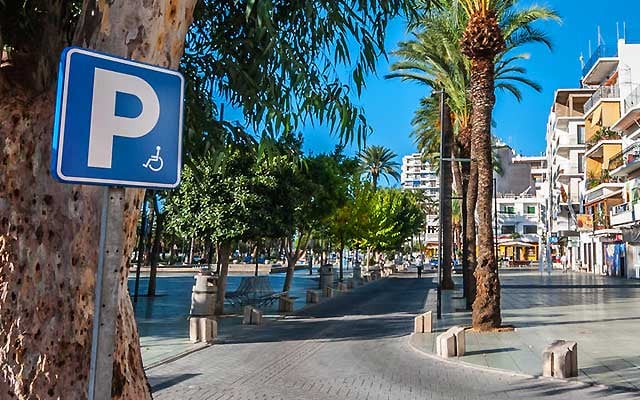
Disabled parking concessions in Spain are managed locally or regionally. Reserved parking spaces are normally marked with a wheelchair symbol.
Rules, fees, and time limits can vary by municipality and car park. Don’t park where parking is prohibited, or in pedestrian zones, unless local concessions specifically allow it.
Recognition of UK Blue Badges is decided by local or regional authorities in Spain. Check the rules for each municipality or region you will visit. Display the badge clearly at the front of the vehicle and always check local signs and car park notices.
Fuel in Spain
Availability of fuel
Unleaded petrol (gasolina sin plomo) and diesel (gasóleo A) are widely available in Spain. LPG is sold as Autogas and is available at some service stations.
Leaded petrol isn’t available.
All electrical and electromagnetic equipment must be switched off when refuelling, including lights, radio, and mobile phones.
You may import up to 10 litres of fuel into Spain in spare cans.
Fuel prices in Spain
Fuel prices in Spain, as with everywhere else, may vary. You can use a website such as https://www.globalpetrolprices.com/Spain/ to check current prices before you travel.
How do I pay for fuel in Spain?
Credit and debit cards are accepted in most stations, but it’s worth checking with your bank before travelling. You can also pay for your fuel with cash.
Electric cars in Spain
Where can I charge my electric car in Spain?
You can use an online map such as Chargemap and apps such as EasyCharging to find electric vehicle charging points in Spain. Plan your route before you travel.How do I pay for electric car charging?
Credit cards are accepted at many charging points and service stations, but it’s worth checking with your bank before travelling and registering with any charging apps you plan to use.
Tips for driving an electric car in Spain
- Plan your routes in advance using a map of charging stations, so you can recharge as needed.
- Plan to charge your electric car overnight if possible.
- Download and register with apps to use and pay for charging points to make the process smoother.
Riding a motorcycle in Spain
Motorcycle regulations
- Motorcycles on the road must always have their lights on.
- Crash helmets are compulsory for riders of mopeds, motorcycles, trikes, and quads, unless the vehicle is equipped with seat belts. This also applies to any passengers.
- A child under 7 can’t be carried as a passenger on any motorcycle or moped.
- A passenger must normally be at least 12 years old. A child aged 7 or over may be carried when the rider is their parent or guardian, or an adult authorised by them, provided the other passenger and helmet requirements are met.
- Moped riders under 18 must not carry passengers.
From 1 October 2026, riders and passengers of motorcycles and mopeds must use helmets approved to UNECE Regulation No. 22, wear protective gloves on interurban roads and wear closed footwear covering the whole foot on all roads. Motorcycles must also carry a high-visibility vest, which the rider must wear when leaving the vehicle on an interurban carriageway or shoulder.
Driving with a caravan or trailer in Spain
If a campervan is over 12m long, or a car and caravan/trailer combination is over 12m long, it must have 1 or 2 yellow reflectors with red borders at the rear. This can be either one long reflector of about 130cm x 25cm, or 2 shorter reflectors of about 50cm x 25cm.
A fire extinguisher is compulsory if you’re towing a caravan or trailer.
Drivers towing caravans may need extension mirrors, as drivers must have a clear rear view of at least 50m.
Speed limits for cars towing a caravan or trailer
Vehicles towing a caravan or trailer are generally limited to 90 km/h on motorways, dual carriageways, and highways, and 80 km/h on other roads.
Motorhomes up to 3,500kg follow the same limits as cars. Motorhomes over 3,500kg are limited to 90 km/h on motorways, dual carriageways, and highways, and 80 km/h on other roads.
Tolls in Spain
Most roads in Spain are free to use, including motorways.
However, there are still some motorways that may require a toll payment to use. The cost varies for each route; you can check which motorways require a toll payment – along with the current tariff – here.
Paying for tolls
You can pay tolls in cash or by credit card.
Many motorways use an electronic toll system, known as Telepeaje or Via T. This lets drivers pass through designated toll lanes without stopping.
Emergency telephones linked to an SOS network are installed at regular intervals on motorways.
Toll-free routes
If you wish to avoid tolls, there are alternative routes that are free to use. Just make sure to plan your trip in advance.
Roadside assistance in Spain
If you break down, switch on your hazard lights and move to a safe place away from traffic. If you must leave a stopped vehicle, put on a high-visibility vest before getting out. Leave from the side away from traffic where possible and wait behind a safety barrier or far away from the carriageway.
If you are involved in an accident
If you’re involved in an accident, or witness one, you must help anyone who’s injured and take steps to keep traffic safe. Put on a reflective vest before leaving your vehicle.
Call 112 if anyone may be injured, the road is unsafe or blocked, or the people involved cannot exchange the required details. Follow the emergency operator’s instructions.
If possible, complete and sign an accident statement form with the other party. Take photos of the vehicles and location if it’s safe to do so. If another driver refuses to give their details, call the police.
Emergency numbers
In an emergency, call 112.
You can also call:
- 092 for local police
- 062 for guardia civil
- 061 for ambulance
- 080 for fire brigade assistance
If you are planning a driving trip through Spain, check out our European breakdown cover page for a quote. Our cover ensures driving in Spain is never a worry – if your vehicle breaks down, we'll help.
We offer alternative accommodation and travel arrangements, recovery of your vehicle back to the UK, and up to £50,000 in legal costs.
21 September 2026


