While effective when properly used, traffic calming measures have been accused of increasing exhaust fumes from braking cars, slowing down emergency vehicles and angering residents. So are they really effective? What's the point of speed bumps exactly? Are we stuck with them? And are there any decent alternatives?
What is a speed bump?
Speed bumps are a type of traffic calming measure designed to slow the speed of any vehicles, therefore improving safety for both road users and pedestrians. There are some variations of speed bumps, known as sleeping policemen, speed humps, speed cushions and speed tables.
Do speed bumps work?
Traffic calming measures such as speed bumps are designed to slow traffic down and are usually used in residential or busy pedestrian areas, but how do speed bumps work exactly?
Traffic calming measures like humps and bumps can help enforce lower speed limits, as most drivers are aware that driving over a bump at speed could cause damage to their own vehicle.
However, critics point out that speed bumps have a number of unintended consequences. Some traffic may transfer to other roads to avoid the humps, moving the problem rather than solving it. And because drivers generally don't stick to a steady speed, the extra acceleration and braking caused by speed bumps can contribute to local air pollution.
Ultimately, successful speed limits should be self-enforcing through both good road design and clear signs.
We provide 24/7 roadside assistance.
Types of speed bumps and speed inhibitors
- Speed bumps: Designed by Compton, usually made of plastic or rubber and clearly marked with paint. According to UK law, they can be as high as 100mm, so that a car has to slow down to 5mph to navigate one without damage. Because they need such a significant speed reduction, they're most often used in parking lots, private roads and in some residential areas.
- Speed humps: Large bumps that span the entire width of the road. They look more like a feature of the road itself than speed bumps do, as they're covered in asphalt or tarmac. They also have a maximum height of 100mm, but they're usually not as tall as speed bumps. They’re often used in residential areas but they're not suitable for bus routes.
- Speed cushions: Essentially speed humps that have been broken up into discrete parts. They look like short rectangular lumps in the road that come in twos or threes, depending on the width of the road. Because they're broken up, emergency vehicles; with their wider axles; can pass over them without slowing down.
- Speed tables: Elongated road humps that taper up from road level to a flattened top over a longer distance. They can be used at a junction or to form a pedestrian crossing. And they're easier for heavier vehicles to get over.
- Chicanes: Artificially constructed bends that make the road into a snake-like shape. Drivers have to reduce speed to navigate the curves.
- Sleeping policemen: A variation of a speed hump, sleeping policemen are known by their distinctive black and yellow colouring – named as such as they (somewhat) resemble a bright and noticeable policeman outfit lying in the road.
How should I drive over speed bumps?
Slowly. Driving over speed bumps too fast can potentially cause damage to your car.
If you drive over them slowly, you shouldn’t see any damage to your car at all, but over time, regularly driving over cushions can increase the wear on the inner shoulder of your tyres. Take the time to check your tyres every now and then.
Is it ok to drive fast over speed bumps?
No, it’s not ok to drive fast over speed bumps as this can lead to damage to your vehicle – components that could be damaged include the springs, ball joints, shock absorbers, struts, and even the alignment of your vehicle could be skewed.
The impact of driving fast over a speed bump is comparable to hitting a pothole at speed, meaning your tyres could be at risk of getting blown out or losing pressure.
The history of speed bumps
- Traffic calming first appeared around 1906 in Chatham, New Jersey, when the average speed of an automobile had reached 30mph.
- In 1953, a physicist named Arthur Holly Compton invented 'traffic control bumps’ – pretty much the rubber speed bumps we know and love today – to slow down cars whizzing past his university.
- It wasn't until 1970 that the first speed bump appeared in Europe, and speed humps finally made their way to Britain in 1983.
Are Speed bumps the only way to calm traffic?
No. Many factors contribute to the increased road safety we’ve enjoyed over the years, including road design, vehicle design, driver education and enforcement. Most traffic calming measures in the UK may improve safety but that doesn't mean all speed bumps make the road safer wherever they're implemented.
While it should never be at the expense of road safety, the removal of some speed humps in cities could help improve traffic flow and reduce exhaust emissions.
The future of speed bumps
Most speed bumps and humps are little more than lumps of tarmac but the latest 'intelligent' speed bump is filled with a non-Newtonian liquid that hardens if you go too fast. The design means slow drivers won't be affected but motorists driving too fast will be met with a bump. These liquid speed bumps are currently only used in parts of Spain – where it was invented – but this could be the future of traffic calming across the world.
Speed bump speed: What’s appropriate?
Generally, speed bumps are installed in areas to make sure drivers adhere to speed limit. Usually, you’ll see a road sign telling you that speed bumps are ahead, along with a speed limit sign. If you’re in a 20mph area with speed bumps, you should reduce your speed to less than 20mph to avoid any potential damage to your vehicle.
Areas with lower speed limits e.g. 10mph are likely to have more severe speed bumps, meaning you should drive even slower when going over them.
What does a speed bump sign look like?
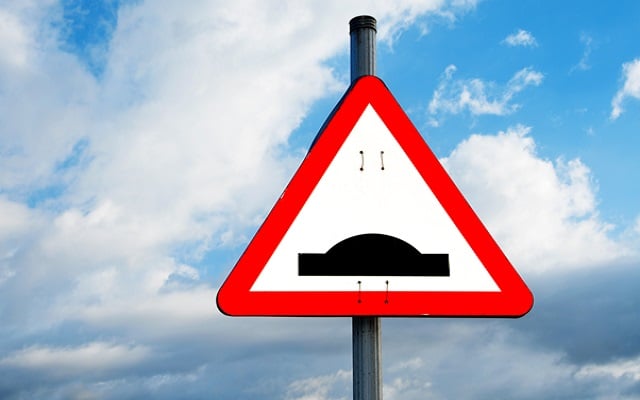
Speed bump signs feature a black rectangle with a hump on the top, featured on a triangle with a red outline, as above.
Where are speed bumps usually used?
Speed bumps are typically installed in car parks, private roads, road crossings and residential zones, particularly where there are schools or nurseries. Entrances to private areas or estates may also feature speed bumps.
In some cases, speed bumps may be installed in particularly accident-prone areas.