6 February 2026
Analysis of 16 Post Opening Project Evaluation (POPE*) of major schemes by The AA can reveal that many so called ‘smart’ motorway schemes are losing the economy money, or barely providing any economic benefit.
Released without fanfare by National Highways yesterday (Thursday 5 February 2026), the M25 All Lane Running (ALR) section between junctions 23 to 27, and the M6 Dynamic Hard Shoulder (DHS) section between junctions 5 to 8 are losing the economy money and have been rated “very poor” by the road agency.
Alongside the two schemes above, a further six schemes have been rated as “not on track - poor” or “not on track – low” in respect of providing value money at the end of the evaluation period once the motorway has been opened to traffic. In many cases, converting the hard shoulder into a permanent or temporary running lane has reduced the speed of traffic, meaning more jams and congestion across England’s motorway network.
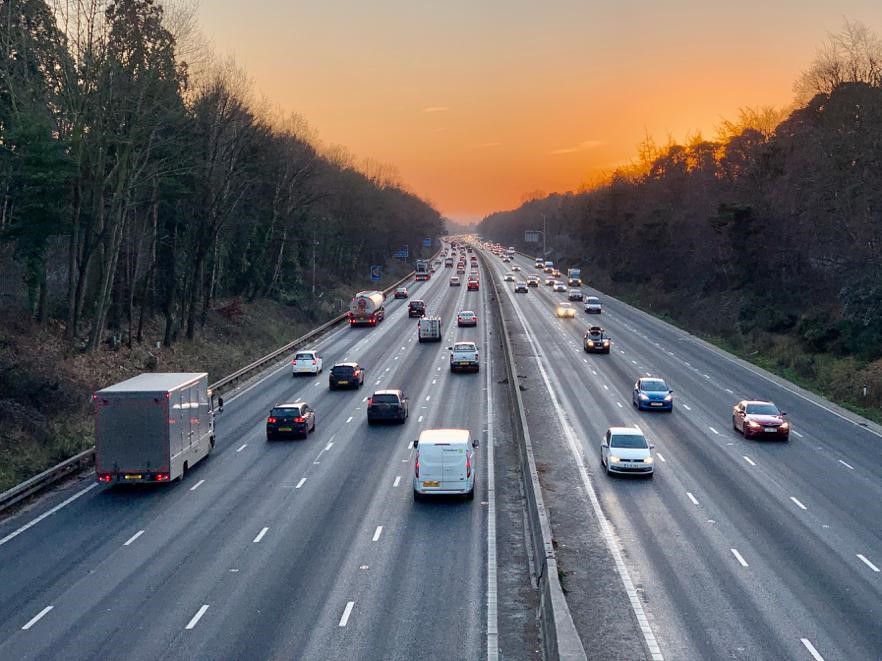
What are the different types of smart motorway?
- Controlled Motorways – The retention of the hard shoulder, but with added safety technology and gantries
- Dynamic Hard Shoulders – The hard shoulder can be used as a running lane at peak times and periods of high congestion
- All Lane Running – The permanent conversion of the hard shoulder into a running lane with emergency areas spaced approximately every 0.75 miles apart
Just three schemes at the end of the five-year evaluation period are “on track” in relation to value for money. The M6 between junctions 10a and 13, which incorporates both a Controlled Motorway which retains a permanent hard shoulder and ALR has a “low” rating, however only has four years of data due to covid occurring in the final year of evaluation.
The M3 ALR section between junctions 2 and 4a is “on track” due faster journey times, but has a worsening safety record.
The only scheme to exceed expectations is the Controlled Motorway on the M25 between junctions 16 to 23 which was also widened. This section saw faster journey times and an improved safety record, highlighting The AA’s calls for this to be the standard bearer for motorway improvements.
“We need the return of the hard shoulder to help give confidence to drivers, both now and in the future.”
Negligible safety benefit
The safety benefit of ‘smart’ motorways has also been brought into question as two schemes show a worsening safety record. The M3 ALR section between junctions 2 and 4a shows an increase in the number of those killed or seriously injured by around a third. The M1 stretch of ALR between junctions 39 and 42 also shows an increase in crashes where people were killed or seriously injured (KSI) on the motorway. The scheme was also given a “poor” value for money rating as journey times did not improve.
Elsewhere, the M25 ALR section between junctions 23 to 27 saw a marginal reduction in those killed or seriously injured. However, at either end of this stretch are two Controlled Motorways which were widened, retained the hard shoulder and installed safety technology (M25 16-23 and M25 27-30). In both cases, a significant reduction in KSIs was observed.
Reports locked away for years with varying datasets
Despite many of these schemes completing their evaluation period between 2017 and 2019, many of the reports are dated September 2023. At the same time, the reports feel inconsistent as the benchmark for analysis varies by report, especially in respect of the safety assessment.
Some reports use fatality weighted injuries, some personal injury collisions and others KSIs either as a standalone figure or per hundred million vehicle miles. The AA is concerned at the inconsistent nature of the figures as it makes it difficult to draw conclusions from the data.
Edmund King, AA president, said; “After a lengthy wait, these reports finally see the light of day. The reluctant release of these documents, without any announcement feels like an attempt to bury bad news.
“This has been a catastrophic waste of time, money and effort. Many of the schemes have slower journeys which causes traffic jams, loses the country cash and worsened the safety record of motorways.
“Motorways which have been widened, the hard shoulder kept, and safety technology added have proved the most successful. We have been calling for this standard for so long and urge any government that looks to improve motorways to use this style as the blueprint.
“While no new ‘smart’ motorway schemes will be built, driver confidence using these schemes remains low. Just under half of drivers feeling anxious or nervous using them, a sentiment which has doubled in the last 12 months**. We need the return of the hard shoulder to help give confidence to drivers, both now and in the future.”
* Post Opening Project Evaluation (POPE) of major schemes - National Highways