Pump prices start to rise again

-
Only Northern Ireland, the North East and Yorkshire/Humberside remain below 150p a litre for petrol
-
New official statistics show 28.1% increase in electricity consumption by EVs in Q1 this year
Petrol and diesel are once again showing price increases at the pump after wholesale costs went up from late June into July.
The average forecourt price of petrol increased from a six-week low of 150.7p on Monday to 151.0p a litre at the weekend. Diesel has largely held at just below 165p a litre, edging up from 164.8p to 164.9p going into the weekend.
Across the regions and nations of the UK, all continue to show a fall in their average pump prices of petrol and diesel over the past fortnight. However, while all of northern England averaged below 150p a litre for petrol the week before, last week only the North East and Yorkshire and Humberside remained. Meanwhile, Northern Ireland retains its significantly cheaper fuel compared to the mainland.
| (Week ending 12 July 2026) | (Week ending 28 June 2026) | (Change in price) | ||||
|---|---|---|---|---|---|---|
| Petrol | Diesel | Petrol | Diesel | Petrol | Diesel | |
| Northern Ireland | 145.2 | 155.4 | 146.8 | 159.0 | -1.6 | -3.6 |
| Scotland | 153.3 | 166.3 | 154.4 | 170.6 | -1.1 | -4.3 |
| Wales | 150.7 | 164.0 | 152.1 | 168.3 | -1.4 | -4.3 |
| North East | 149.0 | 163.1 | 150.6 | 168.1 | -1.6 | -5.0 |
| North West | 150.0 | 164.3 | 151.2 | 168.8 | -1.2 | -4.5 |
| Yorkshire and Humber | 149.3 | 163.9 | 150.5 | 168.6 | -1.2 | -4.7 |
| West Midlands | 151.1 | 165.5 | 152.3 | 169.7 | -1.2 | -4.2 |
| East Midlands | 151.0 | 164.6 | 152.3 | 169.4 | -1.3 | -4.8 |
| East of England | 152.1 | 166.3 | 153.4 | 170.4 | -1.3 | -4.1 |
| London | 151.8 | 165.8 | 152.9 | 170.1 | -1.1 | -4.3 |
| South East | 152.3 | 167.1 | 153.8 | 171.6 | -1.5 | -4.5 |
| South West | 152.1 | 167.0 | 153.6 | 171.4 | -1.5 | -4.4 |
| UK Weekly Average | 151.0 | 164.9 | 152.3 | 169.3 | -1.3 | -4.4 |
Source: Oil Market Journal; Average includes 6 July 2026 to 12 July 2026 inclusive
The uptick in pump prices comes from a 3p to 4p a litre rise in wholesale petrol costs from the last week of June onwards. Diesel costs have jumped by more than 6p a litre in the same period. Both fuels have been impacted by renewed US-Iran conflict leading to higher oil prices, diesel given further momentum by Russia’s ban on its export of the fuel.
Since the start of the US-Iran war, petrol and diesel hit highs of 159.0 and 192.4p a litre respectively in April. After falling away with a ceasefire pending, petrol then rose to 159.7p in May following the failure of negotiations.
Throughout June into July, petrol fell to the 150.7p of early last week and diesel dropped from 184.4p in late May to its current 164.9p a litre.
Behind the scenes, new government statistics are strongly indicating the influence of volatile petrol and diesel prices on the uptake of electric cars and other EVs.
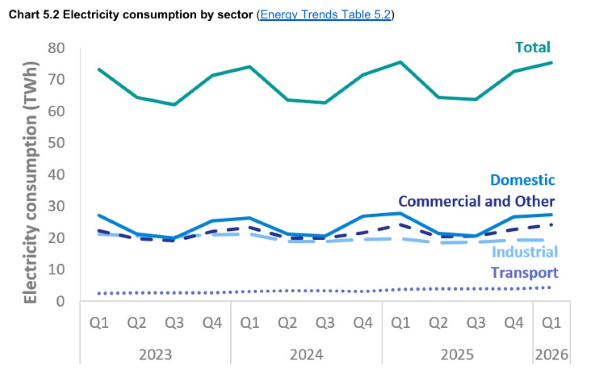
The Department for Energy Security and Net Zero now separates electricity consumption by road vehicles from transport as a whole. These new figures show a 30.7% increase in road vehicles’ power consumption between 2024 and 2025. In the first quarter of this year, electricity used by EVs jumped a further 28.1%.
The department calculates, using Department for Transport data, that two-thirds of that electricity consumption comes from home charging. Overall, electricity demand from transport remains a minor component compared to other sectors*.
“Despite more than a penny coming off the average price of petrol over the past fortnight, drivers across the UK now face new increases heading towards the start of the summer holidays. And it’s always in the back of people’s minds that current pump prices would be 6p a litre worse were it not for the fuel duty cut (5p fuel duty + 1p VAT),” says Luke Bosdet, the AA’s spokesman on pump prices.
“The new government figures on electricity consumption by electric vehicles give a new perspective on the impact of pump prices that not only remain well above the worst endured by drivers before covid (petrol 142.5p, diesel 147.9p in April 2012) but frustrate vehicle owners with their volatility. Large numbers of car owners that can are now ditching petrol and diesel for electricity and its more predictable costs.”
*