EV transition moves up a gear as driver confidence grows

- AA UK EV Readiness Index climbs from 47.5 to 60 in a year
- Just 1.2% of EV breakdowns are now due to running out of charge
- EVs more likely than petrol cars to be fixed at the roadside
- Budget help for drivers without driveways could broaden EV appeal
Britain's transition to electric vehicles is moving firmly in the right direction as falling "range anxiety", excellent roadside support and improving charging and vehicle options give drivers greater confidence to go electric, according to the AA.
Speaking at the Transport + Energy Forum at Warwick Conferences today (12 November), AA president Edmund King OBE will point to a significant improvement in the conditions facing drivers considering an EV.
AA UK EV Readiness Index
The AA UK EV Readiness Index has risen from 47.5 to 60 out of 100 in little over a year, reflecting improvements in the affordability, charging and ownership experience of electric vehicles.
‘Out of charge’
The AA says its own breakdown data should also challenge some of the persistent myths surrounding EV ownership.
Just 1.2% of AA EV breakdown callouts in September 2026 were categorised as ‘out of charge’, compared with 8.3% in 2015. In 40% of those ‘out of charge’ cases the EV driver was able to drive to a charger followed by the AA patrol. Average ‘out of charge’ recovery was just 4.3miles.
And when an EV does break down, it has a good chance of being repaired there and then. The latest AA figures show 87.5% of EV breakdowns are fixed at the roadside, compared with 84.6% for petrol or diesel vehicles.
Some 99% of AA patrols are trained to Level 2 – Electric Vehicle Prepared standard, helping ensure that drivers making the switch have roadside expertise behind them.
Most breakdowns similar to ICE vehicles
The top two breakdowns for EVs are very similar to ICE vehicles.
- 25% EV breakdowns are tyres/wheels
- 17% are the 12 volt battery
Edmund King OBE, AA president, will tell the Transport + Energy Forum:
“Electric vehicles have reached something of a turning point. There are still hurdles to overcome, but the direction of travel is increasingly positive.
“Our EV Readiness Index has moved from 47.5 to 60 in little over a year. That is a significant shift and shows that the conditions for going electric are becoming more favourable for more drivers.
“One of the biggest fears has always been range anxiety and the prospect of grinding to a halt with a flat battery. The reality on the road is rather different. Running out of charge now accounts for just 1.2% of the EV breakdowns we attend, compared with 8.3% in 2015.
“Perhaps even more reassuring is that when an EV does break down, our patrols are actually more likely to fix it at the roadside than a petrol or diesel car. Almost nine in ten EV breakdowns are fixed there and then.
“Drivers shouldn't assume that going electric means being stranded at the roadside waiting for a recovery truck. The cars have improved, charging has improved and roadside assistance and training has evolved with them.
“The next challenge is to make sure the benefits of electric driving aren't confined to those lucky enough to have a driveway.
“That is why the measures in the Budget to reduce the cost of local public charging for drivers without home charging are welcome. Combined with the removal of unnecessary planning barriers for cross-pavement charging, these measures can help make the EV transition fairer.
“We have always said the switch to electric should be an evolution rather than a revolution. Drivers need affordable cars, convenient and competitively priced charging and confidence that help will be there if things go wrong.
“We aren't at the destination yet, but the evidence suggests we're travelling down the right road.”
Budget boost for drivers without driveways
The AA welcomes measures announced in the Budget aimed specifically at motorists unable to charge on their own driveway.
The Government has committed £100 million over two years from spring 2027 to reduce the cost of local, lower-powered public charging, which it estimates could save an EV driver relying on on-street charging around £150 a year.
It is also establishing a taskforce to examine whether motorists could eventually use their domestic electricity tariffs at certain local public chargers.
This follows changes introduced in October removing the need for planning permission in England for qualifying cross-pavement charging installations, potentially saving drivers up to £300.
Sharing home chargers
The AA also thinks many without off-street parking could benefit from sharing neighbours’ chargers. There is a Co Charger app that links the ‘Hosts’ (those with chargers) and ‘Chargees’ (those wanting a way to charge) in their neighbourhoods. It handles communication, booking and payments, making the process quick and simple.
There are more than a million home chargers across the UK that are used less than 6% of the time and these could help those without driveways to switch.
The AA believes tackling the gap between the experience of drivers with and without access to home charging will be crucial to the next phase of EV adoption.
Transport + Energy Forum 2026
Edmund King OBE, AA president, is appearing on the panel “Beyond the ZEV Mandate: What will drive the UK's EV growth?” at the Transport + Energy Forum at Warwick Conferences on Thursday 12 November 2026.
The session is chaired by Chris Pritchett, Co-Head of Energy & Infrastructure at Shoosmiths.
Panellists are:
- Alison Nuttall, Head of Energy Transition & Net Zero, JLR
- Edmund King OBE, President, The AA
- Adam Wood, Managing Director, Renault UK
- Tanya Sinclair, CEO, Electric Vehicles UK
The panel takes place from 14:00–14:40.
AA UK EV Readiness Index
The AA UK EV Readiness Index tracks eight factors affecting drivers' willingness and ability to switch to an electric vehicle, covering new and used vehicle costs, insurance, home and public charging costs, charging availability, running out of charge and roadside repair rates.
The Index stood at 47.5 in September 2025, rising to 48.8 in Q4 2025, 53.8 in Q1 2026, 58.8 in Q2 and 60 in Q3 2026. See AA-UK-EV-Readiness-Index-September-2026 | AA
Press Q&A – EV transition / AA UK EV Readiness Index
Q. What is the main message from the AA today?
The EV transition is moving in the right direction. The AA UK EV Readiness Index has risen from 47.5 to 60 in little over a year, while the practical experience of driving an EV is improving. Running out of charge is now a very small proportion of EV breakdowns and EVs are actually slightly more likely than petrol or diesel cars to be fixed at the roadside.
Q. Does a score of 60 out of 100 really mean Britain is ready for EVs?
No. It means Britain is more ready, not that the job is finished. There are still significant challenges around vehicle affordability, public charging costs and access to convenient charging for people without driveways. The important point is that the Index has moved consistently in the right direction — from 47.5 in September 2025 to 60 in Q3 2026.
Q. What is the AA UK EV Readiness Index?
It is designed to give a balanced picture of how ready UK drivers are to make the transition to electric. It brings together eight factors that affect the real-world decision to switch, including new and used vehicle costs, insurance, home and public charging costs, charging availability, running out of charge and roadside repair rates. It is neither pro- nor anti-EV — it tracks the conditions facing drivers.
Q. Why has the Index improved so much?
There isn't one single reason. It reflects a combination of improving charging provision, greater vehicle choice, changing costs and a better ownership and roadside experience. As the market matures, some of the practical concerns that understandably worried early EV buyers are becoming less significant.
Q. Are you saying range anxiety is now a myth?
Range anxiety is real because drivers want confidence that they can complete their journey and recharge conveniently. But the fear of actually grinding to a halt with an empty battery is increasingly out of step with the evidence. Only 1.2% of AA EV breakdown callouts in September were categorised as out of charge, compared with 8.3% in 2015.
Q. What happens when somebody does run out of charge?
It doesn't necessarily mean a long-distance recovery. In 40% of the AA's out-of-charge cases, the driver was able to drive to a charger with the AA patrol following them. For those requiring recovery, the average distance was only 4.3 miles. Modern EV ranges, better information and expanding charging provision have changed the picture considerably.
Q. Why would someone call the AA if they still had enough charge to drive to a charger?
There can be circumstances where a vehicle has very low charge or the driver is uncertain whether they can safely reach the nearest working charger. Rather than risk becoming stranded, the patrol can help them get safely to charging facilities.
Q. Are EVs harder to repair at the roadside?
Our figures suggest the opposite. 87.5% of EV breakdowns are fixed at the roadside, compared with 84.6% for petrol and diesel vehicles. That challenges the assumption that an EV breakdown automatically means being put on the back of a recovery truck.
Q. What actually goes wrong with EVs?
Many of the problems are reassuringly familiar. Around 25% of EV breakdowns involve tyres or wheels and 17% involve the conventional 12-volt battery. EVs may have sophisticated electric powertrains, but many roadside problems are much the same as those experienced by other motorists.
Q. Can AA patrols safely work on EVs?
Yes. Around 99% of AA patrols are trained to Level 2 – Electric Vehicle Prepared standard. The AA has invested in training and equipment as the vehicle fleet has evolved.
Q. Isn't the biggest problem still the price of an EV?
Affordability remains one of the biggest barriers, particularly in the new-car market. That is why the AA has consistently argued that the transition needs to be consumer-led. Drivers need vehicles they can afford and charging that is convenient and competitively priced. The growing used-EV market should also increasingly open electric driving to more households.
Q. Isn't an EV only really attractive if you have a driveway?
That is one of the biggest inequalities in the current system. Someone with a driveway can generally charge conveniently at home at a much lower cost, while somebody relying on public charging can pay considerably more. Closing that gap is essential if the EV transition is going to work for millions of people who don't have off-street parking.
Q. What did the Budget do about that?
The AA welcomes the Government's commitment of £100 million over two years from spring 2027 to reduce the cost of local, lower-powered public charging. The Government estimates this could save an EV driver relying on on-street charging around £150 a year. We also welcome work examining whether drivers might ultimately be able to use domestic electricity tariffs at certain local public chargers.
Q. Will £150 a year really persuade someone to buy an EV?
On its own, probably not. But it helps tackle one of the fundamental unfairnesses of the current system. The decision to go electric depends on the overall package — purchase price, depreciation, insurance, charging availability, charging price and convenience. Improvements across all of those areas will influence consumer confidence.
Q. What about cross-pavement charging?
Removing unnecessary planning barriers for qualifying cross-pavement charging installations in England is another positive step. It potentially allows more households without conventional driveways to access cheaper domestic electricity rather than relying entirely on the public charging network.
Q. Are you now saying everyone should buy an EV?
No. The AA isn't telling drivers what type of car they should buy. Different technologies and vehicles suit different people and journeys. Our role is to give drivers accurate information and to ensure that whichever vehicle they choose, they receive a fair deal. What the evidence shows is that some of the traditional objections to EV ownership are becoming less significant.
Q. Are EVs now better than petrol cars?
That is too simplistic. EVs can be extremely attractive for drivers who can charge cheaply at home, while other motorists may currently find petrol, diesel or hybrid vehicles better suited to their circumstances. The significant point is that the practical case for EV ownership is strengthening as vehicles, charging infrastructure and roadside support improve.
Q. What is the biggest remaining barrier to EV adoption?
For many drivers it is still affordability and access to convenient, competitively priced charging. We need to avoid creating a two-tier transition where those with driveways enjoy cheap home charging while those without them pay a substantial premium.
Q. Has the EV transition reached a tipping point?
We would call it a turning point rather than a tipping point. A Readiness Index of 60 isn't mission accomplished, but the direction is encouraging. The transition will succeed when drivers feel they are gaining something rather than being forced to give something up.
Q. What's your message to a petrol or diesel driver who remains sceptical about EVs?
Don't base your decision on some of the myths from ten years ago. Look at the vehicle, your journeys, where you would charge and the total cost of ownership. EVs won't yet work perfectly for everybody, but they are becoming a practical and attractive option for a growing number of drivers.
Q. So are we on track for the transition to electric?
We're travelling in the right direction, but we're not at the destination. The Index moving from 47.5 to 60 in little over a year is encouraging. Government and industry now need to keep removing the barriers — particularly affordability and charging inequality — so that drivers themselves have the confidence to make the switch.
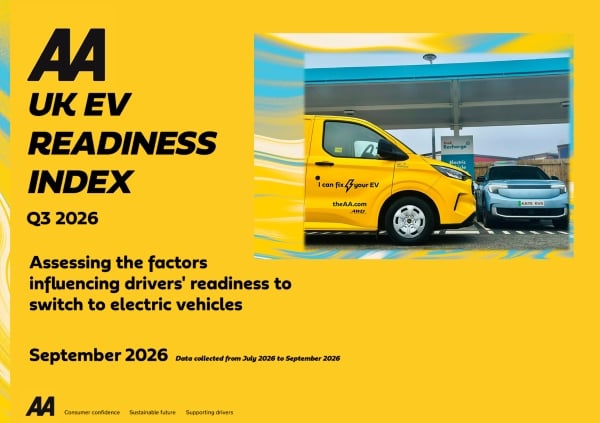
AA UK EV Readiness Index September 2026
25 September 2026