‘Range anxiety’ shifted to ‘pump anxiety’ as global petrol and diesel prices rocketed
- AA UK EV Readiness Index up 5 points
- Fuel hikes due to Iran conflict driving interest in used EVs
- AA Cars searches for used EVs up 78%
- Volatile pump prices likely to influence longer-term buying habits
Pump anxiety replaces range anxiety
Hiked petrol and diesel prices have reshaped driver attitudes towards electric vehicles, with “range anxiety” increasingly being replaced by “pump anxiety”, according to the latest AA UK EV Readiness Index.
The Q2 2026 Index, The AA’s fourth quarterly assessment of the UK’s readiness for EV adoption, shows that disruption to global energy markets has pushed fuel prices higher while EV charging costs have remained stable. As a result, drivers able to charge at home are seeing substantial savings compared with petrol and diesel car owners.
EV Readiness Rating
Back in March 2026 the index exceeded 50 for the first time. The AA’s overall EV Readiness Rating rose to 58.8 in Q2, up from 53.8 in Q1, reflecting improved scores for both public and home charging. The uplift was driven largely by the widening cost gap between petrol and home charging, as petrol prices reached 159.6p per litre at the end of May, almost 20% higher than in the previous quarter’s Index.
For EV drivers charging at home, the Index found that running costs were 67% cheaper per mile than petrol equivalents, compared with 57% cheaper in Q1. That equates to a conservative saving of at least £20 for every 200 miles driven.
Used EV Demand
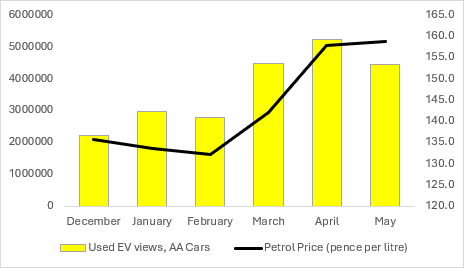
The cost pressure at the pump appears to be feeding directly into used EV demand. Searches for “used EVs” on AA Cars increased by 78% between March and May, compared with the previous three months.
The AA says the trend points to a clear correlation between rising fuel prices and increased consumer interest in used EVs, as motorists look for ways to shield themselves from volatile petrol and diesel costs. The three most searched used EV models on AA Cars were the Nissan Leaf, Tesla Model 3 and Kia Niro, all of which were first launched more than seven years ago, suggesting that demand is strongest for established, more affordable electric models.
Petrol prices drive EV searches
As petrol prices climbed through Q2, searches for used EVs on AA Cars rose sharply, increasing 78% between March and May compared with the prior three months.
Edmund King, AA president, said:
“Range anxiety has shifted to pump anxiety as global petrol and diesel prices have rocketed since the Iran conflict began.
“For years, some drivers have been put off EVs by real or perceived range anxiety. But this latest Index suggests the bigger concern for many households is becoming pump anxiety. When global fuel prices rise sharply, drivers feel it immediately at the forecourt.
“EV drivers, particularly those with access to home charging, have been better insulated from that volatility. That is now showing up in the used car market, where searches for electric vehicles on AA Cars have risen by more than 75% in the last three months.
“Not every driver is yet ready to switch tomorrow. Upfront costs, public charging prices, and policy uncertainty still matter. But the economics of EV ownership are becoming harder to ignore particularly for those who can charge at home.”
Barriers to mass EV adoption remain
The Index also highlights that barriers to mass EV adoption remain. New EVs still remain expensive compared to some petrol equivalents, while used EVs moved from being 10% cheaper than petrol equivalents in Q1 to 3% more expensive in Q2, partly reflecting increased competition and rising demand in the used market.
Public charging remains another major challenge. While higher petrol prices made public charging relatively more attractive, ultra-rapid public charging was still 15% more expensive per mile than petrol, compared with 35% more expensive in Q1. This leaves a significant gap between drivers with access to home charging and those who depend on the public charging network.
Charging network growth and EV reliability
The UK’s charging network continued to grow, with 121,262 EV chargers installed to date, following updated reporting methodology from Zap Map and the Department for Transport. This represents 40.42% of the Government’s 300,000 charging point target by 2030.
The Index also found that EV reliability and driver confidence continue to improve. Running out of charge accounted for just 1.2% of AA EV callouts in Q2, down from 1.5% in Q1 and significantly below historic levels. EVs were also more likely to be fixed at the roadside, with 88.4% of EV callouts resolved at the roadside by AA patrols, compared with 84.6% for petrol and diesel vehicles.
The used EV market is critical
Edmund King added:
“The used EV market is becoming a critical part of the transition. Drivers are not only looking at new technology; they are looking for value, familiarity and lower running costs.
“But the benefits are still uneven. Drivers without driveways or access to cheaper overnight tariffs are not getting the same savings. Unless public charging becomes more affordable and accessible, the EV transition risks becoming a two-speed market.
“Government has helped with the electric car grants and some manufacturers, such as Renault and Hyundai, have changed production to attract higher grants. However, fears about the proposed e-VED pay per mile from 2028 are still putting off some drivers.”
Fuel price shock may shape longer-term demand
The AA says the current fuel price shock may give EV demand a short-term boost, but some of the gains in the Readiness Rating could ease if global energy disruption subsides. However, the experience of volatile pump prices is likely to influence longer-term buying habits, particularly among used car buyers seeking more predictable running costs.
There is also speculation that the 2030/35 ZEV mandate may be adjusted to give more time for motor manufactures to transition their production to zero emissions. The AA has always described the ZEV mandate as ‘challenging but ambitious’ and stresses that both consumers and industry need certainty.
Questions and answers about the June 2026 EV Readiness Index
Q: What is the main finding from the latest AA UK EV Readiness Index?
A: Rising petrol and diesel prices have increased interest in electric vehicles, with “range anxiety” increasingly being replaced by “pump anxiety”.
Q: What does “pump anxiety” mean?
A: It refers to drivers’ concern about volatile and rising petrol and diesel prices, especially when global events push up fuel costs.
Q: How has the AA UK EV Readiness Rating changed?
A: The overall rating rose to 58.8 in Q2 2026, up from 53.8 in Q1.
Q: What drove the increase in EV readiness?
A: The main factor was the widening cost gap between petrol and home charging, as petrol prices rose sharply while EV charging costs remained more stable.
Q: How much cheaper is it to run an EV when charging at home?
A: The Index found home-charged EVs are 67% cheaper per mile than petrol equivalents, compared with 57% cheaper in Q1.
Q: What does that saving mean in practical terms?
A: It equates to a conservative saving of at least £20 for every 200 miles driven.
Q: Has demand for used EVs increased?
A: Yes. Searches for “used EVs” on AA Cars rose by 78% between March and May compared with the previous three months.
Q: Which used EVs were most searched on AA Cars?
A: The three most searched models were the Nissan Leaf, Tesla Model 3 and Kia Niro.
Q: Why are used EVs becoming more attractive?
A: Drivers are looking for more predictable running costs and protection from volatile petrol and diesel prices.
Q: What barriers to EV adoption remain?
A: Upfront costs, public charging prices, access to home charging, and uncertainty over future policy remain significant issues.
Q: Is public charging still more expensive than petrol?
A: Ultra-rapid public charging remains 15% more expensive per mile than petrol, although this is an improvement from 35% more expensive in Q1.
Q: What does the AA say about fairness in the EV transition?
A: The AA warns that drivers without driveways or access to cheaper overnight tariffs may miss out on the biggest savings, creating a potential two-speed market.
Q: How is the UK charging network progressing?
A: The UK now has 121,262 EV chargers installed, representing 40.42% of the Government’s 300,000 charging point target by 2030.
Q: Are EVs proving reliable?
A: Yes. Running out of charge accounted for just 1.2% of AA EV callouts in Q2, down from 1.5% in Q1.
Q: What is the AA’s overall message to drivers?
A: EVs, especially used EVs and those charged at home, are becoming increasingly attractive as fuel prices rise, but affordability, charging access and policy certainty remain crucial.

AA UK EV Readiness Index March 2026
24 March 2026
AA EV Readiness Index Dec 2025
19 December 2025
The AA launches the first UK EV Readiness Index
15 September 2025
AA EV Viewpoint
10 March 2025